


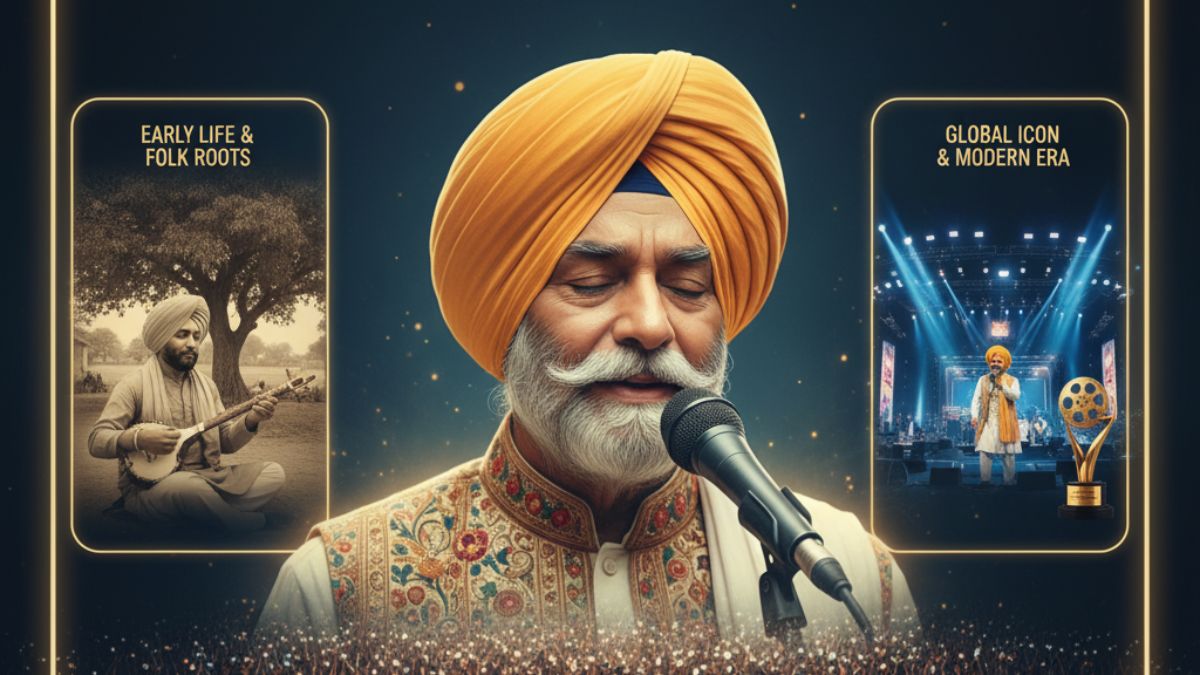
The Man Who Redefined Punjab’s Soul Through Song
If you’ve ever driven through the mustard fields of Punjab with the radio humming in the background, chances are, a Gurdas Maan melody has been your companion. His voice isn’t just sound — it’s an emotion that seeps into the soil. Every note feels like home: the fragrance of mitti after rain, the laughter of harvest, and the quiet ache of longing. In this Gurdas Maan Biography, we explore the man whose music has become the heartbeat of Punjab — a legend who didn’t just sing songs, but told the stories of a people, their pride, and their pain.
Once, in a rare interview, Gurdas Maan said, “Music isn’t something you perform — it’s something you live.” That line captures him perfectly.
Gurdas Maan biography
This Gurdas Maan biography isn’t a sterile timeline of hits and awards. It’s about a man who turned music into memory — who gave Punjab its rhythm, its words, its soul.
Born on January 4, 1957, in Giddarbaha, Punjab, Maan grew up in a land still healing from the wounds of Partition. A reserved boy, often lost in thought, he had no idea he’d someday become the heartbeat of an entire culture.
Now, even at 68, his presence on stage can eclipse performers half his age. The energy, the charisma, the connection — it’s all still there, alive as ever.
- The Man Who Redefined Punjab’s Soul Through Song
- 1 Early Life and Education: A Star Born Among Simplicity
- 2 The Rise of a Voice That Spoke to Every Heart
- 3 A Songwriter Before a Singer
- 4 Experimenting with Cinema: The Actor Within the Singer
- 5 Gurdas Maan’s Family: The Love That Anchored Him
- 6 The Cultural Revolution in Punjabi Music
- 7 Awards, Recognition, and Influence
- 8 Turning Points and Resilience
- 9 Evolution with Time
- 10 Global Legacy: Taking Punjab to the World
- 11 Influence on Modern Punjabi Music
- 12 The Human Side of Fame
- 13 The Philosophy Behind His Art
- 14 Legacy Through Generations
- 15 Gurdas Maan in the Age of Digital Culture
- 16 Personal Resilience and Spirituality
- 17 Comparing Eras: Then and Now
- 18 Lessons from His Journey
- 19 Summary: The Everlasting Legend
- About Hobo.Video
1 Early Life and Education: A Star Born Among Simplicity
Every legend begins somewhere humble. For Gurdas Maan, it began in a home where simplicity wasn’t a choice — it was a way of life. His father, Gurdev Singh Maan, served at the Punjab State Electricity Board. His mother, Tej Kaur, the quiet strength behind every family moment, instilled in him patience, kindness, and faith.
He studied at local schools in Giddarbaha, then moved to DAV College, Malout, before completing his Master’s in Physical Education from Punjabi University, Patiala. Few knew back then that the athletic young man who excelled in wrestling and sports would one day wrestle with words and melodies instead.
It was during a youth festival performance that fate tapped gently on his shoulder. He sang his own composition, “Dil Da Mamla Hai.” The hall fell silent. Then came applause so loud, it changed his destiny overnight.
That song soon reached Doordarshan in 1980. A single TV performance — and Punjab had a new voice. Radios played it endlessly. People hummed it at weddings, bus stops, and harvest fields. “Dil Da Mamla Hai” wasn’t just a hit; it was an awakening.
Even now, anyone searching Gurdas Maan biography in Hindi will find that performance marked the birth of a legend.
2 The Rise of a Voice That Spoke to Every Heart
In the early 1980s, Punjabi music was full of festive bhangra and rustic charm — but it lacked introspection. Then came Maan. His songs didn’t just make people dance; they made them feel. His lyrics carried honesty — the kind that stirs something deep inside.
Unlike most singers of his time, Maan wrote his own words. That changed everything. His songs painted life in Punjab’s villages — young love that bloomed shyly, farmers’ sweat turned to pride, and mothers waiting at dusk for sons who left for cities.
When he sang “Mamla Gadbad Hai” or “Challa,” he wasn’t performing; he was storytelling. That rare blend of simplicity and soul earned him a new title: “Punjab Da Maan” — The Pride of Punjab.
By the mid-80s, his concerts felt more like pilgrimages. People traveled from Ludhiana to London just to hear him say “Sat Sri Akal” into a microphone — and somehow, it always felt personal.
3 A Songwriter Before a Singer
Before the fame, before the cameras, Gurdas Maan was — and still is — a poet. A man who understood silence and turned it into song.
Long before “singer-songwriter” became a global buzzword, Maan was living it. His songs were steeped in Punjab’s reality: in “Apna Punjab Hove,” he imagined a homeland untouched by borders; in “Boot Polishan,” he celebrated the dignity of honest work.
For countless upcoming artists, his lyrics became a textbook on emotion. The Gurdas Maan life story isn’t about luxury or limelight — it’s about seeing beauty in the ordinary.
He once shared, “I don’t chase songs. I wait for them to knock at my heart.”
That patience shaped his art.
It’s no surprise icons like Diljit Dosanjh and Sidhu Moosewala have often called him their greatest inspiration.
4 Experimenting with Cinema: The Actor Within the Singer
By the mid-1980s, Maan’s storytelling instinct pushed him beyond music. Cinema became his next canvas. His debut film, “Mamla Gadbad Hai” (1984), named after his hit song, turned into a massive success.
What followed was a series of performances that blurred the line between singer and actor:
- Ucha Dar Babe Nanak Da
- Shaheed-E-Mohabbat Boota Singh — a role that earned him national acclaim
- Waris Shah: Ishq Da Waaris (2006) — where he became the Sufi poet himself, body and soul
Each performance carried that same truth his songs held — raw, poetic, sincere.
For Waris Shah: Ishq Da Waaris, he won both the National Film Award for Best Male Playback Singer and the Filmfare Critics Award. Not for glamour, but for authenticity.
Acting wasn’t a detour for him — it was just another language for his storytelling heart.
5 Gurdas Maan’s Family: The Love That Anchored Him
Behind every artist who stands tall is someone who keeps them grounded. For Gurdas Maan, that anchor is his wife, Manjeet Maan — a visionary producer and director.
Together, they founded Sai Productions, the company behind several of his cinematic masterpieces. Their partnership is a creative union — she challenges him, he listens, and somehow, they always meet in the middle.
Search Gurdas Maan wife online and you’ll discover more than a name. You’ll find an equal — the woman who’s been his mirror, critic, and muse.
Their son, Gurikk Maan, carries the family’s artistic flame as a filmmaker and music video director. His work echoes the same emotional clarity his father is known for.
Gurdas often jokes that on set, “My son scolds me more than my director ever did,” usually followed by that signature, disarming laugh that fans love.
6 The Cultural Revolution in Punjabi Music
By the 1990s, Gurdas Maan was no longer just a singer. He was the pulse of Punjab. His music stitched together a culture that was learning to live between its roots and the modern world.
As young Punjabis began migrating to Canada, the UK, and the U.S., Maan’s songs became their emotional passports. Tracks like “Ki Banu Duniya Da” and “Pind Diyan Gallan” played softly in foreign kitchens, comforting hearts thousands of miles away.
In a 2005 BBC interview, he shared,
“When I sing, I imagine my mother sitting in the verandah of our old house, listening. That’s who I write for.”
If Bulleh Shah gave Punjab its poetry, Gurdas Maan gave it its music — soul meeting sound.
7 Awards, Recognition, and Influence
Listing awards for someone like Gurdas Maan almost feels secondary — because his greatest achievement is emotional, not material. But yes, the recognition has been immense:
- Padma Shri (2009) – India’s fourth-highest civilian honor
- National Film Award (2005) – for Waris Shah: Ishq Da Waaris
- Countless Punjabi Music Awards honoring his lifelong contribution
As of 2025, Gurdas Maan net worth stands around ₹45–50 crore. Yet, if you ask him, wealth means something else entirely. His currency is connection.
From Toronto to Dubai to Wembley Arena, he took Punjabi music across continents — long before “globalization” became a buzzword.
People call him The Poet Laureate of Punjab — and they’re not wrong. His songs don’t age; they evolve with you.
8 Turning Points and Resilience
Every great journey has moments that test the soul. For Maan, one such moment came in 2007 when a car accident took the life of his close friend and driver, Tejpal.
He survived — but changed. Months later, when he returned to the stage in Ludhiana, his first words were, “This song is for you,” looking toward the sky. The crowd wept with him.
That night defined his resilience — not as a celebrity, but as a human being who heals through art.
He continues to stay connected to his roots — visiting his village, funding education for rural youth, supporting farmers quietly, without fanfare.
9 Evolution with Time
While many artists fade with age, Gurdas Maan has aged like poetry — gaining depth, not dust.
He never resisted change. Instead, he adapted, blending classic folk sounds with digital innovation. He was among the first to embrace YouTube and Spotify, ensuring new generations discovered his timeless art.
In 2015, when he collaborated with Diljit Dosanjh for “Ki Banu Duniya Da,” the internet exploded. It wasn’t just a hit — it was a cultural handshake between eras.
Even today, when Gurdas Maan releases a song, people don’t listen out of nostalgia — they listen because his music still means something.
When he sings, time pauses. Punjab breathes. And the world remembers what real art feels like.
10 Global Legacy: Taking Punjab to the World
The story of Gurdas Maan long outgrew the borders of Punjab. Today, his music belongs wherever a Punjabi heart beats — whether it’s a tractor in Moga or a truck stop in Toronto. His songs have become an emotional bridge, connecting the diaspora to their roots.
You’ll find his voice echoing in the most unexpected corners of the world — in a London gurdwara, a Melbourne wedding, or a New York café run by second-generation Punjabis. For them, his concerts aren’t just shows — they’re homecomings. Flags wave, phulkari dupattas glimmer under stage lights, and for a few hours, everyone forgets distance.
Ask anyone who’s lived abroad for years, and they’ll say the same thing: “When Gurdas Maan sings, it feels like my maa is calling me home.” That’s the kind of connection no marketing or machine can replicate.
Even universities have recognized his cultural footprint. Institutions like SOAS London and Punjabi University, Patiala have studied his lyrics as reflections of migration, identity, and postcolonial emotion. His music has become literature — living, breathing, and still teaching.
11 Influence on Modern Punjabi Music
Scroll through today’s Punjabi charts — full of EDM beats, trap verses, and swagger — and beneath all that noise, you’ll still hear Maan’s echo. He is the foundation.
Artists like Diljit Dosanjh, Sidhu Moosewala, AP Dhillon, and countless others stand tall on the ground he prepared. He proved long ago that Punjabi music could be both poetic and popular.
What Maan offered wasn’t just melody — it was meaning. He showed that songs about identity, migration, and belonging could coexist with commercial success. His art had no expiry date because it wasn’t built for trends; it was built for truth.
He once told a young singer backstage, “Don’t sing to impress — sing to express.” That single sentence captures why his influence still shapes the industry’s moral compass.
In marketing language, you could call it authentic branding. But for Gurdas Maan, it was simply honesty.
12 The Human Side of Fame
Behind the applause and camera flashes stands a man untouched by his own fame. Fans who’ve met him often recall his humility — the way he folds his hands, speaks in their dialect, or bows before elders before performing.
When asked how he stays so grounded, he smiled and said, “The soil I walk on doesn’t let my head rise too high.” That’s not a quote for headlines — that’s a philosophy for life.
His wife, Manjeet Maan, remains his steady anchor. Where he is fire, she’s calm; where he’s chaos, she’s order. Together, they’ve built not just a family, but an empire rooted in respect.
Their son, Gurikk Maan, now directs his father’s music videos, blending tradition with cinematic storytelling. Watching them work together feels like witnessing heritage being passed, not taught. It’s rare — and beautiful.
13 The Philosophy Behind His Art
At the core ofGurdas Maan biographylies one simple truth: art should make people feel — not just listen.
He never sang for fame or charts. He sang to awaken empathy. “If my music doesn’t make someone think, I’ve failed as an artist,” he once said, and meant it.
His songs are layered — love on the surface, philosophy underneath. Tracks like “Waris Shah Nu” and “Roti” explore humanity, history, and morality in one breath.
Listening to him feels like sitting with an elder — gentle wisdom wrapped in melody. You don’t just enjoy the song; you carry it with you long after it ends.
In that sense, Maan isn’t just a singer. He’s a philosopher who happens to use rhythm instead of sermons.
14 Legacy Through Generations
Few artists can unite three generations with one song — Maan does it effortlessly. You’ll see grandparents, parents, and kids swaying together at his concerts, mouthing every lyric. That’s not performance; that’s generational memory.
Once, at a concert in Vancouver, he paused mid-song and said, “When I see three generations dancing together, I know my work has meaning.” The audience erupted — not out of excitement, but out of emotion.
From cassette players to Spotify playlists, his presence never faded. Because he never chased relevance — he became it.
Even his background in sports shaped his discipline. He often compares rehearsing music to wrestling practice: “You must sweat for art like you sweat for strength.”
That commitment — quiet, steady, relentless — is the reason his art has survived every era.
15 Gurdas Maan in the Age of Digital Culture
It’s fascinating to see how naturally Gurdas Maan fits into today’s digital age. Long before hashtags or “UGC” became a marketing buzzword, he was already living that philosophy.
His concerts were the earliest form ofuser-generated content— people singing along, recording, sharing, becoming part of the art itself. He built an organic community, not followers.
Modern influencer campaigns talk about “authentic engagement.” Maan built it decades ago — not through screens, but through soul.
In many ways, his journey predicted what today’s creative economy stands for: real connection over reach, emotion over metrics.
If influencer marketing had a folk ancestor, it would probably be Gurdas Maan.
16 Personal Resilience and Spirituality
The car accident in 2007 wasn’t just a tragedy — it was a turning point. Losing his friend Tejpal shifted something inside him. He became more introspective, more spiritual.
He began each morning with Gurbani, meditation, and long periods of silence before writing. “You must clean your mind before you create art,” he once told a young musician — a line that sounds simple until you try living it.
His later songs — like “Sajna Ve Sajna” and “Roti” — carry a different tone. They’re gentler, wiser, filled with gratitude.
For Maan, spirituality isn’t a performance; it’s a presence. You can hear it in his pauses, his expressions, even the way he closes his eyes mid-song — as if conversing with something higher.
17 Comparing Eras: Then and Now
Compare the 1980s with today’s Punjabi music, and one truth shines through — authenticity never goes out of style.
Back then, Maan’s songs spread through transistor radios and word-of-mouth. Today, artists chase algorithms and viral reels. But only one method still works — truth.
When you Google Gurdas Maan biography in Hindi, you don’t find gossip or controversy. You find respect. Reverence. Longevity.
Marketing strategists often cite him as a case study fororganic influence— the kind no AI can fake. His legacy has become a model for influencer authenticity, where emotion outlasts every platform update.
He showed that technology can amplify art — but only sincerity can sustain it.
18 Lessons from His Journey
There’s a quiet wisdom woven through his entire story — lessons that reach far beyond music:
- Authenticity is timeless. Fame fades, but sincerity doesn’t.
- Culture is your strength. He never diluted Punjab; he amplified it.
- Adapt, but stay grounded. From Doordarshan to YouTube, his truth never changed.
- Discipline drives creativity. Sports taught him resilience; music made it poetic.
- Emotion is influence. Algorithms may sell, but emotions connect.
These lessons aren’t just for artists. They apply to brands, influencers, and creators chasing real connection in a manufactured world.
19 Summary: The Everlasting Legend
The Gurdas Maan biography isn’t merely a story — it’s a meditation on purpose and perseverance. From a shy boy in Giddarbaha to a global icon, he’s proved that sincerity never ages.
He embodies everything Punjab stands for — resilience, poetry, humility, and spirit. His worth isn’t counted in crores, though as of 2025,Gurdas Maan net worthrests around ₹45–50 crore. His real wealth is the love of generations who’ve grown up with his voice.
In an era where digital fame fades in days, he remains timeless. A living reminder that true art doesn’t chase the moment — it defines it.
When Gurdas Maan sings, he doesn’t just perform. He reminds us what it means to feel human.
About Hobo.Video
Hobo.Videois India’s leading AI-powered influencer marketing and UGC platform, home to over 2.25 million creators. It blends AI intelligence with human storytelling to help brands grow through authentic content.
Core Services Include:
- Influencer marketing campaigns
- User-generated content (UGC) creation
- Celebrity and micro-influencer collaborations
- Product testing and audience insights
- Marketplace and reputation management
- Regional and niche influencer activations
Trusted by: Himalaya, Wipro, Symphony, Baidyanath, and The Good Glamm Group.
Great things happen when the right people team up.Join us.
From nano to macro — there’s space for all of us here.Join the platform.
FAQs
Who is Gurdas Maan?
Gurdas Maan is an Indian singer, songwriter, and actor who transformed Punjabi music with soulful storytelling rooted in folk culture.
What is Gurdas Maan age?
As of 2025, he is 68 years old and still performs with unmatched passion.
What are Gurdas Maan’s most famous songs?
“Dil Da Mamla Hai,” “Challa,” “Apna Punjab Hove,” and “Ki Banu Duniya Da.”
Who is Gurdas Maan wife?
His wife, Manjeet Maan, is a producer-director and co-founder of Sai Productions.
Does Gurdas Maan have children?
Yes, his son Gurikk Maan is a filmmaker and music video director.
What is Gurdas Maan education background?
He holds a Master’s degree in Physical Education from Punjabi University, Patiala.
How did Gurdas Maan start his career?
His live performance of “Dil Da Mamla Hai” on Doordarshan in 1980 made him an overnight sensation.
What is Gurdas Maan net worth?
His estimated net worth is ₹45–50 crore, earned through music, films, and live shows.
Why is Gurdas Maan considered a legend?
Because he preserved Punjab’s soul through his art — blending folk heritage with modern emotion.
What can modern influencers learn from Gurdas Maan?
That real influence comes from emotion, not exposure — truth outlasts trends.


