


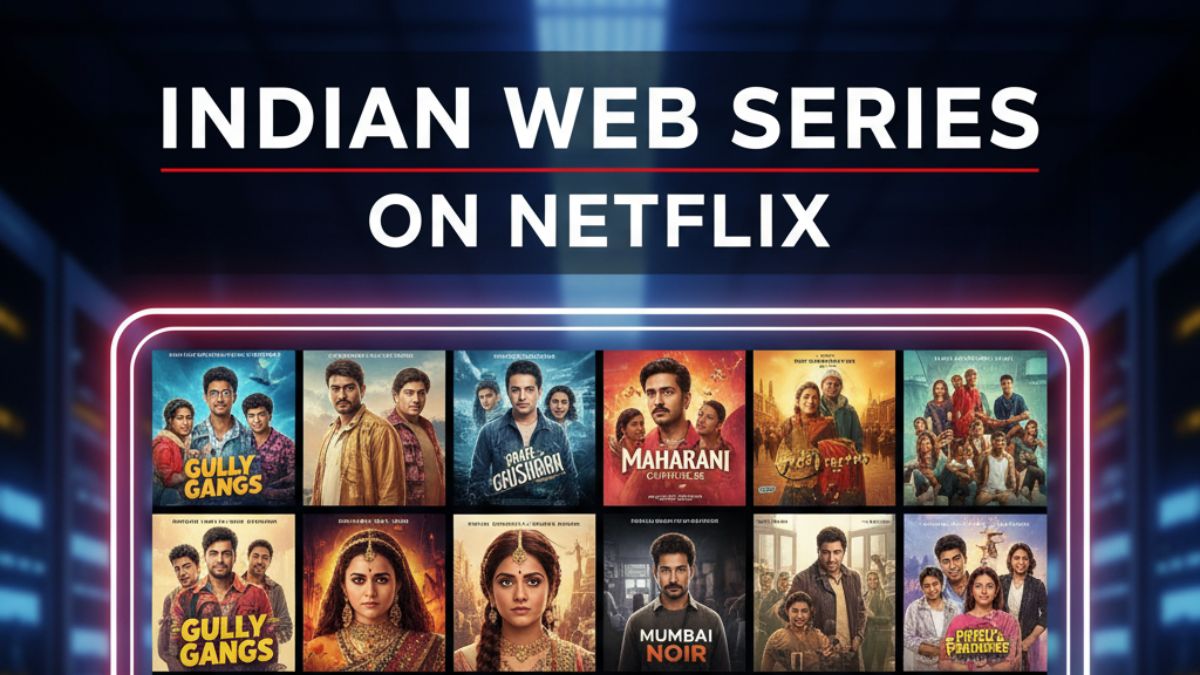
The Changing Pulse of Indian Entertainment
There’s a strange electricity humming through Indian screens right now — not the old silver-screen glamour or the jingle of multiplex popcorn, but something quieter, more intimate. It lives in our phones, in late-night scrolling, in that sudden text from a friend saying, “You need to see this series on Netflix.” You click play expecting noise and distraction, but what looks back at you is startlingly human — imperfect, bruised, breathing.
That’s the secret heartbeat of Indian web series on Netflix: a revolution without the banners.Know more…
They’re not just stories stitched for entertainment; they’re declarations. A rebellion against the predictable, a chorus of new voices that once whispered on the margins. Most of all, they’ve become a rediscovery of what it means to be Indian in the age of algorithms — where the screen has turned into both a mirror and a confession booth.
- The Changing Pulse of Indian Entertainment
- 1.TheDigitalShift: When India Finally Heard Its Own Voice Online
- 2.Why India Fell for the Web Series Storm
- 3.Sacred Games — The Spark That Lit the Screen
- 4.Delhi Crime — When Silence Became the Loudest Voice
- 5.Netflix in India — Not a Platform, an Ecosystem
- 6.Genres Gone Rogue — The New Language of Indian Storytelling
- 7.Beyond Metros — India’s Second Heartbeat on Screen
- 8.The Making of a New Creative Tribe
- 9.The Emotional Afterglow — Why These Stories Linger
- 10.A Mirror and a Megaphone
- 11.From Binge to Belonging — The Psychology of Streaming Obsession
- 12.The Business of Emotion — How Netflix Rewired India’s Entertainment Economy
- 13.The Rise of the Digital Star — When Fame Turned Authentic
- 13.1.The Global Lens — When Indian Stories Found the World
- 13.2. Women at the Helm — Changing the Gaze
- 13.3. India’s Binge Culture — Escape, Empathy, Evolution
- 13.4. Authenticity — The New Creative Currency
- 13.5. From Sacred Games to Global Prestige — Raising the Bar
- 13.6. Challenges Ahead — Balancing Art, Algorithm, and Authenticity
- 13.7. Tomorrow’s Canvas — The Future of Indian Storytelling
- 13.7. A Love Letter to the Screen
- About Hobo.Video
1.TheDigitalShift: When India Finally Heard Its Own Voice Online
A decade ago, the idea of streaming conquering India felt like a tech-dream sold too early. Data crawled like a reluctant snail, connections dropped mid-episode, and every living room still bent around cable television. Then, almost overnight — somewhere between cheap data packs, affordable smartphones, and a restless young audience — the tide flipped.
When Netflix entered India, it wasn’t just launching another app; it was tossing a match into dry creative timber. Suddenly, storytellers who’d been suffocating under censorship or box-office formulas had a playground without a supervisor. No stars required, no song-dance obligations, no scripts written by committee.
For the first time, India didn’t just watch its stories. It felt them.
2.Why India Fell for the Web Series Storm
Indian audiences have always adored drama — it’s practically coded in our DNA — but beneath that melodrama lived a hunger for honesty. Netflix cracked open that vault. Here were shows that looked at our society with tenderness and bite. They dared to be awkward, unglamorous, painfully real.
In a country that loves to paint life in broad cinematic colors, these stories lingered in the half-shades — anxiety, rebellion, loneliness, sexuality, ambition, grief. Sacred Games smoldered with slow dread, Delhi Crime broke hearts with its quiet ache, Jamtara whispered about greed in a Jharkhand accent no movie had bothered to learn.
Indian web series on Netflix did what soap operas and blockbusters couldn’t: they made emotion feel earned. Viewers weren’t just watching stories anymore; they were reclaiming pieces of themselves.
3.Sacred Games — The Spark That Lit the Screen
Every creative revolution needs a first scream. For India, it came wrapped in noir and Sanskrit — Sacred Games.
When it landed in 2018, it felt like an ambush. Gritty yet poetic, violent yet philosophical, it threw open the door for a new cinematic language. Religion, politics, destiny, and moral decay collided with a boldness Bollywood hadn’t dared to touch. And audiences devoured it — not passively, but ravenously, frame by frame, theory by theory.
What Sacred Games proved was monumental: Indians were ready for complex storytelling. They could handle ambiguity, flawed heroes, endings that didn’t spoon-feed closure. This wasn’t “content.” It was culture in motion, a landmark announcing that Indian storytelling could finally speak without translation.
4.Delhi Crime — When Silence Became the Loudest Voice
If Sacred Games was a shout, Delhi Crime was the echo that refused to fade. Based on the 2012 Delhi gang-rape case, it could easily have slipped into sensationalism — but instead, it chose empathy over exploitation.
The series unfolded like a slow-burn prayer for justice. Shefali Shah’s performance didn’t perform rage; it embodied it — that dignified, exhausted anger that feels too familiar to Indian women. Each scene breathed restraint, refusing to prettify the pain or polish the truth.
When Delhi Crime won the International Emmy, it wasn’t just a trophy moment; it was validation that Indian creators could tell stories that were both devastatingly local and universally human.
Netflix had done something Bollywood rarely managed — it turned realism into reverence.
5.Netflix in India — Not a Platform, an Ecosystem
Netflix’s India experiment wasn’t a casual expansion; it was a slow, calculated love affair with a complex market. While competitors raced to stuff their catalogs with every possible show, Netflix played the long game — vision over volume.
Behind its artful choices lay mountains of data: when Indians pause, what they replay, how long they linger before the credits. But data alone doesn’t explain the soul of these shows. The real secret is how they feel.
Every frame looks lived-in — not staged. Lighting feels like monsoon afternoons, not studio setups. Dialogues breathe the rhythm of real speech. Even the pacing — part cinematic, part confessional — seems designed for one-to-one intimacy.
It’s entertainment engineered for empathy.
6.Genres Gone Rogue — The New Language of Indian Storytelling
Once upon a time, Indian genres lived in neat boxes. Comedy was slapstick, romance sugary, crime glamorous. But on Netflix, those boundaries dissolved.
Creators began to mix moods like DJs — myth meeting noir in Leila, politics flirting with love in Taj Mahal 1989, or existential satire smirking through Decoupled. Every experiment chipped away at the old grammar of “what sells.”
And then came the regional wave — a creative renaissance from every linguistic corner. Kota Factory’s grayscale idealism, Paava Kadhaigal’s Tamil sorrow, Kohrra’s Punjabi melancholy — each spoke to a specific soil, yet echoed across the nation.
This isn’t “Bollywood going global.” This is India going plural — a cinema where dialects dream and regional heartbeats score the narrative.
7.Beyond Metros — India’s Second Heartbeat on Screen
What’s truly thrilling about Indian web series on Netflix today is that their geography has shifted. The lens has moved from Bandra rooftops to Bihar backstreets, from South Delhi cafés to dusty lanes where ambition smells of diesel.
Jamtara captured it best — a tiny town turned phishing capital, where dreams run faster than morals. Its genius wasn’t the scam itself but the anatomy of hunger it revealed. Kohrra followed with its haunting rural crime, exploring masculinity and grief like they were inherited heirlooms.
These stories whisper something important: India’s real drama doesn’t unfold in multiplex skylines but in forgotten alleys and unmarked villages. Netflix has given them not just visibility, but dignity.
8.The Making of a New Creative Tribe
Netflix didn’t simply air series — it minted careers.
Filmmakers once locked out of studios now lead global writer rooms. Stage actors became streaming icons. Screenwriters who scribbled unpaid scripts for years suddenly found their names rolling over international credits.
The platform quietly built a new creative republic — one where risk earns respect and individuality isn’t edited out.
Through its labs, mentorships, and writer incubators, Netflix has raised a generation of storytellers fluent in two dialects: local heart and global craft. This isn’t imitation of the West; it’s collaboration with it — on equal footing, in our own accent.
9.The Emotional Afterglow — Why These Stories Linger
What separates Netflix’s Indian shows from the clutter isn’t just glossy production — it’s truth. They stay with you not because they’re perfect, but because they bruise beautifully.
When you watch Mai, you can almost feel the ache tightening behind your ribs. Yeh Kaali Kaali Ankhein turns obsession into poetry and chaos. Little Things mirrors the modern relationship — all the tenderness, confusion, and clumsy grace that come with growing together.
They whisper, they don’t shout. They don’t aim for escapism; they aim for recognition. That’s why, long after the credits fade, you catch yourself thinking about those characters like old friends who moved away.
10.A Mirror and a Megaphone
At their best, these Indian web series on Netflix do something miraculous — they both reflect and redefine us.
They’re raw yet lyrical, vulnerable yet unflinching. They give women the camera, minorities the mic, and youth the vocabulary to describe a new India that’s neither East nor West — just honest.
That’s why they feel personal. They don’t entertain from a distance; they belong to us. They’re the stories of us figuring out who we are — one episode, one heartbreak, one redemption arc at a time.
11.From Binge to Belonging — The Psychology of Streaming Obsession
Something subtle but profound has happened in Indian living rooms. We don’t watch shows anymore; we inhabit them.
When someone says “Jeetu Bhaiya changed my life” or quotes Little Things in a breakup text, that’s not fandom — that’s intimacy. Psychologists call it “parasocial attachment,” but in India, it feels more spiritual. For millions, these stories became therapy, rebellion, companionship.
The silence after a season finale isn’t boredom — it’s loss. Like saying goodbye to people who understood you without ever existing. That’s when you realize Netflix didn’t just sell entertainment here. It sold empathy.
It made watching feel like belonging.
12.The Business of Emotion — How Netflix Rewired India’s Entertainment Economy
Behind all this poetry lies an algorithmic brain ticking quietly. Netflix’s India strategy is less about showbiz and more about sociology.
Unlike cinema, where success is a number at the box office, Netflix counts something more abstract — engagement. How long you linger, what you rewatch, which scenes you rewind to feel again. That data shapes what comes next: the language of subtitles, the accents of characters, even the emotional temperature of new plots.
But the genius isn’t in following trends. It’s in setting them. Sacred Games created India’s streaming identity. Delhi Crime earned global credibility. Kohrra and Guns & Gulaabs proved our eccentricities can travel.
In a few short years, Netflix didn’t just gather an audience — it built an ecosystem where creativity feels like a national resource again.
13.The Rise of the Digital Star — When Fame Turned Authentic
Once upon a time, fame in India came pre-packaged — born in dynasties, polished by PR. Streaming upended that order.
Actors who had spent decades as background fixtures suddenly became household names. Pankaj Tripathi — everyman philosopher. Shefali Shah — face of quiet defiance. Jitendra Kumar, Rajshri Deshpande, Wamiqa Gabbi — the new constellation of authenticity.
These aren’t movie stars. They’re emotional historians, translating our contradictions for the camera. Netflix didn’t just give them visibility; it gave them permission to be real.
The result? A new kind of celebrity — rooted, self-aware, and proudly unmanufactured.
13.1.The Global Lens — When Indian Stories Found the World
Then something unexpected happened. Indian series didn’t just travel; they translated — powered in part by smartdigital marketingthat bridged cultures and algorithms alike. Audiences in São Paulo, Seoul, and San Francisco started streaming Delhi Crime not as “foreign content,” but as shared pain. The grief, the bureaucracy, the fragile hope — it all made sense. Decoupled’s satire of marriage could’ve been set in Manhattan; Class’s teenage chaos felt as universal as any Euphoria.For the first time, the subtitles didn’t create distance — they created connection.Netflix’s reach gave Indian creators something Bollywood rarely offered abroad: contextual respect. No more snake-charmer stereotypes or saffron-washed mysticism. Just storytelling that stands shoulder-to-shoulder with the world because it’s honest, not ornamental.These series became cultural ambassadors, whispering a new truth: India’s contradictions aren’t chaos — they’re choreography.
13.2. Women at the Helm — Changing the Gaze
If one current has quietly powered this revolution, it’s the rise of the female gaze.
Look across Netflix’s Indian slate — Mai, Bombay Begums, Masaba Masaba, Delhi Crime — women aren’t side notes anymore; they’re architects.Behind the lens, directors like Alankrita Shrivastava, Konkona Sen Sharma, and Leena Yadav are building emotional worlds that refuse to simplify womanhood. Their stories allow mess, humor, fury, fatigue — the full, gorgeous range of being alive.It isn’t feminism worn like a marketing badge. It’s feminism as weather — soaking everything it touches, reshaping the soil beneath.Through them, Netflix India has become less about representation and more about reclamation: women owning their stories, not asking permission to tell them.
13.3. India’s Binge Culture — Escape, Empathy, Evolution
Why do we binge? Maybe because in this endless scroll of modern living, these stories are the only things that still pause us.When an Indian viewer presses “Next Episode,” it’s rarely to escape. It’s to understand. Between office deadlines and existential dread, a show like Kota Factory or Little Things feels like a quiet therapy session — familiar, forgiving.Our generation doesn’t chase happy endings; we crave continuity. We keep clicking because we want to stay inside a world where emotions still make sense, even when reality doesn’t.
That’s the secret of Netflix’s Indian web series — they’re not background noise; they’re emotional architecture.
13.4. Authenticity — The New Creative Currency
Scroll through any comment section after a new release, and you’ll see the same word rise again and again: real.That’s the new metric of success.
Not glamour. Not budget. Real.Viewers are allergic to fakery now. They want stories that smell like rain-wet buses, sound like kitchen arguments, and ache like the cities they live in. Netflix got that memo early. It stopped micromanaging and started trusting.By letting creators chase truth instead of trends, the platform stripped away commercial polish and found something raw, luminous, human.Authenticity isn’t an aesthetic anymore — it’s a moral choice.
13.5. From Sacred Games to Global Prestige — Raising the Bar
When Sacred Games dropped, it wasn’t just a series — it was a handshake with the world.
Critics compared it to Narcos and True Detective; suddenly, Indian television had cinematic swagger. Delhi Crime turned national tragedy into international empathy. Leila stretched dystopia through Indian eyes. Khufiya wrapped espionage in quiet heartbreak.Each success didn’t just raise the bar for Indian creators — it recalibrated global perception. Festivals, studios, and awards circuits started to look to India instead of merely at itIt was no longer a novelty act; it was an equal conversation.
13.6. Challenges Ahead — Balancing Art, Algorithm, and Authenticity
But revolutions, even digital ones, grow messy.
The Indian OTT space now stands at its first real crossroads: how to stay fearless when algorithms reward familiarity.Censorship shadows creativity; formula fatigue lurks; budgets demand compromises. The risk is that art could start echoing itself.Netflix’s gamble is to resist that gravity — to trust that audiences will follow courage more than comfort. The question isn’t “What will trend?” anymore; it’s “What will matter?”If the platform can keep its promise of creative freedom intact, India’s streaming story might just become its greatest export.
13.7. Tomorrow’s Canvas — The Future of Indian Storytelling
This isn’t a fad; it’s the foundation of a new cinematic republic.
The web-series boom has rewired how we imagine, shoot, and consume art. The next decade will see deeper regional storytelling, collaborations that blur national borders, and experiments that defy category.Expect thrillers from the North-East, folklore from Himachal, love stories in Manipuri and Mizo tongues — each bearing its own rhythm and scent. The canvas is widening, and the brush is finally in everyone’s hand.India’s Netflix era isn’t about what we watch anymore; it’s about what we become.
13.7. A Love Letter to the Screen
Strip away the stats, the algorithms, the Emmy wins — what remains is simple: we still crave stories because they remind us we’re human.In every trembling pause of Mai, every stolen glance in Little Things, every silence in Delhi Crime, we find pieces of ourselves — confused, hopeful, relentless.So when we talk about Indian web series on Netflix, we’re not really talking about shows. We’re talking about identity, empathy, and the courage to dream in our own accents.The screen is no longer a wall between us and the world. It’s a mirror we finally dare to look into — and the reflection, at last, looks like us.
About Hobo.Video
Hobo.Videois India’s leading AI-powered influencer marketing and UGC company. With over 2.25 million creators, it delivers end-to-end campaign management built for brand growth. The platform blends AI and human strategy to maximize ROI.
Services include:
- Influencer marketing
- UGC content creation
- Celebrity endorsements
- Product feedback and testing
- Marketplace and reputation management
- Regional and niche influencer campaigns
Trusted by top brands like Himalaya, Wipro, Symphony, Baidyanath, and the Good Glamm Group.
Want your brand to stand out, not just fit in?Let’s talk.
Creating content is your thing. Let us help you grow with it.Join now.
FAQs
What makes Indian web series on Netflix different from traditional Bollywood films?
Unlike formulaic Bollywood movies, Indian web series on Netflix explore deeper emotions, regional stories, and social realities with creative freedom and authenticity.
Which Indian web series on Netflix helped shape the country’s streaming revolution?
Series like Sacred Games, Delhi Crime, Kota Factory, and Leila played a major role in defining India’s streaming identity, combining global craft with local depth.
How has Netflix changed the Indian entertainment industry?
Netflix empowered independent creators, spotlighted regional voices, and replaced star-driven storytelling with realism, diversity, and powerful female-led narratives.
Why are Indian audiences so drawn to Netflix’s web series?
Viewers connect with their honesty and emotional depth — shows that reflect modern Indian life, addressing themes like identity, ambition, love, and morality.
What’s the future of Indian web series on Netflix?
The next wave promises more regional diversity, bold themes, and global collaborations — turning India’s streaming era into a new cinematic renaissance.


