


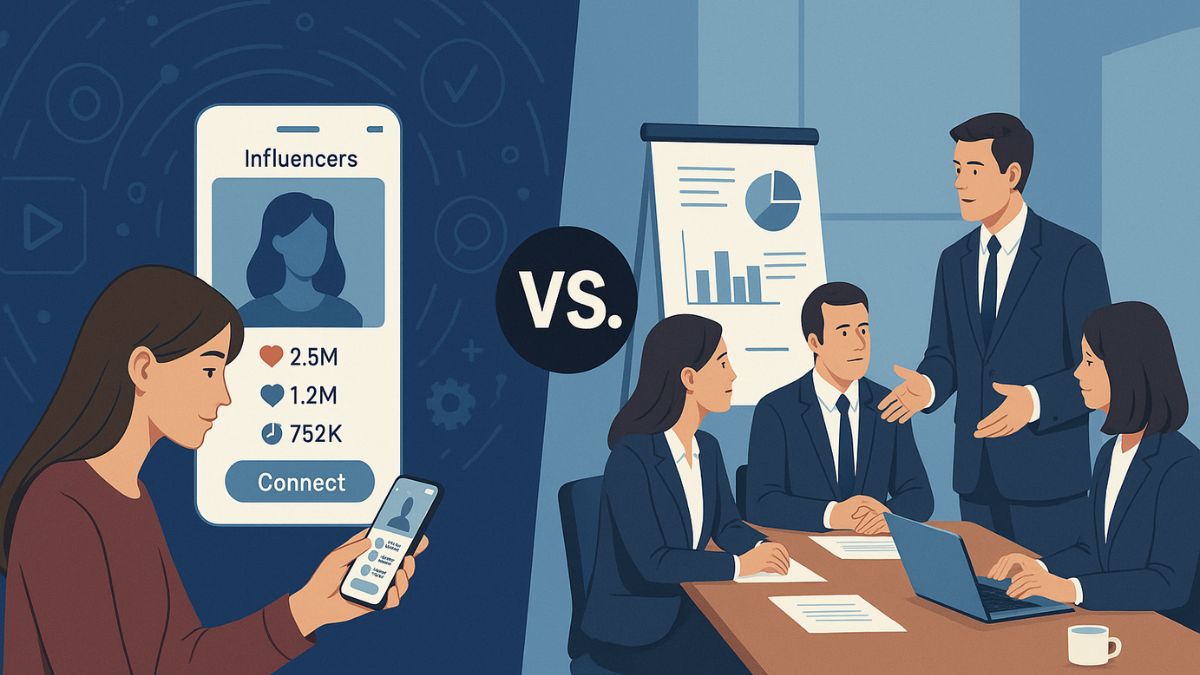
Let’s not sugarcoat it—navigating the wild terrain of social media marketing in 2025 is like trying to hit a moving target during a sandstorm. Especially in India, where regional diversity meets digital velocity, choosing between influencer platforms and traditional agencies isn’t just a tactical call—it’s a survival strategy. The tug-of-war between modern influencer platforms and traditional agency approaches is intensifying. Why? Because influencer marketing isn’t just a buzzword anymore—it’s the real engine behind brand visibility and customer trust.
This isn’t your standard guide wrapped in marketing jargon. We’re diving into the nitty-gritty of influencer marketing strategies, contrasting influencer service platforms versus agency partnerships. You’ll get sharp takes, field-tested insights, and a ground-level view tailored for the Indian market, all served with a dose of honest opinion and no corporate fluff.
1. Understanding the Basics: Influencer Platforms and Traditional Agencies
1.1 What Are Traditional Agencies?
Traditional agencies are the marketing veterans—the kind who cut their teeth on TV spots, print ads, and big-banner brand deals. Their toolkit is massive: from strategic planning to talent management and large-scale media buying. In India, they’ve long been the preferred choice for heavyweight industries—think FMCG giants, automobile brands, and telecom bigwigs. Their strength lies in structured processes, polished execution, and deep connections with macro influencers and celebrities.
But here’s the flip side: you’re often buying the agency framework—not speed, not adaptability, and certainly not affordability. Expect contracts that feel like prenups and processes that crawl through layers of red tape.
1.2 What Are Influencer Platforms?
Now let’s talk about the disruptors—the digital influencer platforms against traditional marketing agencies. These aren’t your average talent databases. They’re tech-first ecosystems, powered by AI, optimized for scale, and obsessed with data. They’re built for speed and flexibility, something India’s scrappy D2C brands and hyperlocal startups are crying out for.
Platforms like Hobo.Video, for instance, don’t just throw a list of influencers your way. They analyze, match, track, and report—all in one place. And instead of only big names, they give you the power to engage nano and micro influencers compared to celebrities—which is precisely what your niche vegan chai brand in Pune needs.
2. Key Differences Between Influencer Platforms vs Traditional Agencies
2.1 Cost and Flexibility
Let’s not mince words—traditional agencies are expensive. They’re like fine-dining: classy but costly, with a fixed menu. The barrier to entry? High. That’s not ideal if you’re an Indian SME or bootstrapped startup hoping to test waters before plunging into influencer promotional methods.
Platforms, on the other hand, let you pay as you go. Want a one-time campaign targeting Telugu-speaking college students in Hyderabad? Done. No yearly contracts. No bloated retainers. This is where influencer agency models versus platform solutions really show their stripes.
2.2 Speed and Efficiency
Need to launch a flash sale tomorrow and go viral? Good luck doing that with a traditional agency. The multi-step approval cycles alone could bury your momentum. Agency-driven marketing can be painfully sluggish.
But with platforms, campaign setup can feel almost frictionless. Automation tools handle everything from influencer outreach techniques to tracking campaign KPIs. In today’s fast-scroll culture, that speed isn’t a luxury—it’s non-negotiable.
2.3 Transparency and Data Access
Here’s where platforms completely outshine their old-school counterparts. Real-time dashboards. Engagement heat maps. Audience geography. Conversion rates. You see it all—no sugarcoating, no delays. That’s transparency at its best.
Agencies? They’ll hand you a 30-slide PDF two weeks later—pretty graphs but limited control. That’s just not how managing influencer campaigns should work anymore.
2.4 Scalability and Reach
Agencies are built for high-stakes, large-budget campaigns. That’s their turf. But when it comes to grassroots outreach—reaching tier-2, tier-3 cities, or regional dialect-specific audiences—they often fall short.
This is where influencer platform ecosystems versus agency frameworks become relevant. Platforms allow you to onboard dozens of creators across regions, languages, and interests without blowing your budget. That’s modern-day influencer marketing management in action.
3. The Evolution of Influencer Marketing: Trends Shaping 2025
3.1 Rise of AI and Automation
Artificial intelligence isn’t just some fancy tech add-on anymore. It’s the backbone of 2025 influencer marketing trends. Platforms use AI to weed out bots, match brand values with creator content, and predict performance with surprising accuracy.
Hobo.Video is already doing this—improving influencer ROI measurement by matching car rental brands with influencers whose followers are literally booking weekend getaways.
3.2 Focus on User-Generated Content (UGC)
Here’s the truth: audiences can smell a scripted brand plug from a mile away. What they crave is UGC—raw, relatable, real. Traditional agencies often can’t supply that at scale. They’re built for polished productions, not creator spontaneity.
Platforms? They tap into creators who generate content daily, naturally. Think influencer-generated content strategies without filters or overproduction. It’s authentic. It works.
3.3 Micro and Nano Influencer Boom
Influencers with fewer than 100K followers are the new MVPs. Their engagement levels? Off the charts. Their audiences? Loyal to a fault. Agencies often overlook them. Platforms don’t.
These small-scale stars are driving real results, and their rise reflects emerging influencer marketing patterns in 2025 that marketers can’t afford to ignore.
3.4 Performance-Based Campaigns
Welcome to the era of “show me the metrics.” Brands want numbers, not just vibes. Platforms excel at this, offering live data feeds that let you course-correct mid-campaign.
Agencies are adapting, sure, but they still have catching up to do in the tracking influencer performance game.
4. How Indian Brands Can Benefit From Influencer Platforms vs Traditional Agencies
4.1 Cost-Effective Marketing
Let’s be real: India’s marketing budgets aren’t Silicon Valley-sized. And that’s fine—if you use platforms. You get influencer marketing value without draining your budget.
Whether you’re a yoga mat startup in Rishikesh or a SaaS tool in Bangalore, you can test, learn, and iterate with minimal risk.
4.2 Localized Content Creation
India isn’t one country—it’s dozens of linguistic and cultural microcosms stitched together. Platforms understand this and give you access to creators fluent in Malayalam, Assamese, Bhojpuri—you name it.
That kind of localized influencer campaign administration? Agencies just can’t compete at that scale.
4.3 Transparent Campaign Management
You want to know what’s working and what’s not—right now. Platforms give you that. With agencies, it’s a waiting game. In a market where consumer preferences shift in a blink, that lag can be lethal.
4.4 Customized Strategies for Niche Markets
You’re not just selling to “Gen Z.” Maybe you’re targeting Tamil-speaking remote workers in Coimbatore who love long bike rides. Platforms can micro-target that. Agencies? They’ll probably recommend a pan-India strategy with a Bollywood star.
5. Challenges in Influencer Platforms and Traditional Agencies
5.1 Challenges With Traditional Agencies
Let’s be blunt: many agencies are still playing 2010’s game in 2025. They resist change, favor mega influencers, and often undervalue content crafting in influencer campaigns. The result? Expensive, outdated, low-engagement campaigns.
5.2 Challenges With Influencer Platforms
Of course, platforms aren’t perfect either. Fraudsters exist. Quality can fluctuate. The lack of human negotiation can lead to mismatched expectations. Not every platform has solid influencer project coordination.
Due diligence is non-negotiable. Work only with platforms that have rigorous verification and vetting in place.
6. The Future Outlook: Social Media in 2025 and Beyond
Social media marketing in 2025 will be hybrid. Think: brand collaboration platforms versus agency-driven marketing—not either-or, but both. The strategic planning of agencies fused with the tech agility of platforms is the sweet spot.
And Indian brands? They’ll need to evolve or risk becoming obsolete. The brands that blend data with emotion, automation with authenticity, will lead the pack.
Conclusion
So, what’s the bottom line in this whole influencer networks versus classic agencies debate? Simple: the rules of the game have changed. Traditional agencies still hold value for big-ticket strategy and celebrity clout. But platforms are where agility, scalability, and measurable impact live. For Indian businesses, especially those playing on the edges of innovation, brand and influencer joint campaigns via platforms might just be your ticket to relevance—and results. Don’t just follow the trend. Choose the tool that fits your voice, your vision, and your audience.
About Hobo.Video
Hobo.Video is the go-to platform for brands seeking smart, impactful influencer marketing in India. With a vast network of niche creators, it ensures your message reaches the right audience—whether by interest, location, or behavior. Every campaign is tailored, not templated, and backed by real-time data to track clicks, conversions, and ROI. From influencer onboarding to performance analysis, Hobo.Video manages everything end-to-end. For brands ready to grow with precision and authenticity, Hobo.Video is a clear choice.
Before you go, check this out: Why Hobo.Video is the Best Platform for Performance-Based Influencer Marketing
If you’re a brand looking for unconventional hypergrowth, connect with us Here
If you’re an influencer ready to grow with us, Register Here


