
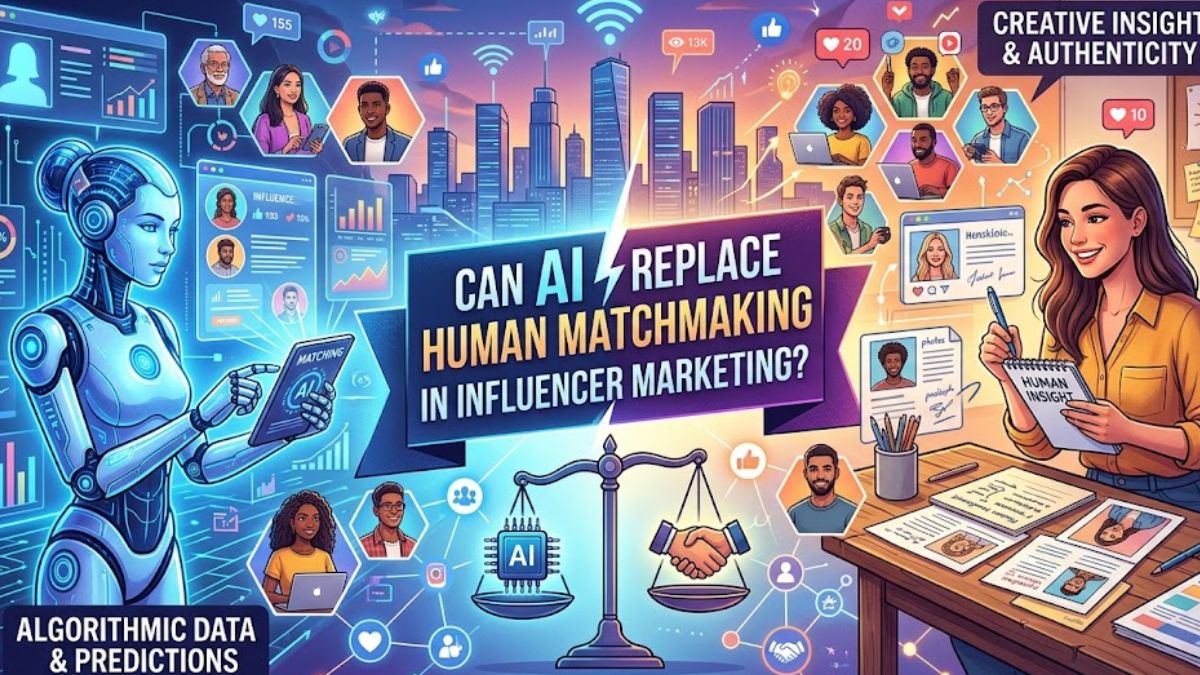
1. Introduction: The Real Question Behind “Can AI Replace Human”
The question “Can AI Replace Human” decision-making in influencer marketing is no longer theoretical it has become deeply practical. Inside brand strategy meetings, agencies, and creator platforms, this debate surfaces repeatedly. As AI tools become more advanced, brands now rely on automation for influencer discovery, audience analysis, and even campaign planning. What once required manual research, intuition, and relationship-building can now be processed through algorithms that scan millions of creators within minutes. This shift creates both excitement and unease. Excitement, because efficiency improves dramatically. Unease, because influencer marketing has always been rooted in trust, authenticity, and emotional storytelling. The concern is not whether AI can assist it clearly can but whether AI can truly understand the subtle human signals that define meaningful creator partnerships. When brands collaborate with influencers, they are not just buying reach; they are borrowing voice, credibility, and emotional connection. That responsibility makes the decision far more complex than a purely data-driven selection.
The real tension emerges when brands begin comparing AI precision with human instinct. AI systems evaluate engagement rates, audience demographics, follower authenticity, and historical performance. These metrics offer clarity and speed. However, influencer marketing operates beyond measurable signals. Tone, personality, humor, cultural nuance, and storytelling authenticity cannot always be captured by data. A creator may have perfect metrics but fail to emotionally align with a brand’s voice. Another may have modest reach but deep audience trust that drives stronger conversions. Human experts often sense these differences instantly, while AI relies on historical patterns. This is why the conversation is evolving. Instead of asking whether AI can replace humans, brands are exploring how AI can support human judgment. The future of influencer marketing is not about automation replacing people — it is about combining machine intelligence with human empathy to create partnerships that feel genuine, not mechanical.
2. The Rise of AI in Influencer Marketing
2.1 Growth of Automation in the Creator Economy
The creator economy has expanded at a breathtaking pace, transforminginfluencer marketingfrom a niche tactic into a core growth channel for brands. As budgets increased, the number of creators exploded across platforms like Instagram, YouTube, TikTok, and emerging short-video ecosystems. Brands suddenly faced a paradox: more creators meant more opportunity, but also more complexity. Marketing teams struggled to manually evaluate thousands of influencers, compare audience quality, and assess campaign fit. This operational pressure accelerated the adoption of AI-powered influencer discovery tools. These systems promised speed, scale, and structured decision-making. Instead of manually scrolling through profiles, brands could now upload campaign criteria and receive curated influencer lists within minutes. AI began reshaping workflows turning influencer selection into a data-driven process. This transformation fueled the growing question: Can AI Replace Human matchmaking in influencer marketing? As automation improved efficiency, many organizations started experimenting with fully AI-driven selection models.
However, as brands leaned into automation, they discovered something unexpected. AI could optimize selection based on numbers, but it could not always replicate emotional alignment. Campaigns that looked strong in predictive models sometimes delivered average results in reality. Engagement metrics were accurate, yet content lacked authenticity. Influencers chosen purely through algorithmic ranking occasionally felt disconnected from brand identity. This revealed a deeper truth about the creator economy: success depends not just on reach, but on resonance. Human managers often evaluate creators based on storytelling ability, tone consistency, and audience trust factors that remain difficult for AI to quantify. This realization shifted the narrative from replacement to collaboration. Brands began using AI to shortlist creators and humans to finalize partnerships. Automation reduced workload, while human judgment preserved authenticity. The rise of AI did not eliminate human involvement it redefined it, positioning AI as an analytical engine and humans as emotional decision-makers.
2.2 How AI Influencer Tools Work Today
Modern AI influencer toolsoperate using machine learning models trained on vast datasets of creator performance and audience behavior. These systems analyze engagement patterns, audience demographics, posting consistency, and brand alignment signals to evaluate influencer suitability. By scanning millions of profiles simultaneously, AI platforms categorize creators into niches, predict campaign performance, and flag suspicious follower activity. This structured approach allows brands to move beyond guesswork. For example, an AI system can identify creators whose audience overlaps with a target demographic, whose engagement rate is above category average, and whose content aligns with brand themes. These capabilities dramatically improve efficiency and reduce manual research time. AI tools also continuously learn from campaign outcomes, refining predictions and improving accuracy. As a result, AI-driven brand collaborations have become more systematic, measurable, and scalable than ever before.
Despite these advancements, AI systems remain dependent on historical data. They evaluate patterns based on past performance, not future emotional impact. This creates limitations in influencer marketing, where creativity and cultural relevance often drive success. A creator may have modest past metrics but possess storytelling potential that resonates strongly with audiences. Humans can identify this intangible quality, while AI may overlook it. Additionally, AI struggles with contextual understanding — humor trends, regional references, and evolving audience sentiment. These factors influence campaign performance but rarely appear in structured data. This is why the question Can AI Replace Human continues to surface. AI can predict engagement probability, but it cannot fully anticipate emotional resonance. Human managers interpret tone, authenticity, and narrative alignment in ways algorithms cannot. The most effective influencer strategies today combine AI-driven insights with human creativity, ensuring campaigns remain both data-backed and emotionally compelling.
3. Human vs AI Matchmaking in Real Campaigns
3.1 Where AI Performs Better
AI systems excel in scale-driven decision-making where speed and data processing matter most. In large campaigns involving hundreds or thousands of creators, manual selection becomes impractical. AI can screen massive influencer databases within minutes, filtering creators based on engagement rate, audience demographics, content category, and brand relevance. This capability dramatically reduces planning time. AI also detects anomalies such as fake followers, engagement pods, and inconsistent audience growth patterns. These checks improve campaign quality by eliminating low-value influencers. Additionally, AI tools map audience overlap across creators, ensuring brands avoid redundant reach and maximize unique impressions. For performance-driven campaigns, this analytical precision offers measurable advantages. Brands can launch campaigns faster, optimize budgets, and track outcomes with structured reporting dashboards.

Amplify Your Brand,
One Influence at a Time.
Beyond efficiency, AI introduces consistency into influencer selection. Human decision-making can be influenced by familiarity, subjective bias, or limited exposure to emerging creators. AI evaluates all profiles using standardized criteria, often uncovering niche influencers overlooked manually. This expands diversity and improves targeting accuracy. For example, AI may identify micro-influencers with high audience trust in specific categories, delivering better conversion potential. Brands using AI-driven matchmaking often report improved ROI, faster execution, and reduced operational overhead. These advantages make AI invaluable for large-scale campaigns. However, even in these scenarios, human review remains important. AI identifies candidates, but humans evaluate narrative fit and emotional alignment. The strongest campaigns leverage AI for discovery and humans for storytelling judgment, ensuring both efficiency and authenticity.
3.2 Where Humans Still Win
Human experts bring contextual understanding that extends beyond measurable metrics. Influencer marketing relies heavily on tone, personality, and cultural nuance — elements that AI struggles to interpret. Humans notice subtle mismatches between influencer voice and brand identity. They evaluate storytelling style, humor sensitivity, and audience expectations. For example, an influencer known for sarcastic humor may not suit a serious financial brand. AI may rank them highly based on engagement, but humans recognize the tonal disconnect. Similarly, regional content differences require cultural awareness. A creator popular in one region may not resonate in another due to language, references, or audience behavior. Human managers intuitively assess these factors, ensuring partnerships feel natural rather than forced. This emotional intelligence plays a critical role in campaign success.
Humans also excel at identifying long-term brand advocates rather than one-time collaborators. They evaluate authenticity, audience trust, and narrative potential. These qualities often lead to stronger brand loyalty and higher conversion rates. AI focuses on performance signals, but humans interpret intention and personality. They understand whether a creator genuinely aligns with a brand’s values. This distinction matters because audiences quickly detect inauthentic partnerships. Campaigns driven purely by metrics may generate impressions but fail to build trust. Human decision-makers prioritize relationships, storytelling continuity, and creator enthusiasm. This human-centered approach ensures influencer collaborations feel genuine. While AI provides valuable data, human intuition ultimately shapes meaningful partnerships that resonate with audiences.
4. AI Influencer Marketing Automation: Power and Limits
4.1 Speed and Scale Advantages
AI-driven automationhas transformed operational efficiency in influencer marketing. Tasks that once required extensive manual effort now happen in a fraction of the time. AI platforms scan multiple social media networks simultaneously, rank creators based on predicted ROI, and recommend campaign structures. This allows agencies to manage large campaigns without expanding team size. Automation also improves reporting accuracy. Real-time dashboards track impressions, engagement, conversions, and audience demographics. These insights enable brands to adjust campaigns quickly. AI also optimizes posting schedules, content formats, and budget allocation. These capabilities make influencer marketing more structured and predictable. Brands benefit from faster launches, improved targeting, and data-driven decision-making.
Beyond speed, AI enables experimentation at scale. Brands can test multiple influencer combinations, content formats, and messaging strategies simultaneously. AI analyzes performance and recommends adjustments, improving outcomes over time. This iterative optimization enhances campaign effectiveness. However, automation focuses primarily on measurable outcomes. It prioritizes efficiency and performance metrics. While this improves operational execution, it does not guarantee emotional resonance. Influencer marketing success depends on storytelling and authenticity. AI accelerates processes but cannot fully replicate human creativity. The most effective strategies combine automation with human insight, ensuring campaigns remain both efficient and emotionally compelling.
4.2 The Emotional Gap in AI Systems
Despite rapid advancements, AI lacks emotional intelligence and contextual awareness. It processes structured data but struggles with unstructured human signals such as humor, tone, and cultural nuance. Influencer marketing often relies on these elements. A creator’s personality, storytelling style, and audience relationship influence campaign success. AI may identify high-performing creators, but it cannot fully interpret emotional authenticity. For example, meme culture evolves rapidly, and AI models may not capture emerging trends immediately. Humans observe these shifts intuitively. They understand audience sentiment and adjust strategies accordingly. This emotional gap limits AI’s ability to fully replace human decision-making.
The challenge becomes more evident in diverse markets where cultural differences shape audience behavior. Language tone, regional humor, and community values vary significantly. AI models trained on global datasets may miss these nuances. Human experts evaluate creators within cultural context, ensuring relevance and authenticity. They understand how audiences perceive collaborations and adjust messaging accordingly. This human perspective prevents misaligned partnerships. While AI offers analytical precision, it lacks empathy. Influencer marketing thrives on emotional connection, and human judgment remains essential. The future lies in combining AI’s speed with human understanding, creating campaigns that are both data-driven and emotionally resonant.
5. Influencer Discovery Tools and Their Evolution
5.1 Data-Driven Creator Mapping
Influencer discovery tools have evolved from simple search dashboards into deeply intelligent analytics engines. Today’s platforms do far more than list creators they map digital personalities through data. These systems track audience authenticity scores, engagement consistency over time, and content niche clustering to understand where creators truly belong. They evaluate follower growth patterns, comment quality, posting behavior, and even audience overlap across brands. For marketing teams, this level of visibility feels almost transformative. What once required hours of manual scrolling now appears as structured insights. Brands can identify creators with genuine audiences, detect inflated metrics, and compare performance objectively. This shift has significantly reduced fraud in influencer marketing. It has also helped brands discover micro-creators with loyal communities who often outperform larger influencers in conversion-driven campaigns. Data-driven creator mapping has introduced discipline into a space once dominated by guesswork and assumptions.
Yet even with such powerful analytics, something deeply human remains outside the reach of algorithms. Trust cannot be quantified entirely. A creator may show consistent engagement and authentic audience signals, but the emotional bond they share with followers often exists beyond measurable metrics. Some influencers build credibility over years through vulnerability, honesty, and community interaction. That trust is felt in the tone of comments, the loyalty of returning viewers, and the willingness of audiences to act on recommendations. AI tools can identify engagement patterns, but they cannot fully interpret emotional loyalty. This is why the debate “Can AI Replace Human” continues. Data-driven mapping accelerates discovery, but humans still evaluate credibility. Experienced marketers often review creators personally, watching their content, reading comments, and sensing authenticity. This blend of analytics and intuition ensures brands choose not just high-performing creators, but trusted voices capable of influencing real decisions.
5.2 Rise of Hybrid Platforms
As influencer marketing matured, platforms began recognizing the limitations of purely automated systems. This led to the rise of hybrid platforms tools that combine AI analytics with human strategy. These platforms use algorithms to shortlist creators based on performance signals, then allow strategists to refine selections using contextual understanding. This model improves campaign planning significantly. AI handles large-scale discovery, while humans evaluate storytelling fit and brand alignment. For brands, this creates balance. They gain speed without losing authenticity. Hybrid platforms also improve creator shortlisting. Instead of relying solely on engagement metrics, human strategists assess tone, communication style, and content personality. This ensures collaborations feel natural rather than forced. Content validation is another area where hybrid models excel. AI may recommend creators, but humans review content direction, messaging, and brand safety before campaigns go live.
This collaborative approach reflects a deeper realization across the industry. Influencer marketing is not purely technical it is relational. Campaign success often depends on chemistry between brand and creator. Hybrid platforms preserve that human element while leveraging AI efficiency. Many brands report better campaign performance when using this combination. They experience smoother execution, stronger storytelling, and improved audience response. The question “Can AI Replace Human” therefore evolves into something more nuanced. The answer is not binary. AI does not replace humans it amplifies them. The most effective influencer campaigns now emerge from collaboration between machine intelligence and human creativity. This hybrid model ensures decisions remain data-informed yet emotionally grounded, balancing analytical precision with authentic storytelling.
6. AI-Driven Brand Collaborations in India
6.1 The Indian Influencer Ecosystem
India’s influencer ecosystem is vast, vibrant, and incredibly diverse. With more than 80 million creators across platforms like Instagram, YouTube, and short-video networks, the scale alone makes manual selection extremely challenging. Brands launching nationwide campaigns must navigate thousands of potential creators across categories lifestyle, tech, finance, beauty, education, gaming, and regional entertainment. AI-driven brand collaborations have therefore grown rapidly. Automation allows marketers to filter creators by language, location, engagement rate, and audience demographics. This efficiency is especially valuable for large campaigns. Instead of manually researching creators in different regions, brands can rely on AI tools to produce structured recommendations. These platforms also help detect fake followers and inflated engagement, improving campaign quality. As a result, AI adoption in Indian influencer marketing has accelerated significantly, particularly among ecommerce brands and startups seeking rapid scale.
However, India’s diversity introduces complexities that challenge automation. Regional languages, cultural traditions, and audience expectations vary widely across states. A campaign that resonates in Hindi-speaking regions may not connect with Tamil or Telugu audiences. Festive timing also differs cultural moments in one region may not align with another. These nuances shape how content is received. Human experts understand these differences intuitively. They recognize tone sensitivity, local humor, and storytelling preferences. AI systems, while powerful, may struggle to interpret such cultural depth. This is why brands continue questioning “Can AI Replace Human” decision-makers in India. The answer often leans toward collaboration. AI accelerates discovery, but humans refine selections based on cultural relevance. This hybrid approach ensures campaigns feel localized, authentic, and emotionally resonant across diverse audiences.
6.2 The Role of Trust in Brand Deals
Trust remains the foundation of influencer marketing. Audiences follow creators not just for content, but for credibility. When influencers recommend products, their audience perceives it as personal advice. This emotional dynamic makes trust critical for campaign performance. Even when AI identifies high-performing creators, human validation ensures brand safety and authenticity. Marketers often review past content, tone consistency, and audience reactions before finalizing collaborations. They evaluate whether the creator genuinely aligns with brand values. This step prevents partnerships that feel transactional. AI can analyze metrics, but humans interpret sincerity. For brands, this distinction matters deeply. A campaign driven by trusted voices often generates stronger engagement, higher conversions, and long-term loyalty.
Human oversight also ensures audience sentiment fit. A creator’s audience may be highly engaged, but not receptive to certain product categories. Experienced marketers understand these subtleties. They evaluate comment sections, community interactions, and audience behavior. This qualitative assessment complements AI analytics. As influencer marketing matures, brands increasingly rely on this layered approach. AI handles data-driven discovery, while humans ensure emotional alignment. This balance reinforces the idea that AI influencer marketing automation works best with human guidance. Trust cannot be automated entirely. It must be interpreted, nurtured, and protected. This is why human involvement remains essential even in advanced AI-driven collaborations.
7. Campaign Optimization and Performance Strategy
7.1 Data-Led Optimization Systems
Modern campaign optimization systems have transformed how influencer marketing performance is managed. These tools track real-time metrics impressions, engagement, click-through rates, conversions, and audience response. Based on this data, AI platforms automatically adjust campaign variables. They optimize budget allocation, shift investment toward high-performing creators, and recommend changes in content timing. This dynamic optimization improves efficiency significantly. Brands no longer wait until campaign completion to analyze results. Instead, adjustments happen during execution. Industry benchmarks suggest that data-led optimization can improve ROI by 30–45% in certain campaigns. This improvement stems from continuous performance monitoring and rapid decision-making. AI systems identify trends early, allowing marketers to scale successful content and pause underperforming collaborations.
However, data-driven optimization focuses primarily on performance signals. It enhances efficiency but does not define creative direction. AI can suggest which creators perform best, but it cannot determine narrative tone. Humans interpret audience sentiment and adjust messaging accordingly. For example, a campaign may show strong engagement but limited conversions. Human strategists may refine storytelling, reposition product messaging, or adjust emotional hooks. This creative intervention often unlocks deeper audience connection. While AI improves tactical execution, humans shape strategic direction. The debate “Can AI Replace Human” therefore persists. Data-led optimization enhances performance, but human creativity drives impact. The strongest campaigns emerge when AI analytics inform human-led storytelling decisions.
7.2 Why Strategy Still Needs Humans
Strategy in influencer marketing extends beyond metrics. It involves crafting narratives that resonate emotionally. Humans decide campaign storytelling angles, emotional hooks, and cultural messaging. They understand audience psychology and brand voice. AI may identify optimal creators, but humans determine how those creators communicate brand value. This distinction shapes campaign success. For example, two influencers may deliver similar engagement rates, yet one may tell a compelling story that drives conversions. Humans recognize storytelling potential and guide content direction. This creative guidance cannot be fully automated. Emotional resonance depends on intuition, empathy, and cultural awareness qualities uniquely human.
Human strategists also manage long-term brand positioning. They ensure campaigns build consistent identity rather than isolated promotions. This continuity strengthens audience trust. AI optimization focuses on short-term performance, while humans consider brand perception over time. This balance is essential for sustainable growth. Human vs AI matchmaking therefore works best as collaboration. AI identifies opportunities, humans shape narrative execution. Together, they create campaigns that are both efficient and meaningful. The future of influencer marketing lies in this partnership where data informs decisions, and human creativity brings them to life.
8. Marketing Personalization Algorithms and Audience Targeting
8.1 How Algorithms Shape Content Delivery
Marketing personalization algorithms play a crucial role in influencer campaign targeting. These systems analyze user behavior watch time, engagement history, and interest clusters — to understand audience preferences. Based on this data, platforms recommend creators whose content aligns with user interests. This improves targeting accuracy significantly. Brands can reach audiences more likely to engage and convert. Personalization algorithms also help identify niche communities. For example, a tech gadget brand can target audiences interested in mobile reviews, productivity tools, and gaming accessories. This precision reduces wasted impressions and improves campaign efficiency. AI-driven targeting ensures influencer content reaches the right viewers at the right time.
However, personalization algorithms operate within structured behavioral patterns. They recommend content based on past activity, not evolving emotional context. Human marketers interpret audience intent beyond data signals. They understand emerging trends, shifting preferences, and cultural moments. For instance, a viral trend may not yet appear in algorithmic recommendations. Humans detect such shifts early and adapt campaigns accordingly. This dynamic understanding enhances relevance. While algorithms improve targeting accuracy, human insight ensures contextual relevance. This interplay keeps the debate “Can AI Replace Human” active. Algorithms guide delivery, but humans shape messaging. Together, they create campaigns that feel both precise and meaningful.
8.2 Limitations in Real-World Scenarios
Despite advanced targeting, algorithms face limitations in real-world influencer marketing scenarios. Viral trends often emerge unpredictably. Emotional storytelling evolves rapidly. Cultural humor varies across regions and communities. AI models trained on historical data may not capture these nuances immediately. As a result, algorithm-driven recommendations sometimes miss emerging creators or trending content styles. Human experts observe these shifts organically. They monitor social conversations, meme culture, and audience sentiment. This qualitative awareness helps brands stay relevant. Without human intervention, campaigns risk feeling outdated or disconnected from cultural context.
Human involvement also ensures adaptability. Influencer marketing thrives on spontaneity and creativity. Algorithms optimize performance but may prioritize safe choices. Humans experiment with bold storytelling and unconventional creators. This experimentation often leads to breakthrough campaigns. Real-world influencer marketing therefore depends on both structure and intuition. Algorithms provide analytical foundation, while humans bring emotional intelligence. This balance prevents over-automation and preserves authenticity. The question “Can AI Replace Human” ultimately highlights this dynamic. AI enhances efficiency, but human creativity drives resonance. Together, they create influencer campaigns that connect deeply with audiences.
9. Case Insights from Indian Influencer Marketing Industry
9.1 Market Growth Reality
The Indian influencer marketing landscape has moved from experimental budgets to boardroom-level strategy in just a few years. Reports indicate the market reached nearly ₹2,200 crore in 2023, with projections pointing toward a strong 25% CAGR through 2026. Behind these numbers lies a deeper shift in how brands communicate. Traditional advertising once relied on broad messaging, but influencer marketing India has introduced intimacy into scale. Micro influencers, in particular, have reshaped expectations. Engagement rates between 6–8% are no longer surprising when creators speak to tight-knit communities that trust them. These communities behave differently from mass audiences. They comment, ask questions, and often purchase based on recommendations. This behavioral shift explains why brands are allocating larger budgets toward influencer-led campaigns. The growth is not just financial it reflects a change in how audiences form relationships with brands.
Yet within this growth story, a subtle transformation is unfolding. As the ecosystem expands, the complexity of choosing the right creators increases. Brands are no longer selecting from hundreds of influencers but from millions across languages, categories, and audience segments. This is where AI-driven tools enter the conversation. They bring structure to chaos, scanning massive creator pools and identifying patterns quickly. However, the emotional layer of influencer marketing remains distinctly human. Engagement rates may be measured numerically, but the reasons behind them are emotional relatability, authenticity, and trust. Marketers on the ground often describe campaigns where a smaller creator outperforms a celebrity simply because their audience believed them. These real experiences reinforce a core truth: influencer marketing India is becoming AI-heavy, but still human-led. Data guides discovery, but humans interpret meaning. Growth numbers tell one story, but human connection explains why those numbers exist.
9.2 Real Campaign Behavior Patterns
Observing real campaign execution reveals a consistent behavioral pattern across brands. The process often begins with AI filtering for scale. Tools analyze thousands of creators based on engagement rate, audience demographics, niche alignment, and content frequency. This stage dramatically reduces manual effort. Marketing teams receive structured shortlists instead of raw creator pools. However, this is only the beginning. Once AI narrows down candidates, human validation takes over. Strategists review content tone, storytelling ability, and audience sentiment. They examine comment sections, watch long-form videos, and assess authenticity. This second layer often reshapes the final creator list. A creator may look strong on paper but lack narrative depth. Another may show moderate metrics but possess a powerful emotional bond with followers. Humans recognize these nuances.
This hybrid behavior reflects real-world campaign dynamics. Brands increasingly trust AI for efficiency but rely on human intuition for quality. Campaign managers often share that final decisions rarely depend solely on numbers. Instead, they look for creators who “feel right” for the brand. That feeling comes from observing communication style, personality, and audience interaction. This process illustrates why the question “Can AI Replace Human” is evolving. It is no longer framed as replacement. Instead, it becomes collaboration. AI handles scale, humans handle sensitivity. This dual-layer workflow improves both speed and authenticity. Real campaigns that adopt this model often report smoother execution, stronger audience engagement, and more natural brand integration. The industry is gradually accepting that the most reliable outcomes emerge when machine intelligence and human judgment work together.
10. Hobo.Video Ecosystem and Creator Economy Shift
10.1 Platform-Led Evolution
The creator economy is entering a new phase where platforms are shaping how collaborations happen. Ecosystems like Hobo.Video illustrate this shift by blending technology with human insight. These platforms go beyond simple influencer listings. They build structured creator environments including UGC videos, AI-powered UGC workflows, influencer marketing India campaigns, and collaborations with top influencers in India. This integrated approach changes how brands execute campaigns. Instead of managing multiple tools and agencies, brands interact with a unified ecosystem. AI assists in discovering creators, tracking performance, and managing content workflows. At the same time, human strategists guide campaign direction, storytelling, and creator selection. This layered approach improves both efficiency and authenticity.
The rise of such ecosystems reflects a broader transformation in influencer marketing. Brands no longer want fragmented solutions. They seek platforms that combine analytics, creativity, and execution. Hobo.Video-style ecosystems respond to this need by creating collaborative environments. Creators, strategists, and brands interact within the same framework. Campaigns become more fluid, with faster approvals and better content alignment. This evolution also reshapes the “Can AI Replace Human” debate. Instead of positioning AI against humans, platforms embed both into a single workflow. AI accelerates processes, while human insight refines outcomes. The result is a system that feels both structured and organic. This balance is driving the next phase of the creator economy, where technology enhances relationships rather than replacing them.
10.2 Why Human Strategy Still Matters
Even within highly automated ecosystems, human strategy remains the guiding force. Influencer marketing thrives on emotional storytelling narratives that connect with audiences on a personal level. Automation can identify creators and track metrics, but it cannot craft emotional arcs. Humans decide how a campaign should feel. They determine tone, pacing, and messaging. This becomes especially important in India, where regional diversity shapes audience perception. Content that resonates in one region may feel disconnected in another. Human strategists understand these cultural subtleties. They adapt messaging, recommend language variations, and guide creators accordingly. This localization often determines campaign success.
Creator-brand alignment is another area where human direction proves essential. A creator may match demographic requirements but still feel mismatched emotionally. Humans evaluate personality compatibility and long-term brand fit. This ensures collaborations appear authentic rather than transactional. Platforms offering best influencer platform solutions therefore still rely on human oversight. Automation supports workflow efficiency, but strategic thinking shapes narrative direction. Real campaigns demonstrate that audiences respond more strongly when storytelling feels natural. This authenticity comes from human judgment. As automation grows, human strategy becomes even more valuable. It transforms data-driven campaigns into emotionally resonant experiences that audiences trust and remember.
11. Future of AI in Influencer Matchmaking
11.1 What Will Change by 2026
Looking ahead to 2026, AI in influencer matchmaking is expected to become significantly more advanced. Prediction accuracy is likely to exceed 90% in identifying creators who match campaign goals. Tools will analyze deeper behavioral signals including audience sentiment, content resonance, and conversion patterns. Campaign setup time may reduce by nearly 60%, allowing brands to launch collaborations within days rather than weeks. Reporting will also become fully automated, with dashboards offering real-time insights across creators, content formats, and audience segments. These advancements will reshape operational efficiency. Marketing teams will spend less time on manual coordination and more on strategy. AI will handle repetitive tasks, freeing humans to focus on creative direction.
Despite these improvements, complete automation remains unlikely. Influencer marketing is built on relationships and storytelling. AI can predict performance, but it cannot replicate human empathy. Campaigns often succeed because creators interpret brand messaging in their own voice. This spontaneity cannot be fully scripted. Human strategists also respond to unexpected cultural moments viral trends, social conversations, and shifting audience moods. These dynamic elements keep campaigns fresh. Even as AI marketing tools 2026 evolve, human involvement will remain central. Technology will enhance decision-making, but emotional intelligence will continue guiding strategy. The future points toward collaboration rather than replacement.
11.2 The Hybrid Future Model
The future of influencer matchmaking is balanced and collaborative. AI will handle data-heavy tasks such as creator discovery, audience analysis, and performance forecasting. Humans will focus on creativity shaping narratives, guiding creators, and ensuring authenticity. Brands will define strategy, aligning campaigns with long-term positioning. This three-layer model strengthens influencer partnerships. Instead of transactional collaborations, brands build meaningful relationships with creators. AI supports scalability, while humans nurture authenticity. Together, they create campaigns that feel both efficient and personal.
This hybrid model also reduces friction in campaign execution. AI identifies opportunities quickly, humans refine messaging, and brands approve direction. The workflow becomes seamless. Over time, this collaboration will deepen trust between brands and creators. Influencer marketing will evolve into a more structured yet emotionally grounded ecosystem. The “Can AI Replace Human” debate will gradually fade, replaced by a more practical understanding. AI enhances human capability rather than replacing it. The strongest brand influencer partnerships will emerge from this synergy where analytics meets intuition, and technology amplifies storytelling.
Conclusion
Key Learnings and Summary
The journey of AI in influencer marketing reveals a clear pattern. AI improves speed, efficiency, and data clarity, but it does not replace emotional depth. Human judgment continues to shape campaign success. Real-world experiences show that hybrid models consistently outperform purely automated approaches. Data tools reduce effort, but creativity still requires human insight. This becomes even more important in India, where diversity, language, and cultural nuance influence audience response. Campaigns that combine AI analytics with human storytelling tend to deliver stronger engagement, higher trust, and more meaningful brand connections.
So, can AI replace human matchmakers? Not completely. AI can assist, accelerate, and enhance decision-making, but it cannot replicate intuition, empathy, and cultural understanding. Influencer marketing thrives on authenticity something rooted in human connection. The future therefore belongs to collaboration. AI will handle complexity, humans will guide creativity, and brands will shape strategy. Together, they will build influencer campaigns that are not only efficient, but deeply human.
FAQ’s
Can AI Replace Human influencers in marketing completely?
AI can support influencer marketing by analyzing data and suggesting creators. However, it cannot fully replace human understanding of emotion, culture, and storytelling. Therefore, AI works best as a support system rather than a complete replacement in influencer marketing workflows.
How does AI influencer marketing automation work?
It uses machine learning to analyze influencer profiles, audience data, and engagement rates. This helps brands shortlist creators faster. However, human review is still needed to ensure authenticity and brand alignment in campaigns.
What is human vs AI matchmaking in influencer marketing?
It refers to comparing manual influencer selection with AI-based systems. While AI is faster and data-driven, humans bring emotional intelligence and cultural understanding, making both approaches complementary.
What are influencer discovery tools used for?
These tools help brands find relevant influencers based on niche, engagement, and audience data. They reduce manual effort and improve targeting accuracy, but still require human validation for final selection.
How do AI-driven brand collaborations improve campaigns?
They help brands quickly identify suitable influencers, predict campaign performance, and optimize targeting. However, creative direction and storytelling still depend on human marketers.
Are AI marketing tools 2026 expected to replace marketers?
No. These tools will automate repetitive tasks but not replace strategic thinking. Marketers will still be needed for creativity, storytelling, and relationship building.
What is social media influencer selection process today?
It combines AI filtering with human judgment. AI handles data screening while humans evaluate content quality, tone, and brand fit before final selection.
What are campaign optimization software benefits?
They help improve ROI, track performance in real-time, and adjust targeting. These tools make campaigns more efficient but still require human strategy.
Why is influencer marketing India growing so fast?
Because of high social media usage, regional content diversity, and rising brand budgets. India’s creator ecosystem is expanding rapidly across platforms.
What is the future of Can AI Replace Human in marketing?
The future is hybrid. AI will handle data-heavy tasks, while humans will focus on creativity and strategy. Both will work together instead of replacing each other.
About Hobo.Video
Hobo.Videois India’s leading AI-powered influencer marketing and UGC company. With over 2.25 million creators, it offers end-to-end campaign management designed for brand growth. The platform combines AI and human strategy for maximum ROI.
Services Include
- Influencer marketing
- UGC content creation
- Celebrity endorsements
- Product feedback and testing
- Marketplace and seller reputation management
- Regional and niche influencer campaigns
Trusted by brands like Himalaya, Wipro, Symphony, Baidyanath, and the Good Glamm Group.
You’ve already started your journey now let’s scale your brand growth.Let’s go.
This isn’t just another app. It’s a community for creators.Come be part of it.

 Vishnumaya