
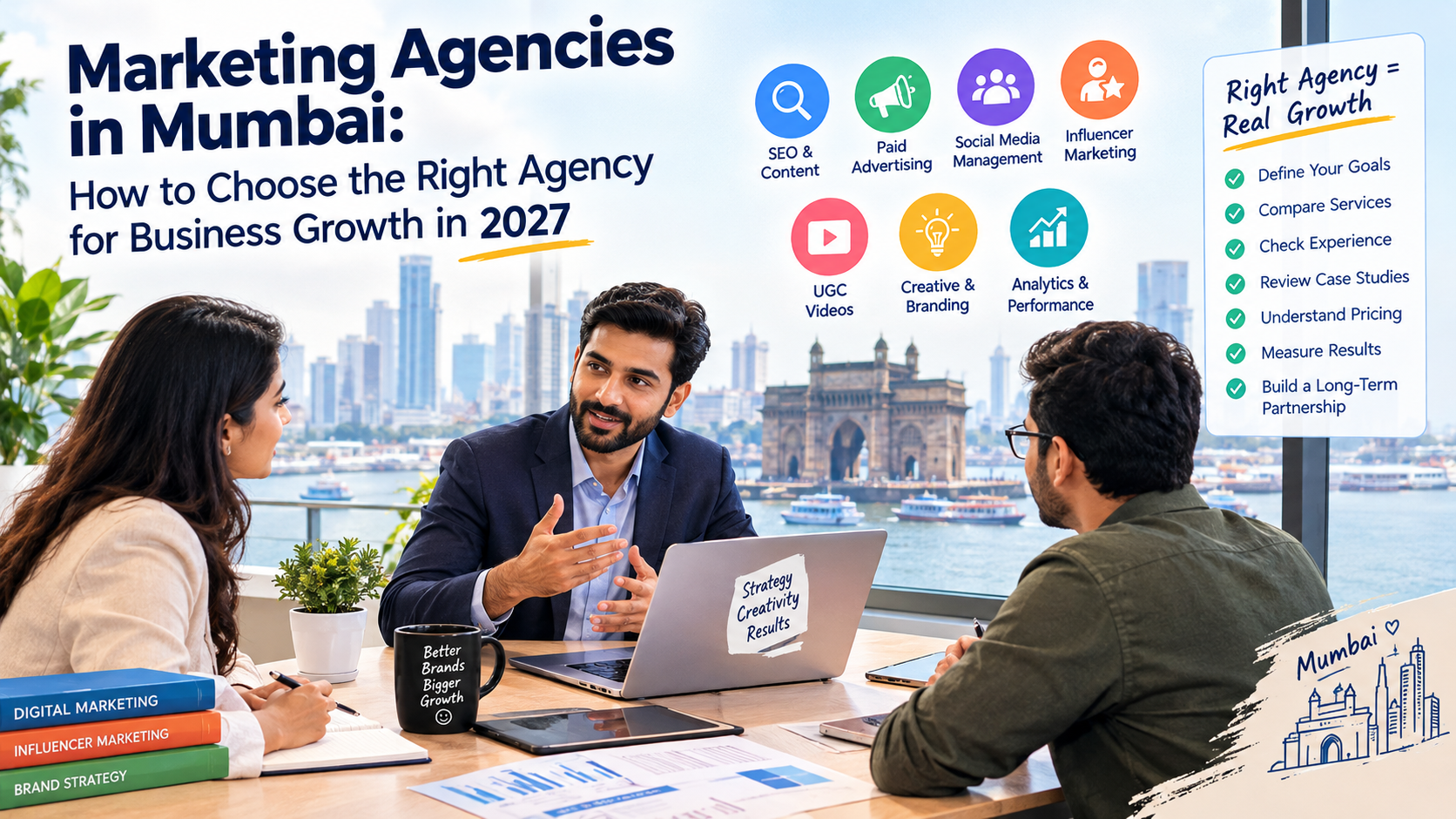
- 1. Introduction: Why Choosing the Right Marketing Agency in Mumbai Matters in 2027
- 2. Understand Mumbai’s Marketing Landscape Before You Shortlist Agencies
- 3. How to Choose Marketing Agencies in Mumbai: A Practical Evaluation Framework
- 4. Services, Pricing and Performance: What Should a Mumbai Marketing Agency Deliver?
- 5. Red Flags, Contracts and a 90-Day Plan for a Better Agency Partnership
- Choosing an Agency for Long-Term Growth: Your Decision Checklist
- Key learnings: How to choose the right agency
- About Hobo.Video
1. Introduction: Why Choosing the Right Marketing Agency in Mumbai Matters in 2027
Choosing between marketing agencies in Mumbai can feel confusing, especially when every proposal promises growth. One agency may talk about social media reach, while another focuses on sales and lead generation. A third may recommend influencer campaigns, search optimization, or paid advertising. However, your business does not need every service at once. It needs the right combination of services for its current goals.
That decision matters because marketing now influences several stages of the customer journey. People discover brands through search engines, social platforms, online videos, recommendations, and creator content. Consequently, businesses need agencies that understand both visibility and commercial results. Marketing agencies in Mumbai can offer different combinations of strategy, creative production, advertising, technology, and campaign management. Therefore, comparing them requires more than looking at a portfolio or monthly fee.
Mumbai also brings a diverse business environment. It includes financial services, entertainment, retail, real estate, fashion, hospitality, consumer brands, and fast-growing startups. Each sector faces different customers, budgets, regulations, and buying cycles. A suitable agency should understand those differences before suggesting a campaign. This guide explains how to shortlist partners, compare services, assess costs, measure results, and avoid common mistakes before signing an agreement.
2. Understand Mumbai’s Marketing Landscape Before You Shortlist Agencies
2.1 Why businesses need more than visibility
A marketing campaign should help people move from awareness to meaningful action. For example, a restaurant may want more local bookings, while a real estate company may need qualified enquiries. An ecommerce brand may focus on profitable purchases and repeat customers. Meanwhile, a business-to-business company may value sales meetings more than social media followers.
India’s advertising market shows why digital marketing deserves serious attention. According to the ET Brand Equity–Ipsos State of Digital Marketing in India 2025–26 report, total advertising spending reached ₹1.11 lakh crore in FY2025. Digital advertising accounted for ₹49,000 crore, or 44% of the market, after growing 20% year over year. The report also projected digital advertising spending of ₹56,400 crore in FY2026. Read the Ipsos report.
These figures describe India’s market, not Mumbai alone. Still, they show why businesses need a clear digital strategy. Simply publishing more posts or running more ads does not guarantee profitable growth. Instead, the agency should connect its work to a defined business outcome.
2.2 Match your agency choice to your business stage
The right partner depends on where your business stands today. A new business may need positioning, a website, local visibility, and its first lead-generation campaign. A growing company may need better conversion tracking, consistent creative, and a stronger content plan. Meanwhile, an established brand may require several specialists working across different channels.

Amplify Your Brand,
One Influence at a Time.
Before you contact agencies, answer three questions. First, what outcome must improve during the next six to twelve months? Second, which audience should the business reach? Third, what can the company realistically invest in strategy, execution, and media? These answers will make your brief much clearer.
For instance, a neighbourhood clinic may need local search visibility and accurate service information. A fashion brand may need product videos, creator collaborations, paid social campaigns, and ecommerce optimisation. Although both businesses need marketing, their priorities differ. Therefore, avoid hiring an agency simply because it offers the largest service list. Choose a partner whose skills match your actual needs.
2.3 Decide which type of agency fits your needs
Marketing agencies in Mumbai differ in size, specialisation, and working style. A full-service agency may coordinate strategy, creative, media, and digital execution under one account team. A specialist agency may offer deeper expertise in SEO, paid advertising, public relations, or influencer campaigns. A smaller agency may provide closer access to senior staff and more flexible working arrangements.
Use the following comparison as a starting point:
| Agency type | Suitable business need | What to check |
|---|---|---|
| Full-service agency | Multiple channels and one central partner | Team depth, coordination and accountability |
| SEO agency | Organic search visibility and content | Technical expertise, content quality and reporting |
| Performance marketing agency | Paid traffic, leads and sales | Tracking, testing process and cost efficiency |
| Creative agency | Brand identity, campaigns and advertising assets | Creative thinking, production quality and rights |
| Influencer marketing agency | Creator partnerships and audience trust | Creator fit, campaign controls and measurement |
| UGC content agency | Product-focused videos and creator-style assets | Content rights, quality control and usage terms |
| Social media agency | Consistent publishing and community engagement | Content planning, response standards and reporting |
Some agencies cover several of these services. However, breadth alone does not prove quality. Ask who will do the work, which tasks the agency handles internally, and which tasks it outsources. Then compare the proposed team with your goals.
3. How to Choose Marketing Agencies in Mumbai: A Practical Evaluation Framework
3.1 Start with a clear business brief
Before requesting proposals, write a short brief describing the problem you need to solve. Avoid starting with a list of platforms. Instead, explain your audience, offer, current performance, budget, and desired outcome. This gives each agency a fair chance to recommend an appropriate plan.
For example, “We need more sales” is too broad to guide a campaign. A better brief might say, “We want to increase qualified enquiries from Mumbai and Pune over the next two quarters while keeping lead quality stable.” You should also share the current website, sales process, previous campaign results, and any restrictions.
Next, ask each agency to explain its assumptions. It should identify the information it still needs, the work it recommends first, and the metrics it will use. A thoughtful partner may challenge your original idea when the evidence suggests a better route. That is often more useful than an agency that agrees with every request.
3.2 Review case studies, not just impressive logos
A portfolio can show creative skill, but it may not explain the agency’s contribution to business growth. Ask for case studies that describe the starting problem, the campaign approach, the time period, and the measured outcome. Also, ask whether the agency controlled the whole project or delivered only one part.
Look for evidence that connects activity with results. Did qualified enquiries increase? Did cost per acquisition fall? Did organic traffic attract relevant visitors? Did the brand learn which audience or message worked best? Strong case studies explain both the result and the method.
Be careful with screenshots that lack context. A large reach number does not reveal how many people became customers. Similarly, a ranking improvement may not produce valuable traffic if the keyword attracts the wrong audience. Ask what happened after the campaign ended and whether the client continued working with the agency.
If an agency cannot share confidential details, it can still provide anonymised results or a clear explanation of its process. However, it should not invent figures or make unsupported claims. Your goal is to assess the agency’s thinking, not merely its presentation skills.
3.3 Meet the people who will manage your account
The senior team may deliver the pitch, but different employees may handle your daily work. Therefore, ask who will own strategy, content, media buying, reporting, and client communication. Confirm whether the people you meet will remain involved after onboarding.
A useful agency partner should explain complex decisions in simple language. It should also welcome questions about costs, timelines, campaign risks, and measurement. If the team avoids clear answers during the sales process, communication may become harder once the contract begins.
Ask how often you will meet, how quickly the agency responds, and who approves urgent changes. Also, confirm how the agency handles missed deadlines or campaigns that underperform. A strong relationship does not require every experiment to succeed. It requires honest reporting, clear ownership, and a sensible response when results disappoint.
3.4 Ask these questions before signing
Use this checklist during agency meetings:
- What business problem will your proposed strategy solve first?
- Which services are included in the monthly fee?
- Is the advertising budget separate from the agency fee?
- Who owns the advertising accounts, website, analytics, and creative files?
- How will you define a qualified lead or successful conversion?
- What will the first 30, 60, and 90 days involve?
- Which reports will we receive, and how often?
- How will you test new ideas and explain failed experiments?
- Which team members will work on the account?
- What are the contract term, notice period, and exit conditions?
Compare the answers side by side. You will quickly see which agencies explain their work clearly and which rely on broad promises. Do not select a partner only because it offers the lowest price or the most confident presentation.
4. Services, Pricing and Performance: What Should a Mumbai Marketing Agency Deliver?
4.1 SEO and content marketing
Search engine optimisation helps businesses reach people who actively look for relevant information, products, or services. A suitable SEO partner should review technical issues, search intent, content quality, internal links, and conversion paths. It should also explain which improvements matter most and how the team will measure progress.
SEO usually takes sustained work. Results depend on competition, website condition, content relevance, and other factors. Therefore, avoid agencies that guarantee a specific Google position. Ask instead for a realistic plan covering technical fixes, content priorities, measurement, and review periods.
Content marketing should also answer real customer questions. For example, a Mumbai property business might publish useful guides about neighbourhoods, buying steps, and common costs. A consumer brand might create product comparisons, practical demonstrations, or detailed buying advice. Each page should serve a distinct purpose rather than repeat similar keywords across multiple URLs.
Ask the agency how it will connect organic visits with enquiries or sales. Rankings and impressions are useful indicators, but they do not show the entire business impact. A good report should explain what changed, why it may have changed, and what the team plans to do next.
4.2 Paid advertising and performance marketing
Paid advertising can help businesses test offers, reach specific audiences, and generate traffic faster than many organic strategies. However, advertising can also waste money when tracking, targeting, landing pages, or creative are weak. A performance marketing agency should examine the full journey instead of focusing only on ad clicks.
Before launching campaigns, confirm who pays the media platforms and who owns the accounts. The agency fee and advertising spend should appear as separate line items. You should also know which conversion events the team will track and how it will identify poor-quality leads.
Useful metrics include cost per qualified lead, customer acquisition cost, conversion rate, revenue, and return on ad spend. Choose metrics based on your business model. A high click-through rate may look attractive, but it cannot compensate for leads that never become customers.
Ask how the team tests headlines, visuals, audiences, landing pages, and offers. It should document changes and avoid making too many changes at once. Otherwise, the team may struggle to understand which action caused the result. Clear testing helps businesses learn and spend more confidently.
4.3 Influencer marketing, UGC Videos and AI-assisted campaigns
Creator-led content can help brands explain products through relatable demonstrations, experiences, and everyday use cases. However, an influencer campaign should start with audience fit and campaign objectives. Follower count alone does not show whether a creator can reach the right people or communicate the product effectively.
A suitable influencer marketing partner should explain creator selection, audience checks, content approvals, disclosure requirements, usage rights, and reporting. It should also confirm whether creator fees, production costs, product shipping, and paid amplification are included. These details can significantly change the final campaign cost.
UGC Videos can support product pages, social media, and paid advertising when the content fits the intended use. However, user-generated content does not automatically mean the brand owns unlimited rights. Contracts should specify usage duration, platforms, paid advertising rights, editing permissions, and any restrictions.
AI influencer marketing and AI UGC tools may help teams organise research, develop concepts, or test creative variations. Nevertheless, businesses should review factual accuracy, brand suitability, consent, privacy, and any platform-specific rules. AI should support a clear strategy rather than replace proper review.
For brands exploring creator-led growth, Hobo.Video offers influencer marketing, UGC content creation, celebrity endorsements, product feedback and testing, marketplace and seller reputation management, and regional and niche influencer campaigns. Choose any partner by assessing the actual campaign plan, team, deliverables, and measurement approach.
4.4 Creative, branding and social media management
Creative work influences how people recognise and remember a brand. A good creative agency should understand the audience, brand position, message, and purpose behind each asset. It should not simply produce attractive graphics without considering where and how the audience will see them.
Social media management also involves more than scheduling posts. It can include content planning, short-form video, community responses, creator coordination, reporting, and campaign support. Before hiring, clarify the number of deliverables, revision rounds, production days, and approval responsibilities.
Ask whether photography, filming, travel, talent, and editing are included in the proposal. These costs may sit outside the monthly retainer. Also, agree on who owns final files and whether you can reuse the content after the contract ends.
A practical content plan should balance brand storytelling, useful information, product education, customer questions, and campaign messages. It should also leave room to respond to timely opportunities without abandoning the broader strategy. Consistency matters, but useful content matters more than publishing every day simply to maintain a schedule.
4.5 How much do marketing agencies in Mumbai cost?
There is no single standard price for marketing agencies in Mumbai. Fees depend on the scope, seniority of the team, number of channels, content production, campaign complexity, and reporting requirements. A small social media package differs greatly from an integrated campaign involving strategy, video production, paid media, SEO, and creator partnerships.
Published agency pricing guides provide a broad indication of the market, but their ranges are not a verified city-wide rate card. For example, a 2026 Indian agency pricing guide lists many small-business retainers around ₹25,000–₹75,000 per month, generally excluding advertising spend. Larger or more specialised engagements can cost substantially more. See the published pricing discussion.
Use the following table as a budgeting framework, not a quotation:
| Budget component | What to clarify |
|---|---|
| Strategy and onboarding | Audit, research, planning and setup fees |
| Monthly agency retainer | Exact services, hours and deliverables |
| Advertising spend | Amount paid to media platforms |
| Creative production | Shoots, editing, design, talent and revisions |
| Influencer or creator fees | Talent fees, usage rights and paid amplification |
| Tools and technology | Software, analytics, CRM and subscriptions |
| Taxes and extras | GST, travel, third-party fees and additional work |
Request itemised proposals from at least three suitable agencies. Compare the same deliverables, service levels, and reporting expectations. A low fee may suit a narrow requirement, but it may not cover the expertise needed for a complex campaign. Likewise, a higher fee only makes sense when the scope and value justify it.
4.6 Measure results beyond reach and followers
Before a campaign starts, agree on what success means. A brand awareness campaign may track reach, frequency, video completion, or relevant audience growth. A lead-generation campaign should track qualified enquiries and sales outcomes. An ecommerce campaign may focus on conversion rate, acquisition cost, revenue, and repeat purchases.
Use a simple measurement framework:
- Awareness: Relevant reach, impressions and video views.
- Consideration: Engaged visits, product page activity and enquiries.
- Conversion: Qualified leads, purchases and booking completions.
- Efficiency: Cost per lead, acquisition cost and return on spend.
- Retention: Repeat purchases, renewals and customer lifetime value.
Avoid treating every metric as equally important. Choose a primary KPI and a few supporting metrics. Then review results alongside the original objective and campaign costs.
The agency should also explain the limits of its reporting. Attribution can be difficult when people see an ad, research elsewhere, and convert later. Use consistent tracking, clear definitions, and a sensible review period. This approach makes it easier to distinguish genuine progress from attractive but incomplete numbers.
5. Red Flags, Contracts and a 90-Day Plan for a Better Agency Partnership
5.1 Warning signs to take seriously
Some agency promises sound attractive because they remove uncertainty. Unfortunately, marketing does not work that way. Search positions, viral reach, and sales outcomes depend on several factors that no agency controls completely. Treat guarantees of number-one rankings or guaranteed virality as warning signs.
Other concerns include vague proposals, unclear reporting, hidden media fees, and refusal to share account access. Be cautious when an agency cannot explain its strategy or keeps changing its claims. Also, question case studies that show impressive results without dates, context, or an explanation of the agency’s contribution.
Watch how the team handles questions. A reliable partner should discuss risks, dependencies, and trade-offs honestly. It should tell you what it needs from your team, including product information, approvals, access, and sales feedback.
Before signing, verify references where possible. Review the contract, data access, intellectual property terms, payment schedule, cancellation rules, and confidentiality clauses. If the work involves creators, also clarify disclosure requirements and content usage rights. These checks may feel routine, but they can prevent expensive disagreements later.
5.2 What your contract should cover
A clear contract protects both sides. It should define the scope of work, deliverables, timelines, fees, payment terms, reporting, and approval process. It should also explain how the agency handles extra requests or work outside the agreed scope.
Make account ownership explicit. Your business should understand who controls the domain, analytics property, advertising accounts, social profiles, and campaign assets. Where practical, maintain business-owned access rather than relying on a single employee’s personal account.
For creator campaigns, include creator selection, content requirements, disclosures, payment terms, revisions, usage rights, and cancellation conditions. If AI tools are involved, discuss data handling, consent, human review, and the intended use of generated assets.
Finally, agree on an exit process. The agency should explain how it will transfer files, access, reporting history, and outstanding work if the partnership ends. A fair agreement does not need to predict every possible problem. It should make responsibilities clear enough to resolve normal issues without confusion.
5.3 A practical 90-day onboarding plan
The first three months should establish a working process and generate useful learning. They should not be treated as a guarantee that every channel will become profitable within 90 days. Different strategies need different timeframes, especially SEO, brand building, and complex B2B campaigns.
Days 1–30: Research and setup
- Confirm goals, audience, offers and priority markets.
- Review current marketing, website, tracking and content.
- Agree on KPIs, reporting definitions and approval steps.
- Finalise the campaign plan, budget and responsibilities.
- Fix critical tracking or account-access issues.
Days 31–60: Launch and learn
- Launch agreed campaigns or content activities.
- Test relevant messages, audiences, offers and formats.
- Review lead quality and early engagement.
- Record results and identify avoidable spending.
- Discuss what the early evidence supports.
Days 61–90: Improve and prioritise
- Expand the strongest supported ideas.
- Fix weaknesses in creative, targeting or landing pages.
- Review cost and conversion trends.
- Confirm priorities for the next quarter.
- Decide what to stop, continue, or test next.
The best review meetings focus on decisions, not just dashboards. Ask what the team learned, which evidence supports its recommendation, and what it wants to test next. That routine helps both sides stay accountable without expecting instant results from every activity.
Choosing an Agency for Long-Term Growth: Your Decision Checklist
Marketing agencies in Mumbai should be evaluated on their ability to understand your business, execute consistently, and learn from results. The right partner may not be the biggest agency or the cheapest provider. It is the team whose skills, communication, working style, and commercial approach match your needs.
Before making the final decision, use this checklist:
- Business fit: Does the agency understand your sector and target customers?
- Strategic clarity: Can it explain why each proposed activity matters?
- Relevant experience: Can it show credible examples of similar work?
- Team quality: Have you met the people who will actually execute the work?
- Scope clarity: Are deliverables, exclusions, and timelines written down?
- Budget transparency: Are fees, media spend, production, and extras separated?
- Measurement: Are KPIs tied to business goals and defined consistently?
- Communication: Are reporting and approval processes practical?
- Ownership: Will your business retain appropriate account and asset access?
- Flexibility: Can the agency adapt when evidence changes the plan?
Once you shortlist two or three agencies, score them against the same criteria. Give more weight to the factors that matter most for your business. For instance, a company running paid acquisition may prioritise tracking and conversion expertise. A consumer brand launching a new product may prioritise creative quality, creator relationships, and campaign execution.
Do not rush the decision because a proposal expires or an agency claims limited availability. Take the time to check references, clarify costs, and review the contract. A suitable marketing partner should welcome a thoughtful selection process because it creates a stronger working relationship.
Key learnings: How to choose the right agency
Remember these practical points when comparing marketing agencies in Mumbai:
- Define the business outcome before selecting services.
- Match the agency type to your current priorities.
- Compare case studies, team experience, and execution plans.
- Ask for itemised pricing and keep media spend separate.
- Set clear KPIs and reporting definitions before launch.
- Check account ownership, content rights, and contract terms.
- Be cautious of guaranteed rankings, viral reach, or instant results.
- Use the first 90 days to establish tracking, test ideas, and learn.
- Review business outcomes instead of focusing only on impressions and followers.
- Choose a partner that communicates clearly and takes responsibility.
The best agency relationship is a partnership, not a monthly invoice. Your business brings product knowledge, customer insight, and timely decisions. The agency brings strategy, execution, measurement, and outside perspective. Both sides need to share information and act on evidence.
About Hobo.Video
Hobo.Video is India’s leading AI-powered influencer marketing and UGC company. With over 2.25 million creators, it delivers end-to-end campaign management designed for brand growth. The platform blends AI intelligence with human strategy to ensure maximum ROI.
Services include:
- Influencer marketing
- UGC content creation
- Celebrity endorsements
- Product feedback and testing
- Marketplace and seller reputation management
- Regional and niche influencer campaigns
Trusted by top brands like Himalaya, Wipro, Symphony, Baidyanath, and Good Glamm Group.
Inspired by what you read? Let’s turn ideas into impact. Connect with us and unlock your brand’s next growth chapter. Start here.
If you’re an influencer looking for real brand growth, this is your moment. Join now.
Frequently Asked Questions
How do I choose the best marketing agency in Mumbai?
Start by defining the result you need, such as qualified leads, ecommerce sales, organic visibility, or brand awareness. Then shortlist agencies with relevant experience and ask for detailed proposals. Compare their teams, scope, fees, measurement methods, and communication processes. Finally, check references and contract terms. The best agency is the one that fits your goals and can explain how it will work toward them.
How much do marketing agencies in Mumbai charge?
Costs vary by service, team size, competition, and campaign complexity. Published Indian pricing guides show small-business retainers around ₹25,000–₹75,000 monthly in some cases, while specialist and integrated engagements may cost much more. Advertising spend, creator fees, production, software, and taxes may be extra. Ask for an itemized quote and compare the same deliverables before judging which proposal offers better value.
What services do marketing agencies in Mumbai provide?
Depending on their specialization, agencies may offer SEO, content marketing, social media management, paid advertising, website development, branding, public relations, influencer marketing, UGC content, and analytics. Some manage several channels under one agreement, while others focus on a specific service. Choose based on your business goals rather than the longest service list. Also, confirm which work the agency performs internally and which work it outsources.
Should a small business hire a full-service agency?
Not always. A small business may benefit more from one specialist who solves its most urgent problem. For example, a local service provider may first need a strong website, local search visibility, and lead tracking. A full-service agency may make sense when several channels need coordination or the business lacks internal marketing resources. Compare the cost and expected value of each option before committing.
What is the difference between a marketing agency and a digital marketing agency?
A marketing agency may cover traditional and digital channels, including brand strategy, public relations, advertising, events, and media planning. A digital marketing agency usually focuses on online channels such as search, paid media, websites, email, and social platforms. However, service boundaries vary. Ask each provider which channels it manages, how they work together, and whether it measures the combined effect on your business.
