
A Shopify store rarely fails on day one. It fails quietly. Pages load slower after traffic grows. Checkout bugs appear during sales. Support responses delay when urgency peaks. Most Indian founders realise this only after launch. That moment forces one hard decision — Shopify development company vs freelancer.
At first, the choice feels financial. Later, it becomes strategic. Store stability, growth velocity, and brand trust all trace back to this decision. Founders who understand the Shopify development company vs freelancer trade-off early avoid rebuilds, revenue leaks, and months of recovery.
- 1. Shopify Development Company vs Freelancer: The Structural Reality
- 2. Cost Reality in India: Shopify Agency vs Freelancer
- 3. Shopify Development Cost Comparison (India)
- 4. Expertise Depth: Shopify Developers vs Agency
- 5. Project Management and Accountability
- 6. Scalability: Where Freelancer Builds Break
- 7. Marketing, CRO, and Conversion Thinking
- 8. Security, Compliance, and Risk
- 9. Speed vs Sustainability
- 10. Post-Launch Support and Continuity
- 11. India-Specific Nuances Agencies Handle Better
- 12. When Freelancers Make Sense
- 13. When Agencies Become Non-Negotiable
- 14. Hiring a Shopify Development Company in India: What to Ask
- Conclusion
- About Hobo.Video
1. Shopify Development Company vs Freelancer: The Structural Reality
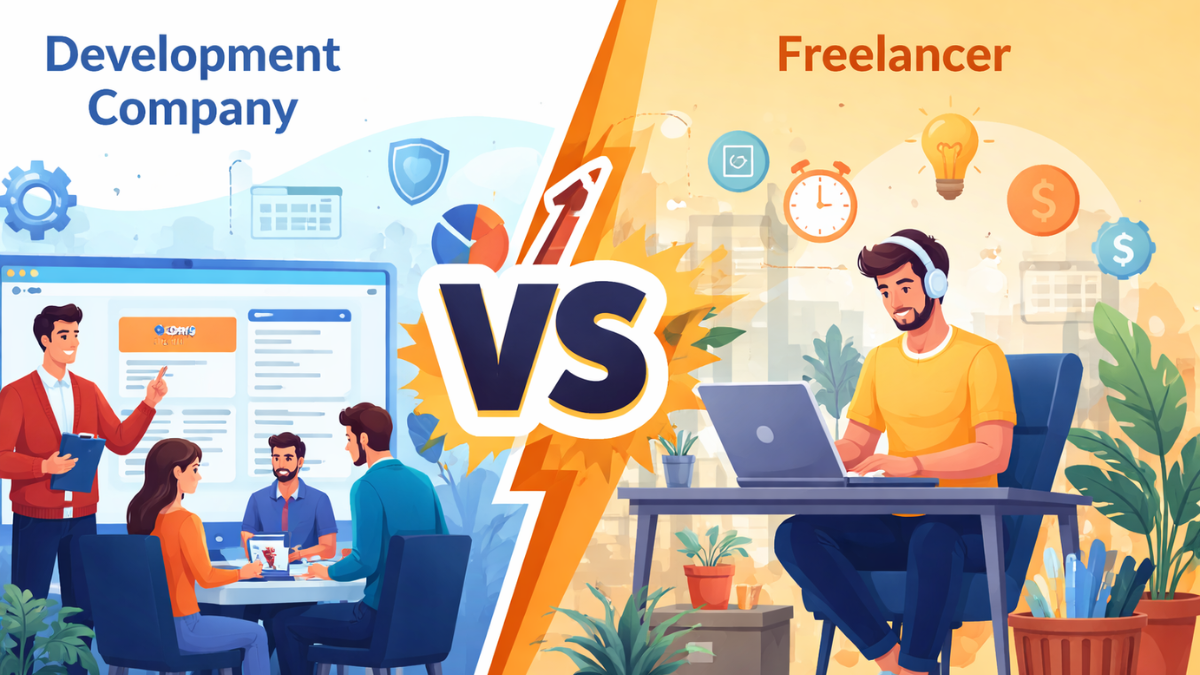
A Shopify web development company works as a system. Designers focus on UX. Developers handle Liquid and APIs. QA teams test edge cases. Project managers protect timelines. Work continues even when one person steps away.
A freelancer works alone. Sometimes exceptionally well. Often under pressure. One person handles design, development, testing, revisions, and support. When priorities clash, quality suffers.
Across 120+ Shopify rebuilds reviewed over the last few years, the most common failure was not skill. It was capacity. A Shopify development agency plans continuity. A freelancer plans completion.
That distinction defines the Shopify development company vs freelancer debate.
2. Cost Reality in India: Shopify Agency vs Freelancer
Cost dominates every Shopify agency vs freelancer conversation. Indian freelancers typically quote ₹40,000–₹1.2 lakh. Agencies start around ₹2.5 lakh and scale upward.

Amplify Your Brand,
One Influence at a Time.
Freelancers win upfront. Agencies win over time.
Clutch client reviewsfrequently highlight that choosing the cheapest software development vendors often leads to regret, with common complaints about extensive rework, missed deadlines, and post-launch failures due to poor quality or misaligned expertise.
Freelancers juggle multiple projects. Timelines slip. Revisions stretch. Agencies distribute work internally. Delivery stays predictable.
Bundled shopify development services—QA, UX audits, speed optimisation, and support—often erase the initial price gap.
Hidden costs decide most Shopify freelancer vs company outcomes.
3. Shopify Development Cost Comparison (India)
| Factor | Freelancer | Development Company |
|---|---|---|
| Initial Cost | Low | Medium–High |
| Delivery Consistency | Variable | High |
| QA & Testing | Minimal | Dedicated |
| Scalability Readiness | Weak | Strong |
| Post-Launch Support | Uncertain | Retainer-based |
| Business Risk | High | Managed |
This explains why Shopify company vs individual developer decisions often reverse within 6–12 months.
4. Expertise Depth: Shopify Developers vs Agency
In Shopify developers vs agency evaluations, depth matters more than talent.
Freelancers often excel in one area. Design or development. Rarely both. Agencies hire specialists across roles.
A shopify development agency india invests in certifications. Teams include shopify experts india trained on Liquid, APIs, custom apps, and performance tuning.
Shopify merchants using certified partners benefit from optimised setups and tools that drive stronger performance, such as 36% better conversion rates compared to competitors and faster load times through partner-led optimisations.
Freelancers struggle to track frequent Shopify updates. Agencies assign that responsibility.
Thus, Shopify development company vs freelancer becomes a risk calculation.
5. Project Management and Accountability
Process decides outcomes.
In every serious Shopify agency comparison, project management stands out. Agencies use sprint planning, documentation, and escalation paths. Clients see progress weekly.
Freelancers rely on personal discipline. Illness, overload, or emergencies pause work.
PMI research shows structured project management improves success rates by 28%
That alone shifts many Shopify company vs individual developer decisions.
6. Scalability: Where Freelancer Builds Break
Growth exposes weak foundations.
Traffic spikes slow stores. App conflicts appear. International payments complicate flows. Freelancers often retrofit solutions later, increasing cost and downtime.
A Shopify web development company plans scale early—app limits, caching, architecture.
Statista projects India’s ecommerce revenue at US$67.16bn in 2025, reflecting robust growth fueled by mobile penetration and Tier-2/3 expansion.
Brands planning growth cannot afford fragile builds. Hence, Shopify development company vs freelancer becomes future-focused.
7. Marketing, CRO, and Conversion Thinking
A store without traffic fails invisibly.
Agencies integrate CRO, SEO, and growth early. Many shopify development agency india teams collaborate with influencer and content platforms.
Freelancers stop at launch. Optimisation becomes optional.
Google reports 53% of mobile users abandon sites that load slowly.
Influencer-led trust accelerates conversion. Platforms like Hobo.Video combine influencer marketing, UGC Videos, AI influencer marketing, and AI UGC to humanise Shopify stores.
Agencies plan this. Freelancers rarely do. This is why followingbest practices for influencer marketing and UGC content creation in Indiabecomes critical once Shopify traffic starts scaling beyond ads.
8. Security, Compliance, and Risk
Shopify secures hosting. Custom code introduces risk.
Agencies audit code. Freelancers often skip reviews. IBM reports average global breach costs at $4.45 million
Data compliance adds complexity. GDPR and Indian IT rules evolve constantly. Agencies track updates. Freelancers may miss them.
This is where Shopify freelancer vs company choices impact trust.
9. Speed vs Sustainability
Freelancers deliver fast. Agencies deliver steady.
In Shopify agency vs freelancer debates, speed tempts founders. Rushed builds break later.
Nielsen Norman Group shows UX-led improvements can raise conversions by up to 400%
Agencies prioritise UX. Freelancers prioritise tasks.
Thus, Shopify development company vs freelancer becomes a trade between urgency and endurance.
10. Post-Launch Support and Continuity
Launch is the beginning.
Bugs surface. Apps clash. Updates break layouts. Agencies offer retainers. Freelancers move on.
HubSpot data shows 68% of customers leave due to poor support.
Support quality quietly shapes revenue.
11. India-Specific Nuances Agencies Handle Better
India demands nuance. COD logic. GST flows. Regional UX patterns.
Shopify experts india inside agencies handle this daily. Freelancers often lack multi-region exposure.
India is expected to cross 900 million internet users. Localisation decides winners. Therefore, Shopify development company vs freelancer must consider cultural scale. This approach mirrors howUGC influencers elevate brand strategyby blending regional familiarity with authentic storytelling.
12. When Freelancers Make Sense
Freelancers work well for:
- MVP launches
- Small catalogs
- Tight timelines
- Clear briefs
When strategy stays internal, freelancers execute efficiently. Expecting long-term strategic guidance often disappoints.
13. When Agencies Become Non-Negotiable
Custom apps introduce dependencies that require ongoing testing, updates, and coordination across teams. High traffic amplifies even small technical flaws, turning minor issues into revenue-impacting failures within minutes. International expansion introduces further complexity through multi-currency pricing, regional taxes, shipping logic, and compliance requirements that are subject to frequent changes. Agencies are built to absorb this complexity through specialised roles and backup systems, while freelancers remain single points of failure. Beyond a scale threshold, Shopify development company vs freelancer stops being a preference and becomes a business necessity.
14. Hiring a Shopify Development Company in India: What to Ask
Before hiring:
- Who handles QA and security reviews?
- What post-launch support is included?
- How are Shopify updates managed?
- What happens if a team member exits?
Clear answers separate professionals from vendors.
Conclusion
Key Learnings
- Freelancers optimise for speed and cost
- Agencies optimise for growth and stability
- Shopify development company vs freelancer decisions shape long-term revenue
- Indian brands scaling fast need structure
- Short-term savings often cost long-term growth
About Hobo.Video
Hobo.Video is India’s leading AI-powered influencer marketing and UGC company. With over 2.25 million creators, it delivers end-to-end campaigns designed for brand growth. The platform blends AI with human strategy for maximum ROI.
Services include:
- Influencer marketing
- UGC content creation
- Celebrity endorsements
- Product feedback and testing
- Marketplace and seller reputation management
- Regional and niche influencer campaigns
Trusted by Himalaya, Wipro, Symphony, Baidyanath, and the Good Glamm Group.
Let’s take your brand from “trying” to “thriving.” We’re just a click away.
Influencer? Let’s help you get the visibility (and income) you deserve. Join today.
FAQs
Is a Shopify development company better than a freelancer?
For scaling brands, yes. Agencies offer systems, accountability, and long-term support. Freelancers suit limited, short-term builds.
Are Shopify freelancers reliable in India?
Some are excellent. Reliability varies widely. Agencies provide predictability through teams and contracts.
What is Shopify development cost in India?
Freelancers charge ₹40,000–₹1.2 lakh. Agencies start around ₹2.5 lakh, depending on scope and scale.
Do agencies use Shopify experts India?
Yes. Most agencies employ certified shopify experts india across UX, development, and QA.
Can freelancers handle complex Shopify stores?
Rarely alone. Complexity demands collaboration.
Does influencer marketing help Shopify stores?
Yes. Influencer-led traffic converts warmer than cold ads.
