
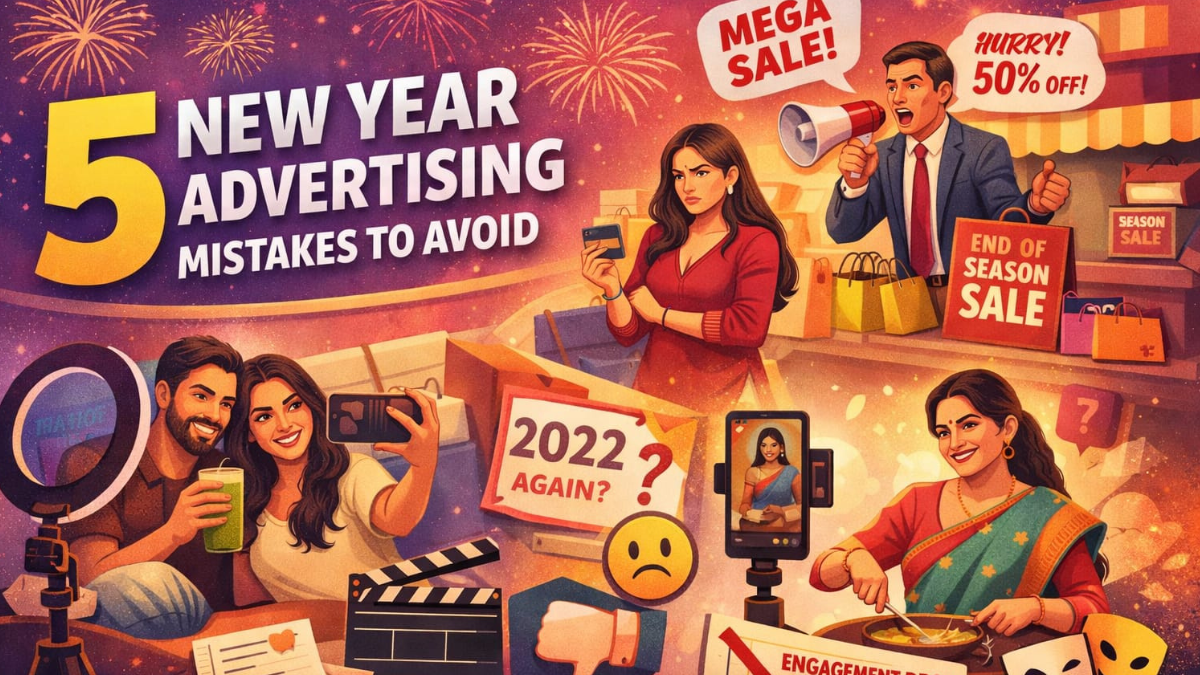
Why New Year Ads Disappoint More Than Brands Admit in 2026
Every January, marketing teams walk in with fresh budgets and big expectations. On paper, everything looks right. New creatives, new plans, new targets. Yet by February, many brands quietly realise their new year ads did not land the way they hoped.
This happens not because audiences stop caring, but because the same New Year advertising mistakes repeat every year. In India especially, January is emotional, reflective, and cautious. When brands treat it like just another sales window, advertising mistakes show up fast. Engagement slows, trust weakens, and even well-funded new year marketing campaigns struggle to create recall.
In short: The most common New Year advertising mistakes include treating January like a clearance sale, recycling last year’s creatives, ignoring regional audiences, chasing virality over brand recall, and underestimating the power of UGC and influencer marketing.
- Why New Year Ads Disappoint More Than Brands Admit in 2026
- 7 New Year Advertising Mistakes at a Glance
- 1. Treating New Year Ads Like Discount Announcements
- 2. Ignoring Influencer Marketing in New Year Campaigns
- 3. Repeating Last Year’s New Year Ad Campaigns
- 4. Misjudging the January Consumer Mindset
- 5. Chasing Virality Instead of Brand Recall
- 6. Ignoring Regional and Cultural Context in India
- 7. Underestimating the Power of UGC Videos
- Conclusion
- About Hobo.Video
7 New Year Advertising Mistakes at a Glance
| # | Mistake | Why It Hurts |
|---|---|---|
| 1 | Treating ads like discount announcements | Audiences tune out post-festive urgency |
| 2 | Ignoring influencer marketing | Brand-only messaging feels distant |
| 3 | Recycling last year’s creatives | Audiences recognise patterns and disengage |
| 4 | Misjudging the January mindset | January buyers reflect, they don’t impulse-buy |
| 5 | Chasing virality over brand recall | Views spike but brand memory doesn’t build |
| 6 | Ignoring regional and cultural context | Generic English ads miss India’s growth markets |
| 7 | Underestimating UGC videos | Polished ads feel fake in January’s honest mood |
1. Treating New Year Ads Like Discount Announcements
1.1 Why Over-Promotional New Year Ads Backfire
A common pattern shows up every January. Brands replace festive banners with “New Year Sale” creatives and push harder on offers. Flat discounts. Loud CTAs. Urgency everywhere. This feels logical, but in reality, it creates New Year marketing missteps.
After months of festive spending, Indian consumers enter January more guarded. They reassess finances, goals, and priorities. Think with Google notes that post-festive shoppers respond better to value and relevance than urgency-led messaging. Brands that ignore this end up with New Year ad failures, where reach exists but intent does not convert.
Over time, this approach becomes one of the most damaging New Year advertising pitfalls because it trains audiences to ignore January messaging altogether. According toNielsen’s2025 marketing effectiveness report, campaigns that push urgency without aligning to real consumer behaviour consistently underperform on ROI.
1.2 What Works Better Than Discounts in January
Stronger new year marketing ideas shift the tone. Instead of shouting offers, they acknowledge where the consumer is mentally. Stories around progress, learning, honesty, or fresh starts feel more natural. This helps in avoiding advertising mistakes that make brands sound desperate or disconnected.

Amplify Your Brand,
One Influence at a Time.
Creator-led storytellingworks particularly well here. When influencers talk about real habits, challenges, or resets, audiences listen. It feels human, not promotional. Hobo.Video explains why creator narratives consistently outperform brand monologues in this space. Brands that understand what madecertain campaigns travel far,like the ones that leaned into reflection over celebration, tend to avoid these mistakes more naturally.
2. Ignoring Influencer Marketing in New Year Campaigns
2.1 Why Brand-Only Messaging No Longer Builds Trust
Audiences today trust people before platforms. Yet many brands still depend heavily on polished visuals and scripted brand language. This creates New Year marketing errors, especially in emotionally driven periods like January.
Think with Google highlights that ads featuring relatable people outperform traditional brand-led creatives in attention and recall. When brands ignore this shift, New Year campaign mistakes become inevitable. Messages feel distant. Claims feel exaggerated. Engagement drops even when targeting is right.
This is one of those advertising mistakes that does not show immediately in dashboards, but quietly hurts long-term trust.
2.2 How Influencer Marketing Reduces New Year Advertising Pitfalls
Influencer marketing works because it removes friction. Creators already have trust. Their audience listens before judging. Partnering with top influencers in India helps brands avoid New Year marketing missteps caused by overly polished brand talk.
Hobo.Video supports brands with scalable AI influencer marketing, without losing regional and cultural nuance. This balance allows new year marketing campaigns to feel personal while still reaching scale.
3. Repeating Last Year’s New Year Ad Campaigns
3.1 Why Recycled Creatives Stop Working Fast
Reusing formats feels efficient. Teams already know what worked last year. But audiences remember patterns better than marketers expect. When the same hooks, visuals, or narratives repeat, advertising mistakes show up as creative fatigue.
Think with Google confirms that creative freshness directly impacts ad attention. Even strong messages lose power when repeated. This is why many viral new year ads fail to deliver results when recycled the next year.
Repetition quietly turns new year ad campaigns invisible.
3.2 Refreshing Creative Without Losing Brand Identity
Refreshing creative does not mean abandoning identity. It means changing perspective. Short-form videos, UGC formats, and creator diaries allow brands to tell familiar stories differently. This helps avoid New Year advertising pitfalls without confusing audiences.
UsingAI UGChelps brands test multiple narratives quickly. However, human review remains critical. Hobo.Video balances AI speed with human checks to prevent New Year ad failures caused by over-polished content.
4. Misjudging the January Consumer Mindset
4.1 Why January Is Not About Aggressive Selling
January is quieter. People slow down spending. They evaluate rather than impulse-buy. Brands that push urgency-heavy messaging run into New Year marketing errors like low conversion rates and weak engagement.
Think with Google shows that Indian consumers seek reassurance and clarity after festive overload. When brands ignore this, New Year campaign mistakes increase, even if targeting and creatives look strong on paper.Dash Socialanalysis of New Year marketing shows that audiences respond better to reflective and value-led messaging than high-pressure sales tactics during January.
4.2 Aligning New Year Marketing Ideas With Real Intent
Educational and value-led content performs better in January. Reviews, testimonials, and creator explainers reduce friction. They also reduce New Year advertising mistakes linked to mistrust.
Many famous Instagram influencers naturally post reset routines, productivity habits, and honest product experiences during this period. Collaborating with them allows brands to stay present without forcing immediate sales.
5. Chasing Virality Instead of Brand Recall
5.1 Why Viral New Year Ads Often Fail Long-Term
Virality looks good in reports. Views spike. Shares increase. But without clear brand linkage, virality becomes hollow. This leads to New Year ad failures where content travels but brands do not.
Think with Google highlights that strong brand cues are essential for long-term impact. Ignoring this creates New Year advertising pitfalls that inflate short-term metrics but damage memory.
5.2 Balancing Creativity With Brand Memory
The best creative new year ads entertain while anchoring identity. Creator formats help here because brands integrate naturally into stories rather than interrupting them. This reduces advertising mistakes linked to forced placements.
When creators introduce products in context, audiences stay engaged instead of switching off. The brand becomes part of the narrative, not a break in it, which strengthens recall without feeling intrusive.
6. Ignoring Regional and Cultural Context in India
6.1 Why One-Language New Year Ads Miss Growth
India’s digital growth is no longer metro-led. Tier-2 and Tier-3 cities now account for a significant share of online consumption, and these audiences overwhelmingly prefer content in their own language. English-only New Year ads limit reach and relevance by design, often without brands realising it. This is one of the most overlooked New Year marketing missteps because the gap doesn’t show up in impressions , it shows up in engagement quality and conversion intent.
Language shapes trust, not just comprehension. When an ad speaks in a familiar tongue, it stops feeling like a broadcast and starts feeling like a conversation. Google India data consistently shows that regional language content sees 25–40% higher engagement outside metros. For New Year campaigns specifically, where emotional resonance matters more than reach, that gap in relatability becomes a gap in performance.
6.2 How Regional Influencers Prevent New Year Ad Failures
Regional creators bring something no translation can replicate genuine cultural familiarity. They reference local festivals, use neighbourhood humour, and speak in rhythms that feel native rather than adapted. When a Tamil creator talks about January in Chennai, or a Marathi creator reflects on the year gone by, audiences in those markets listen differently. That listening translates directly into stronger watch time, higher saves, and better conversion intent.
Working with regional influencers also prevents the tone-deaf messaging that causes New Year ad failures in vernacular markets. A campaign that feels warm and reflective in Mumbai can feel cold and corporate in Coimbatore if the language and cultural cues don’t shift accordingly. Hobo.Video’s AI discovery enables brands to identify and activate regional creators at scale — across languages, cities, and audience sizes without losing the authenticity that makes local content work in the first place.
7. Underestimating the Power of UGC Videos
7.1 Why UGC Outperforms Polished Ads in January
January is the month audiences are most resistant to being sold at. After two months of festive advertising, polished brand visuals trigger instant scrolling. People have seen enough perfect lighting, rehearsed smiles, and aspirational backdrops. What they respond to in January is honest content that reflects real life, real spaces, and real emotions without performance. This is why UGC consistently outperforms studio-produced ads during this period, and why ignoring it is one of the costliest New Year advertising mistakes a brand can make.
The numbers support this clearly. UGC-based ads get 4x higher click-through rates than non-UGC formats, according to Stackla research. In January specifically, when audiences seek reassurance over excitement, that authenticity gap widens further. A real customer talking about why they actually use a product, imperfect lighting, mid-sentence pauses and all lands harder than the most expensive brand film because it answers the question audiences are genuinely asking: does this work for someone like me?
7.2 Scaling UGC Without Losing Trust
The challenge with UGC at scale is maintaining the rawness that makes it work. Many brands fall into the trap of over-directing creators or over-editing submissions until the content loses the imperfection that made it credible in the first place. When UGC starts looking scripted, audiences disengage almost immediately. Real reactions, minor hesitations, and natural language are what signal authenticity and those signals are fragile. One heavy-handed edit can turn a genuine testimonial into something that feels like a brand ad wearing a disguise.
Hobo.Video addresses this through a dual-layer approach: AI-assisted moderation handles volume and quality consistency, while human review protects tone and authenticity. This means brands can activate hundreds of UGC creators during the New Year window without the output feeling factory-produced. The goal is content that scales in quantity while staying honest in character. When that balance holds, UGC doesn’t just reduce New Year advertising mistakes, it becomes the strongest trust signal a brand can deploy in January.
8. What Works Instead: New Year Advertising That Actually Lands
| Mistake | What to Do Instead |
|---|---|
| Discount-heavy messaging | Lead with emotion and value stories |
| Brand-only creatives | Use influencer and UGC content |
| Recycled campaigns | Refresh hooks, formats and creators annually |
| Ignoring January mindset | Create reassurance-led, soft-sell content |
| Chasing virality | Prioritise brand memory over shares |
| English-only ads | Add regional language creator content |
| Over-polished UGC | Keep it real, raw and authentic |
Conclusion
New Year advertising fails quietly, not in the brief, not in the budget, but in the assumptions brands carry into January. Indian audiences in January are reflective, cautious, and deeply resistant to being sold at. The brands that win this window are the ones that acknowledge that honestly. They swap urgency for empathy, polished brand visuals for real creator voices, and generic campaigns for regionally rooted storytelling. Avoid these seven mistakes and January stops being a write-off, it becomes the month that sets the tone for everything that follows.
About Hobo.Video
Hobo.Video is India’s leading AI-powered influencer marketing and UGC company. With over 2.25 million creators, it offers end-to-end campaign management designed for brand growth. The platform combines AI and human strategy for maximum ROI.
Services include:
- Influencer marketing
- UGC content creation
- Celebrity endorsements
- Product feedback and testing
- Marketplace and seller reputation management
- Regional and niche influencer campaigns
Trusted by top brands like Himalaya, Wipro, Symphony, Baidyanath and the Good Glamm Group.
Great things happen when the right people team up. Join us.
Influencers thrive in the right space — this is one of them. Get started.
FAQs
Why do New Year ads fail despite high budgets?
Because messaging ignores consumer mindset, relies too much on discounts, and lacks authenticity.
Are influencer-led New Year campaigns effective?
Yes. They reduce New Year marketing missteps by building trust faster.
What works best for new year marketing campaigns?
UGC, creator stories, and value-led communication.
Should brands avoid discounts completely?
No. Discounts should support messaging, not dominate it.
Is January good for launching campaigns?
Yes, if content focuses on reassurance and relevance.
Why is UGC important in January?
Audiences seek honesty after festive overload.
How many influencers should brands work with?
Micro and regional creators often perform best.
What is the biggest New Year advertising mistake Indian brands make?
Treating January like an extension of the festive sale season. Indian consumers enter January in a reflective, budget-conscious mindset. Brands that push urgency-heavy discount messaging during this period see low engagement and weak conversions because the messaging conflicts with how audiences actually feel.
When should Indian brands start planning New Year ad campaigns?
Ideally in October–November. New Year campaigns that perform best in India are planned 6–8 weeks in advance, allowing time for creator outreach, UGC production, regional language adaptation, and platform-specific edits before the December–January window opens.
How do regional influencers improve New Year campaign performance?
Regional influencers bring cultural familiarity and local language authenticity that national campaigns can’t replicate. In Tier-2 and Tier-3 cities, audiences respond significantly better to creators who reflect their daily life and speak in their language, making regional influencer partnerships one of the highest-ROI decisions for New Year campaigns in India.
