
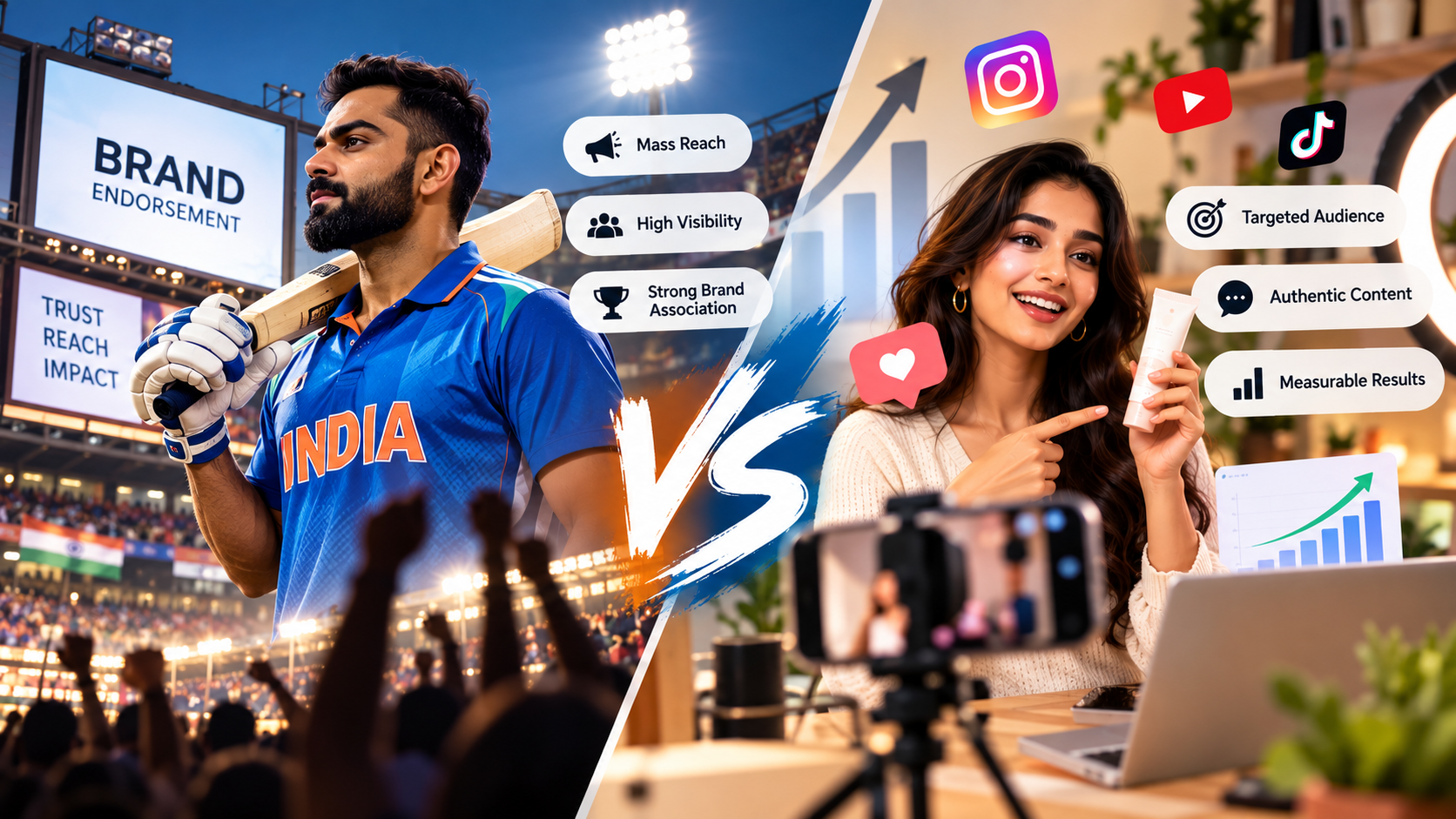
Cricket endorsements vs digital creators is becoming an important discussion in Indian marketing as brands reconsider their advertising budgets in 2026.
Indian brand marketing is entering an interesting phase. While cricket stars continue to command attention, digital creators are changing how businesses communicate with consumers. Moreover, brands are no longer evaluating endorsements solely by the popularity of the person appearing in an advertisement. Instead, they are also considering audience relevance, campaign objectives, content formats, and measurable business outcomes.
As a result, an important question arises: should brands invest in cricket personalities, digital creators, or both?
The answer depends on what a business wants to achieve. For example, a famous cricketer can introduce a brand to a broad audience, whereas a specialist creator can explain a product in detail. Similarly, a regional influencer can connect with consumers through familiar language and local experiences. Therefore, each approach offers different opportunities.
Meanwhile, recent industry reporting highlights this changing balance. According to The Economic Times, cricket endorsements remain commercially strong even as brands reconsider how they allocate advertising budgets between celebrities and digital creators. Furthermore, the report notes that advertisers are increasingly interested in targeted audiences and measurable engagement.
For Indian businesses, this is not simply a contest between celebrity fame and creator authenticity. It is a question of how to build a marketing strategy that connects brand visibility with meaningful customer action.
In this article, we examine the latest endorsement trends, compare cricket personalities with digital creators, and explain how Indian brands can develop a balanced, measurable campaign strategy.

Amplify Your Brand,
One Influence at a Time.
- 1. Why Cricket Endorsements Remain Important in India
- 2. Why Digital Creators Are Attracting More Brand Attention
- 3. Cricket Endorsements vs Digital Creators: What Is the Difference?
- 4. The Bigger Change: Brands Are Rethinking Budget Allocation
- 5. How Indian Brands Can Combine Cricket Stars and Creators
- 6. How to Measure Whether an Endorsement Is Working
- 7. Risks Brands Should Consider Before Signing Endorsement Deals
- 8. A Practical Checklist for Choosing Between Cricket Stars and Digital Creators
- 9. What This Shift Means for the Future of Indian Brand Marketing
- Conclusion: Choose Partners Based on the Job They Need to Do
- Frequently Asked Questions
- About Hobo.Video
1. Why Cricket Endorsements Remain Important in India
Cricket occupies a distinctive position in Indian popular culture. International matches, domestic tournaments, and the Indian Premier League create recurring opportunities for brands to reach large audiences.
For advertisers, this visibility can make cricket personalities valuable partners. A recognised player can help a brand establish immediate familiarity, particularly when the campaign targets a broad consumer market.
The commercial strength of cricket endorsements is also reflected in recent reporting.
According to The Economic Times, industry estimates placed India’s sports celebrity endorsement market at approximately ₹1,350 crore in 2025, with cricketers accounting for nearly 90% of the market. The report said the market was expected to exceed ₹1,500 crore in 2026. These figures are industry estimates reported by the publication, rather than audited totals for every endorsement contract.
Source: The Economic Times — Brands still bank on cricketers as Bollywood appeal fades.
1.1 National recognition can accelerate brand awareness
A well-known cricketer brings an established public identity to a campaign. Consumers may recognise the player before they understand the product or its benefits.
This familiarity can help a brand attract attention during a launch, seasonal promotion, or major advertising campaign.
For example, a financial services company introducing a new consumer product may use a recognised cricket personality to make its campaign more noticeable. A consumer electronics brand might use the association to reinforce themes such as performance, reliability, or ambition.
However, recognition does not guarantee a purchase. The brand must still communicate a relevant benefit and give consumers a reason to consider its offering.
1.2 Cricket provides repeated opportunities for exposure
Cricket-related marketing does not depend on a single advertisement. Brands can connect campaigns with tournament promotions, match-day content, digital videos, television advertising, and social media conversations.
Repeated exposure can help maintain brand familiarity over a campaign period.
The challenge is ensuring that each appearance serves a clear purpose. Repeating the same endorsement message across every platform may increase visibility without answering different customer questions.
Brands should therefore consider how to adapt their creative assets while preserving a consistent message.
1.3 Cricket partnerships can extend beyond individual endorsements
The commercial ecosystem includes player endorsements, team partnerships, tournament sponsorships, broadcast integrations, and other brand associations.
In September 2026, the Board of Control for Cricket in India announced Campa, SBI Life, and ChatGPT as associate partners for India’s home cricket programme for a two-season period through March 2028. The BCCI said the combined value of the three partnerships exceeded ₹130 crore, representing a 44% increase over the previous cycle.
Source: BCCI — Announces Campa, SBI Life and ChatGPT as Associate Partners for India Home Cricket.
This announcement illustrates the continuing commercial importance of cricket partnerships. It does not, by itself, establish that every cricket sponsorship produces a positive return. Brands must evaluate each investment against its objectives and costs.
2. Why Digital Creators Are Attracting More Brand Attention
Digital creators offer a different kind of marketing opportunity. Instead of relying only on a famous face, brands can collaborate with people who have developed audiences around particular interests, communities, or content formats.
These audiences may follow creators for beauty advice, technology reviews, fitness routines, food recommendations, travel experiences, or everyday entertainment.
That specialisation can help brands communicate with a more relevant audience.
For example, a skincare business launching a new moisturiser may collaborate with creators who regularly discuss skincare routines. A consumer electronics brand may work with technology reviewers who explain product features and comparisons.
The value lies in the relationship between the creator’s content, the audience’s interests, and the brand’s objective.
2.1 Creators can explain products in everyday language
Traditional celebrity advertisements often concentrate on a central brand message. Creator-led content can offer more room for product demonstrations, practical explanations, tutorials, and frequently asked questions.
A creator might demonstrate how a product works, explain its main features, or show how it fits into an everyday routine.
This format can help customers understand a product before visiting a website or retail store.
However, creator content is not automatically more trustworthy than celebrity advertising. Its credibility depends on factors such as the creator’s expertise, the relevance of the recommendation, transparency about paid partnerships, and the accuracy of product claims.
Brands should select creators whose content and audience fit the product rather than assuming that every creator collaboration will generate trust.
2.2 Smaller creators can provide specialised audience access
Not every campaign requires a nationally recognised personality.
Micro and nano creators may be useful when a brand needs to reach a specific interest group, city, language community, or product category.
For example, a regional food brand might work with local food creators. A home organisation business might collaborate with creators who regularly share practical home-improvement content.
The brand can focus on audience relevance instead of pursuing reach alone.
Smaller creators are not guaranteed to be less expensive per meaningful outcome, and follower count alone does not determine campaign quality. Brands should assess audience authenticity, content quality, commercial terms, and previous campaign results.
2.3 Digital campaigns offer more opportunities for measurement
Creator campaigns can be designed around trackable activities such as product-page visits, affiliate links, discount codes, enquiries, app installations, or purchases.
These tools can help brands understand how audiences respond to content.
For example, a retailer might provide separate tracked links to several creators. The marketing team can then compare attributed traffic, conversions, and acquisition costs under a consistent measurement framework.
Such reporting has limitations. Customers may discover a product through a creator and purchase later through another channel. Attribution settings can also affect reported results.
Brands should therefore interpret campaign data carefully rather than treating every tracked conversion as proof that a single creator caused the purchase.
3. Cricket Endorsements vs Digital Creators: What Is the Difference?
Cricket personalities and digital creators can both contribute to brand growth, but their roles may differ. The right choice depends on the audience, product, budget, creative requirements, and intended outcome.
| Evaluation factor | Cricket personality | Digital creator |
|---|---|---|
| Main opportunity | Broad recognition and visibility | Audience relevance and specialised communication |
| Content possibilities | Large campaigns, endorsements, match-related promotions | Tutorials, demonstrations, reviews, stories, short-form videos |
| Audience strategy | Often suited to broad national or category-level reach | Can target particular interests, communities, languages, or regions |
| Production approach | May involve larger productions and formal approvals | Can range from simple creator-led videos to complex productions |
| Measurement options | Brand studies, campaign reach, search interest, sales analysis | Engagement, tracked traffic, conversions, enquiries, and other campaign metrics |
| Potential limitation | High fees, limited availability, or weaker product-specific relevance | Variable content quality, audience authenticity, and campaign consistency |
These are general distinctions, not universal rules. However, A famous cricketer can create detailed digital content, while a digital creator can become widely recognised. Both types of partnership require careful selection.
3.1 When should a brand choose a cricket personality?
A cricket personality may be suitable when a brand wants to:
- Introduce itself to a broad audience.
- Build awareness around a major product launch.
- Strengthen an existing association with sport or performance.
- Support a large seasonal campaign.
- Develop a recognisable brand identity over time.
Therefore, The decision should also account for endorsement fees, exclusivity, production costs, usage rights, and the possibility of competing commercial associations.
A popular personality may attract attention, but the brand still needs a relevant message and a plan for evaluating results.
3.2 When should a brand choose digital creators?
Creator partnerships may be suitable when a brand wants to:
- Explain product features or usage.
- Reach niche or regional audiences.
- Test different creative concepts.
- Generate user-generated content for authorised advertising use.
- Support product discovery and consideration.
- Measure specific actions through tracked links or campaign tools.
Thus, Brands should avoid selecting creators only because their content is currently popular. The creator’s audience, credibility, content style, and suitability for the product matter more than a temporary trend.
3.3 When does a combined approach make sense?
A combined campaign can be useful when a brand needs both broad awareness and detailed product communication.
A cricket personality might introduce the campaign through a high-visibility endorsement. Selected creators could then demonstrate the product, answer customer questions, or develop content for different audience groups.
The approach creates a potential connection between awareness and consideration.
However, using both does not automatically improve performance. The additional costs must be justified by the campaign’s objectives, expected reach, creative requirements, and measurement plan.
4. The Bigger Change: Brands Are Rethinking Budget Allocation
The current shift is not simply about replacing celebrities with influencers. It reflects a broader question about how marketing budgets should be distributed across channels and activities.
Historically, brands often planned large endorsement campaigns around a prominent personality, a central advertisement, and a media schedule.
Digital marketing has expanded the available options. Businesses can now allocate resources to a combination of large partnerships, creator networks, short-form video production, paid social advertising, and performance measurement.
Recent reporting from The Economic Times describes brands reconsidering celebrity-led spending while giving more attention to digital creators and targeted audience engagement.
The publication also reported that a survey of more than 100 brands and marketers by the Indian Influencer Governing Council highlighted the creator economy’s growing importance, with 15–25% of brand marketing budgets moving towards the segment. This is a survey finding reported by the publication, not a universal allocation rule for every business.
4.1 The awareness-to-conversion model
One way to organise a campaign is to assign different roles to different marketing activities.
Awareness: Use a recognised personality, broad-reach advertising, or a major partnership to introduce the brand.
Consideration: Use creator demonstrations, comparisons, tutorials, and product explanations to answer customer questions.
Conversion: Use relevant product pages, clear offers, retargeting where appropriate, and easy purchasing journeys to help interested customers take action.
Retention: Use product education, customer support, community content, and follow-up communication to encourage repeat engagement.
This is a planning framework, not a guaranteed funnel. Customers may discover a brand through a creator, purchase after seeing a celebrity advertisement, or move between channels before making a decision.
The purpose is to give each activity a defined role instead of judging every marketing investment by the same metric.
For more context, read Hobo.Video’s guide to UGC in Digital Marketing: Full Funnel Strategy for Growth.
4.2 Budget decisions should reflect business objectives
A brand should not allocate money to cricket endorsements merely because competitors are doing so. It should not move its entire budget to creators because creator marketing is receiving attention either.
Instead, marketing teams should ask:
- What business outcome are we trying to achieve?
- Which audience do we need to reach?
- How much investment can the business support?
- What evidence will help us assess performance?
- Which creative assets can be reused with appropriate permissions?
- How will the campaign contribute to longer-term brand growth?
These questions make the allocation process more practical.
5. How Indian Brands Can Combine Cricket Stars and Creators
A combined campaign works best when each partnership has a clear role.
The following examples illustrate possible approaches. They are hypothetical planning scenarios, not claims about actual campaign results.
5.1 Example: A consumer electronics launch
Imagine an electronics company introducing a new smartphone.
The brand could use a recognised cricket personality to communicate the launch and establish broad awareness. Technology creators could then explain the camera, battery, interface, and other relevant features.
A creator’s demonstration could help consumers understand how the product performs in everyday situations.
The campaign could use separate creative assets for awareness and product education while maintaining consistent brand messaging.
Potential measurement: Reach and brand awareness for the endorsement campaign; qualified product-page visits, enquiries, and purchases for the product-focused activity.
The brand should evaluate the results against the objectives and costs of each component.
5.2 Example: A beauty and personal care brand
A personal care company might want to introduce a new product across several customer segments.
Rather than relying on one national endorsement alone, it could use a broad-reach campaign alongside creators who discuss relevant beauty routines, product ingredients, or personal care concerns.
Creators could produce educational content, provided all product claims are accurate and properly supported.
The brand could compare audience responses across different content approaches and use the findings to guide future creative development.
Potential measurement: Relevant reach, video engagement, product-page activity, and purchase outcomes.
The campaign should not imply that a creator’s experience proves a product works for every customer.
5.3 Example: A regional food brand
A food company expanding into new cities may need to build familiarity with consumers who have different language preferences and eating habits.
A major personality could support a broader launch, while local creators could explain product availability, preparation, serving ideas, or regional relevance.
The brand should choose creators based on audience fit and local knowledge, not merely location.
Potential measurement: Regional reach, store or website visits, offer redemptions, and sales where reliable tracking is available.
This approach may help the company test which markets deserve additional investment.
5.4 Example: A financial services brand
A financial services company may use a recognised personality to support awareness, but customers may also need clear explanations before choosing a product.
Specialist creators or qualified subject-matter communicators could help explain product features, eligibility requirements, fees, and limitations.
The content must comply with applicable financial advertising rules and avoid misleading promises.
Potential measurement: Qualified enquiries, completed applications, and customer acquisition costs, subject to appropriate privacy and compliance requirements.
These examples demonstrate why campaign design should begin with the customer journey rather than the popularity of a potential endorser.
6. How to Measure Whether an Endorsement Is Working
Marketing teams should distinguish between visibility, engagement, customer action, and business impact.
A campaign can perform well on one dimension without succeeding on every other dimension.
6.1 Measure awareness
Depending on the campaign, useful measures may include:
- Reach and impressions.
- Frequency of exposure.
- Brand search interest.
- Brand awareness or recall studies.
- Relevant media coverage.
Reach and impressions show exposure, but they do not automatically establish that consumers remember the brand.
For major campaigns, brand-lift research or other suitable measurement methods may provide additional context.
6.2 Measure audience response
For creator-led activity, teams may evaluate:
- Video views and completion.
- Comments, shares, and saves.
- Audience questions.
- Relevant profile visits.
- Click-through rate.
Engagement should be interpreted in context. A large number of comments does not automatically mean the audience trusts the recommendation or intends to purchase.
Brands should examine the quality and relevance of the response, not just the total count.
6.3 Measure conversion and commercial outcomes
When the objective is sales or lead generation, possible metrics include:
- Purchases or qualified enquiries.
- Conversion rate.
- Cost per acquisition.
- Attributed revenue.
- Return on ad spend.
- Customer acquisition cost.
For example, a brand might use tracked links or campaign-specific codes to compare activity across creator partnerships.
These tools are useful, but they may not capture every influence on a customer’s decision. Attribution models and reporting windows can affect the results.
6.4 Account for the full cost of the campaign
The cost of a partnership can extend beyond the endorsement fee.
A realistic budget may include:
- Creator or celebrity fees.
- Production and editing.
- Agency or campaign management.
- Paid media.
- Travel and logistics.
- Licensing and usage rights.
- Exclusivity arrangements.
- Compliance and approvals.
Brands should compare the total investment with the campaign’s intended outcomes.
A lower-cost creator campaign is not automatically more profitable, just as a high-cost celebrity campaign is not automatically wasteful.
The right decision depends on the commercial value generated and the strategic objectives involved.
7. Risks Brands Should Consider Before Signing Endorsement Deals
Both celebrity endorsements and creator campaigns involve risks. A careful selection and approval process can reduce avoidable problems.
7.1 Audience and brand mismatch
A personality may have enormous popularity but limited relevance to the product.
Before signing a deal, brands should assess the audience, the person’s public image, the product category, and the campaign message.
The central question is whether the partnership makes sense to the intended customer.
7.2 Overexposure and competing partnerships
When a personality promotes many unrelated products, a particular endorsement may receive less attention or appear less distinctive.
Brands should review existing commercial associations and negotiate appropriate category exclusivity when necessary.
Exclusivity should be clearly defined in the contract, including its scope and duration.
7.3 Unclear content rights
A contract should clarify where content can appear, how long it can be used, whether paid advertising is permitted, and whether the brand can edit or repurpose the material.
Permission to publish an organic post should not automatically be treated as permission for every future commercial use.
This is particularly important when a brand wants to reuse creator content across advertising platforms.
7.4 Misleading claims and disclosure failures
Paid endorsements must be transparent. Product claims should be accurate and supported by appropriate evidence.
Moreover, brands and creators should review relevant disclosure requirements and platform policies before publishing sponsored content.
The Advertising Standards Council of India (ASCI) provides guidance and codes relevant to advertising and influencer disclosures in India.
The Department of Consumer Affairs is another useful official resource for consumer protection guidance.
7.5 Weak measurement
A campaign may generate attention without producing the business outcome the company needs.
Before launch, agree on the objective, measurement method, reporting responsibilities, and evaluation period.
Avoid relying on a single metric when the campaign has several objectives.
8. A Practical Checklist for Choosing Between Cricket Stars and Digital Creators
Before committing to an endorsement strategy, marketing teams can use the following checklist.
- Define the campaign’s main business objective.
- Identify the audience and markets the campaign needs to reach.
- Decide whether broad recognition, specialist communication, or both are required.
- Evaluate potential partners for relevance, credibility, and content suitability.
- Estimate the complete campaign cost, including production and media.
- Establish content rights, usage periods, and exclusivity terms.
- Verify claims, disclosures, and applicable advertising requirements.
- Decide how awareness, engagement, and conversion will be measured.
- Record a baseline for comparison where possible.
- Review the findings before deciding whether to expand the campaign.
This checklist helps ensure that partner selection is connected to the wider marketing strategy. A brand should also revisit its assumptions as its product, audience, or market conditions change.
9. What This Shift Means for the Future of Indian Brand Marketing
The growing attention on creator-led marketing does not mean cricket endorsements are becoming irrelevant.
The current market suggests that brands are exploring more ways to combine established recognition with specialised content and measurable digital activity.
Cricket personalities can continue to support high-visibility campaigns. Digital creators can help explain products, engage niche communities, and produce content suited to specific customer questions. Therefore, the most useful strategy may be a carefully designed combination, but the right mix will differ by company.
A national consumer brand, a regional retailer, and a small direct-to-consumer business do not necessarily need the same marketing model.
Budget size, category, customer journey, and commercial objectives all influence the decision. Marketing teams should therefore resist treating celebrity endorsements and creator campaigns as competing choices that require one permanent winner.
Instead, they should determine what each activity can contribute, measure the results appropriately, and adjust the strategy based on evidence.
For brands looking to strengthen the connection between creator content and business outcomes, the next opportunity lies in building a repeatable process for selecting partners, producing relevant content, measuring results, and applying the learning to future campaigns.
Conclusion: Choose Partners Based on the Job They Need to Do
Cricket endorsements and digital creator campaigns offer different ways to connect brands with Indian consumers.
Cricket personalities can provide broad recognition and support large-scale campaigns. Digital creators can offer specialised audience access, practical product explanations, and opportunities for trackable engagement.
Neither approach guarantees success.
The right decision depends on the product, audience, budget, campaign objective, and evidence available to evaluate performance.
For many brands, the opportunity is not to replace one marketing format with another. It is to create a balanced strategy in which every partnership has a clear purpose.
A recognised personality might introduce the brand. Relevant creators might explain the product. A well-designed digital journey might help interested customers take the next step.
When these activities work together, brands can connect awareness with consideration and conversion without assuming that visibility alone equals business impact.
How Hobo.Video Can Support Creator-Led Campaigns
Hobo.Video combines AI-powered technology with human strategy to support influencer marketing and user-generated content campaigns.
Its services include influencer marketing, UGC campaigns, celebrity endorsements, product feedback and testing, marketplace and seller reputation management, and regional or niche creator campaigns.
With a network of 2.25 million creators and end-to-end campaign management, Hobo.Video helps brands plan and manage creator-led marketing initiatives.
Brands exploring a combination of celebrity reach and creator-led content can learn more about the available services at Hobo.Video.
Frequently Asked Questions
1. What is the difference between cricket endorsements and digital creator marketing?
Cricket endorsements often focus on recognition and broad visibility. Digital creator marketing can focus on particular interests, communities, product demonstrations, and measurable customer actions. Moreover, both approaches can support awareness and consideration, depending on the partner and campaign.
2. Why do Indian brands continue to invest in cricket personalities?
Cricket personalities can help brands reach large audiences and establish familiarity. Recurring exposure through cricket events and digital platforms can support campaign visibility. however, the commercial value still depends on audience fit, campaign execution, costs, and the intended outcome.
3. Are digital creators replacing celebrity endorsements in India?
Not entirely. Recent reporting suggests that brands are reconsidering how they allocate budgets, with more attention going towards digital creators. However, cricket endorsements remain commercially important. The balance differs across brands, categories, and objectives.
4. Are micro-influencers better than cricket stars for marketing?
Neither is universally better. A cricket star may be appropriate for broad awareness, while a micro-influencer may be more suitable for a specific audience or product category. Brands should compare relevance, costs, content quality, and campaign results.
5. How can brands measure the ROI of influencer marketing?
Brands can track qualified visits, enquiries, purchases, attributed revenue, and acquisition costs to measure influencer marketing ROI. However, they should also account for production, creator fees, media spending, and other expenses.
Furthermore, attribution limitations must be considered when interpreting the results. As a result, brands can make better-informed decisions about future campaigns.
6. Can brands use cricket celebrities and digital creators in the same campaign?
Yes. A campaign can use a recognised personality for awareness and creators for product education or audience-specific content. The strategy should assign each activity a clear role and evaluate the results against suitable metrics.
7. What should brands check before signing an endorsement deal?
Brands should assess audience relevance, reputation, commercial terms, usage rights, exclusivity, production requirements, disclosure obligations, and measurement plans. These checks can help reduce avoidable commercial and reputational risks.
8. How can small Indian brands benefit from creator marketing?
Smaller brands can explore creators whose audiences align with their products and target markets. They should start with a clear objective, an appropriate budget, transparent collaboration terms, and a practical way to measure outcomes. They do not need to imitate large celebrity campaigns to build a relevant creator strategy.
About Hobo.Video
Hobo.Video is India’s leading AI-powered influencer marketing and UGC company. With a network of more than 2.25 million creators, it delivers end-to-end campaign management designed for brand growth. Moreover, the platform combines AI technology with human strategy to help brands reach their marketing goals.
Its services include:
- Influencer marketing
- UGC content creation
- Celebrity endorsements
- Product feedback and testing
- Marketplace and seller reputation management
- Regional and niche influencer campaigns
Additionally, leading brands such as Himalaya, Wipro, Symphony, Baidyanath, and the Good Glamm Group trust Hobo.Video.
Ready to build a strategy that works for your brand? Let’s build it together.
Influencer life is different when you’re backed by the right crew. Let’s grow.

 Anooshka Pandey
 Vishnumaya