
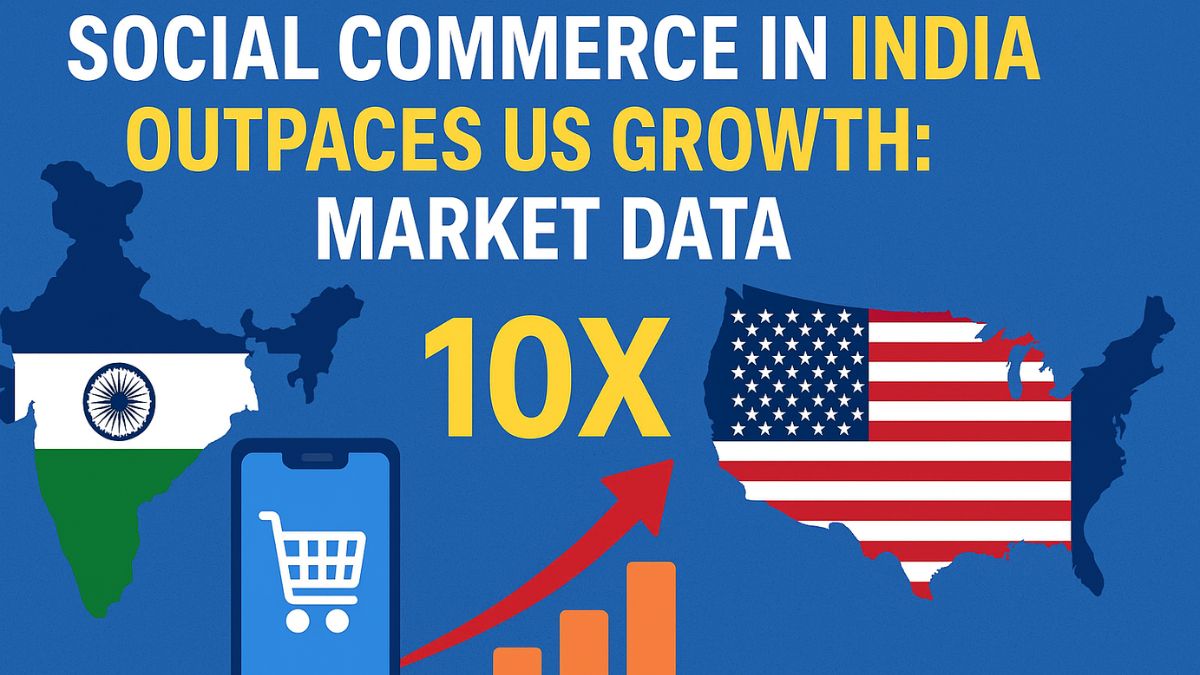
India’s digital landscape is transforming at a speed that surprises even the most seasoned market watchers. Social commerce growth in India has not only gained momentum but is now scaling at nearly 10 times the pace of the United States. According toBain & Company, India’s social commerce market is projected to reach USD 70 billion by 2030, driven by mobile-first shopping, influencer-driven commerce, and a massive young consumer base. This makes social commerce one of the fastest-growing segments of India’s digital economy. Unlike the West, where e-commerce is more saturated, India’s social commerce ecosystem is just getting started, and its exponential rise is already setting benchmarks for the global market.
- 1. Understanding Social Commerce in India
- 2. Market Data That Proves the Boom
- 3. Key Drivers of Social Commerce Growth in India
- 4. Comparison: Why India Outpaces the US
- 5. Role of Influencers and UGC in Social Commerce
- 6. Future of Social Commerce in India
- Conclusion: Summary and Learnings
- About Hobo.Video
1. Understanding Social Commerce in India
1.1 What is Social Commerce?
Social commerce refers to buying and selling products directly through social media platforms such as Instagram, Facebook, and WhatsApp. Unlike traditional e-commerce, where customers browse on dedicated websites or apps, social commerce integrates shopping into platforms where people already spend time. This seamless experience makes the buying journey shorter and more engaging. In India, the model thrives due to the popularity of WhatsApp and Instagram, where millions of users interact daily.
1.2 Why Social Commerce is Growing Faster in India
The biggest reason for social commerce growth in India is accessibility. With over 750 million smartphone users and a monthly data cost among the lowest in the world, Indian consumers are shopping more frequently on social media. In contrast, US consumers are accustomed to establishede-commerceplatforms like Amazon, making them less dependent on social media for purchases. This shift in consumer behavior explains why social commerce adoption is significantly stronger in India.
2. Market Data That Proves the Boom
2.1 India’s Projected Market Size
According to a report by Bain & Company and Sequoia, India’s social commerce market, currently valued at USD 8–10 billion, is projected to grow to USD 70 billion by 2030. This shows a compound annual growth rate (CAGR) of 55–60%, highlighting its unmatched momentum compared to the global market.
2.2 US vs India Social Commerce
In 2024, the US social commerce market was valued at USD 67 billion, but its growth rate is slowing to a CAGR of 20% or less. India, in contrast, is outpacing this with a significantly higher trajectory. This data reinforces that India’s growth curve is more promising and less saturated compared to developed economies.
2.3 Digital Retail Growth India
The Indian e-commerce market overall is set to touch USD 200 billion by 2027, with social commerce contributing a major share. Unlike Western countries, where traditional e-commerce dominates, India’s market is more fragmented, giving social selling platforms an opportunity to build trust at the grassroots levels.
3. Key Drivers of Social Commerce Growth in India
3.1 Influencer-Driven Commerce
Indian consumers trust recommendations from micro and nano-influencers far more than celebrity ads. A survey by Nielsen showed that over 70% of millennials in India prefer influencer recommendations over brand advertisements. Influencer-driven commerce is therefore a critical driver, with platforms like Instagram and Hobo.Video enables creators to promote products directly to niche communities.

Amplify Your Brand,
One Influence at a Time.
3.2 Mobile Shopping Penetration
With over 95% of internet users in India accessing the web through smartphones, mobile shopping penetration is at its peak. The country has seen mobile commerce adoption at a scale unmatched globally. Easy access to apps, local payment wallets, and UPI (Unified Payments Interface) has made mobile-first shopping not only convenient but also secure.
3.3 Social Selling Platforms
Platforms such as Meesho, GlowRoad, and Shop101 have pioneered social commerce in India. Meesho alone reported over 120 million monthly active users in 2024, creating one of the largest seller networks. These platforms empower local entrepreneurs, especially women, to start businesses without heavy investments. This grassroots empowerment fuels digital retail growth in India and sustains long-term expansion.
3.4 Online Shopping Behavior India
Indian consumers are value-driven, community-oriented, and love discovering products through recommendations. This explains the surge in social commerce growth in India, as platforms combine entertainment and trust with product discovery. Online shopping behavior in India reflects a unique blend of aspirational buying and social trust, making it different from Western models.
3.5 Cross-Border E-commerce Trends
Another growing aspect is cross-border e-commerce trends. Indian buyers are increasingly interested in international products discovered through social platforms. Whether it’s Korean beauty products or US lifestyle goods, social commerce platforms are bridging global demand with local supply chains, thereby expanding choices for consumers.
4. Comparison: Why India Outpaces the US
4.1 Young Demographics
India has a median age of 28 years, making it one of the youngest consumer markets in the world. Social media usage is high among youth, who are naturally inclined toward social commerce. In contrast, the US has a median age of 38 years, reflecting a more mature market with slower adoption curves.
4.2 Price Sensitivity and Value Demand
Indian consumers are price-conscious, and social commerce enables better deals through community buying, group discounts, and peer referrals. This makes social commerce growth in India more scalable compared to the US, where consumers focus more on convenience than discounts.
4.3 Entrepreneurial Ecosystem
India’s social commerce market thrives on millions of small-scale sellers, especially women entrepreneurs, who use WhatsApp and Instagram shops. In fact, over 60% of Meesho’s sellers are women, highlighting how entrepreneurship fuels the ecosystem. The US market, dominated by large retailers, lacks this grassroots dynamism.
5. Role of Influencers and UGC in Social Commerce
5.1 UGC Videos and Trust Building
User-generated content (UGC) plays a key role in driving social commerce. A report by HubSpot found that 79% of people say UGC highly impacts their purchasing decisions. In India, shortUGC videoson Instagram Reels or Hobo.Video creates authentic narratives that make products more relatable than polished brand ads.
5.2 AI Influencer Marketing
AI influencer marketing is transforming campaign targeting in India. Platforms like Hobo.Video uses AI UGC insights to match brands with the right influencers. This ensures better ROI for businesses while giving consumers authentic recommendations.
5.3 Best Influencer Platforms
India now has some of the best influencer platform networks. Hobo.Video, for example, enables micro-influencers to connect with brands seamlessly. By leveraging AI and UGC Videos, it positions itself as a top influencer marketing company in India, offering real engagement rather than vanity metrics.
6. Future of Social Commerce in India
6.1 Digital-First Consumption
With over 900 million projected internet users by 2025, India is rapidly shifting to digital-first consumption. Social commerce will naturally capture a large share of this market, as trust and discovery remain central to consumer choices.
6.2 Integration of Payments
The rise of UPI transactions, which crossed 10 billion transactions monthly in 2024, makes social commerce payments smooth and reliable. Seamless payment integration accelerates adoption rates and creates an inclusive ecosystem for both buyers and sellers.
6.3 Expansion of Cross-Border E-commerce Trends
As logistics infrastructure improves, cross-border e-commerce trends will further fuel the market. Indian consumers are increasingly aspiring for international products, and social commerce platforms provide easy access. This will add new layers to the digital retail growth India story.
Before you go, explore e-commerce brands that UGC creators give an edge.Read here.
Conclusion: Summary and Learnings
- Social commerce growth in India is outpacing the US by nearly tenfold, thanks to mobile-first adoption and young demographics.
- Influencer-driven commerce and UGC Videos are crucial in building consumer trust.
- Mobile shopping penetration ensures that the majority of online purchases happen on handheld devices.
- Social selling platforms empower small sellers, especially women, fueling grassroots entrepreneurship.
- Online shopping behavior India shows consumers prefer peer recommendations over traditional ads.
- Cross-border e-commerce trends are expanding product availability and consumer choices.
- AI influencer marketing and platforms likeHobo.Videoare shaping the next wave of influencer-led commerce.
- Digital retail growth India will continue to expand, making the ecosystem richer and more inclusive.
About Hobo.Video
Hobo.Video is India’s leading AI-powered influencer marketing and UGC company. With over 2.25 million creators, it offers end-to-end campaign management designed for brand growth. The platform combines AI and human strategy for maximum ROI.
Services include:
- Influencer marketing
- UGC content creation
- Celebrity endorsements
- Product feedback and testing
- Marketplace and seller reputation management
- Regional and niche influencer campaigns
Trusted by top brands like Himalaya, Wipro, Symphony, Baidyanath, and the Good Glamm Group.
Looking to grow your brand with the right strategy? Our experts are here.Get started now.
It’s not just about followers, it’s about real growth.Become a part of it.
Frequently Asked Questions (FAQs)
QWhat is social commerce and how is it different from e-commerce?
Social commerce refers to shopping directly on social media platforms, while e-commerce usually takes place on dedicated websites or apps. Social commerce offers a seamless shopping journey integrated with daily social media use, making it more interactive and trust-driven than traditional e-commerce.
Q2. Why is social commerce growth in India faster than in the US?
India’s younger demographics, affordable internet, and trust in peer recommendations drive faster adoption. In contrast, the US market is already saturated with established e-commerce players like Amazon, leaving less room for social platforms to dominate.
Q3. What role do influencers play in social commerce?
Influencers act as trusted advisors in the buying journey. In India, influencer-driven commerce thrives because consumers value authenticity and peer recommendations. Micro and nano-influencers particularly impact local communities, making them critical to social commerce growth.
Q4. How do UGC Videos impact purchase decisions in India?
UGC Videos create authenticity by showing real experiences of users. Research shows that 79% of consumers trust UGC more than traditional advertising. In India, short-form videos on platforms like Hobo.Video help consumers relate to products before making purchases.
Q5. Which are the leading social selling platforms in India?
Meesho, GlowRoad, and Shop101 are among the leading platforms. Meesho has crossed 120 million monthly active users, showcasing the massive adoption of social commerce. These platforms empower small entrepreneurs with zero or minimal investment.

 Vishnumaya