
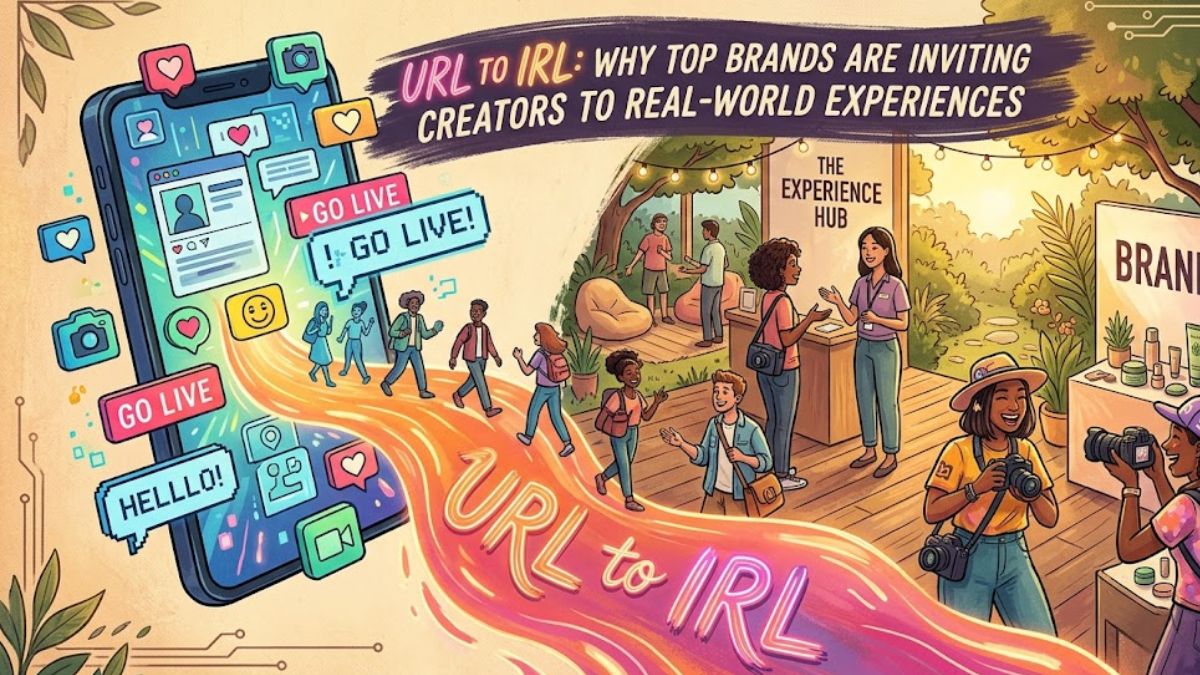
1. Introduction: Why URL to IRL Is Changing Marketing Forever
URL to IRL isn’t just another marketing buzzword that’ll fade in a year. It’s a real shift in how brands earn trust, build emotional connection, and actually drive conversion in the creator economy right now. At the core, it takes digital discovery and ties it directly to real-world experience in a way ads on a screen just can’t pull off. Over the last five years, brands have figured out something that should’ve been obvious sooner: attention online by itself doesn’t cut it anymore. India has over 820 million internet users as of 2024, and even with all that reach, trust is still the thing missing from most digital marketing. That gap is exactly where URL to IRL steps in.
Instead of just running another batch of online ads, brands are now flying creators out to factories, retail stores, hotels, and product experiences directly. Those creators turn whatever actually happens there into content people believe, because they were there for it. That’s basically why URL to IRL has become a core piece of experiential marketing strategy now, not a side experiment. At this point, nearly every major creator-led campaign has some offline component built into it. Fashion brands, tech companies, doesn’t matter the category, everyone’s testing URL to IRL as a way to build something deeper with their audience than a 15-second ad ever could.
- 1. Introduction: Why URL to IRL Is Changing Marketing Forever
- 2. What Exactly Does URL to IRL Mean in Modern Marketing?
- 3. Rise of Creator-Led Brand Campaigns in India
- 4. Experiential Marketing Strategy: The New Growth Engine
- 5. Digital to Real-World Marketing: The Shift in Consumer Journey
- 6. Brand Engagement Transformation in the Creator Economy
- 7. Data Insights Behind URL to IRL Growth
- 8. Challenges in URL to IRL Execution
- 9. Conclusion
- About Hobo.Video
2. What Exactly Does URL to IRL Mean in Modern Marketing?
2.1 Understanding the Core Idea Behind URL to IRL
Strip it down and URL to IRL is just this: take a digital interaction and turn it into something physical. Someone discovers a brand online, usually through a creator they already follow, and then they get to actually experience that brand in real life.
What that looks like in practice varies, but here are some of the more common versions brands are running right now:
- A creator checking into a hotel and documenting the actual stay, room tours, breakfast, the whole experience, instead of a polished ad for the property
- A beauty influencer testing products live inside a brand’s own studio, where viewers can see real reactions instead of a script
- A tech reviewer showing up to a product launch event and giving people their honest first impressions on camera
- A food creator visiting the actual kitchen or factory where a product gets made, so the audience sees the process instead of just the packaging
All of this falls under digital-to-real-world marketing, where the storytelling starts as something purely online and ends up becoming a lived, physical moment.
2.2 Why URL to IRL Works Better Than Digital-Only Ads
Regular digital ads are easy to scroll past and just as easy to forget. The numbers back that up: the average person sees something like 5,000 ads a day and ends up remembering less than 10% of them. That’s a brutal ratio for any brand trying to actually stick in someone’s mind. URL to IRL flips that. When a creator physically goes through something, the content that comes out of it just reads as more real. People can tell the difference between someone performing enthusiasm and someone actually reacting to something in front of them. That’s the real engine behind what’s being called brand engagement transformation across the industry. People trust lived experience a lot more than they trust a script, and that trust gap is exactly what’s pushing conversion rates higher for brands leaning into URL to IRL.
3. Rise of Creator-Led Brand Campaigns in India
3.1 Explosion of Influencer Marketing India
India has turned into one of the fastest-growing markets anywhere for the creator economy. With more than 100 million content creators active across platforms here, demand for influencer marketing in India has gone up sharply, and it’s not slowing down. Brands have also changed who they’re working with. It’s not just A-list celebrities anymore. Micro creators, UGC creators, and people with smaller but tightly engaged niche audiences are getting real budget now too.

Amplify Your Brand,
One Influence at a Time.
That shift has led to something more structured: creator-led campaigns where the creator is treated less like a one-off promoter and more like an actual media channel in their own right, with their own audience, their own format, their own credibility built in.
3.2 Why Brands Are Inviting Influencers Offline
One of the bigger shifts recently has been brands actually flying creators out for offline events. Real factory visits, real product launches, full experiential trips, not just a press release sent over email. The logic behind it is simple. Offline experience creates authenticity in a way that’s hard to fake from behind a desk. That trend connects directly back to URL to IRL. The story still starts online, but it only becomes believable once it gets grounded in something physical that actually happened.
4. Experiential Marketing Strategy: The New Growth Engine
4.1 How Experiential Marketing Works Today
An experiential marketing strategy is built around creating an actual emotional moment instead of just pushing a product message at people.
What brands are putting together now includes things like:
- Creator trips, where a small group of creators gets flown somewhere to experience a brand’s product or service firsthand over several days
- Product immersion events, where people get extended hands-on time with something instead of a quick demo
- Live testing sessions, often streamed or filmed in real time so the audience sees genuine first reactions
- Retail walkthroughs, where creators tour a physical store or showroom and show what it’s actually like to shop there
All of this sits under the umbrella of experiential marketing strategy, and URL to IRL is basically the connective tissue holding it together.
4.2 Data-Driven Impact of Experiential Campaigns
This isn’t just a feel-good creative idea either. Research shows experiential campaigns can boost brand recall by up to 74%, a massive jump compared to passive digital ads. Separately, another study found that 91% of consumers say they’re more likely to buy after actually attending an event tied to a brand. That’s the part that matters for anyone deciding where to put their budget. URL to IRL isn’t just creatively interesting, it’s measurably driving performance too.
5. Digital to Real-World Marketing: The Shift in Consumer Journey
5.1 How Consumer Behavior Has Changed
People don’t take ads at face value anymore, not the way they used to. Instead, they go research things themselves, watch reviews, follow creators they trust, and only then make a decision. That behavior shift is exactly why digital-to-real-world marketing is growing the way it is.
A typical buying journey now tends to look something like this:
- Discovery, usually through a piece of creator content someone stumbles into
- Engagement, where they start following along on social media and watching more
- Offline experience, where a URL to IRL campaign gives them something tangible to connect with
- Purchase decision, which comes after all of that trust has actually been built up
5.2 Why Offline Experience Matters More Than Ever
When someone watches a creator actually go through a product or experience in person, trust jumps in a way a polished ad just can’t replicate. That’s the core reason URL to IRL campaigns tend to outperform regular digital ads specifically in industries where conversion is hard-won, travel, fashion, electronics, the categories where people genuinely hesitate before spending money.
6. Brand Engagement Transformation in the Creator Economy
6.1 From Ads to Experiences
It used to be all about impressions. How many people saw the ad, how many times. Now the focus has shifted to actual experiences. That’s the shift people are calling brand engagement transformation. Instead of a brand just saying “buy this product,” the message now tends to be closer to “come experience this alongside the creators you already trust.” That difference, between being sold to and being invited into something, is really what gives URL to IRL its power.
6.2 Role of UGC and Creator Ecosystem
The growth of UGC creator networks has changed how brands actually scale these campaigns. Instead of paying for expensive, polished production, brands now lean on real moments captured directly by creators out in the field. Platforms like Hobo.Video, known as a top influencer marketing company
7. Data Insights Behind URL to IRL Growth
Some numbers worth sitting with:
- Global influencer marketing spend cleared $21.1 billion in 2024
- Offline experiential marketing lifts brand recall by roughly 70%
- 63% of Gen Z say they’d rather a brand show up in person than buy another ad slot
- India’s creator base has grown past 2 million active influencers
- Offline activations are pulling in engagement quality up to three times higher than digital alone
That’s not noise. That’s budgets quietly moving toward what actually works.
8. Challenges in URL to IRL Execution
8.1 High Cost of Offline Campaigns
Cost is the obvious problem. Venues, travel, on-ground staff, the logistics nobody thinks about until the week before the event, it adds up fast. Big brands can absorb that. Smaller ones often can’t, which keeps offline activations out of reach for exactly the brands that might gain the most from them.
8.2 Measuring ROI Accurately
Tracking the return is messier. A digital ad hands you a click count and a conversion rate by the next morning. An offline event hands you a feeling, maybe a bump in engagement afterward, maybe a recall survey if someone remembered to run one. Nobody’s quite figured out how to put a number on “people felt something real,” and brands keep doing it anyway, because that feeling seems worth more than the spreadsheet can prove.
9. Conclusion
Key Takeaways
- URL to IRL is changing how brands actually reach people, not just where they advertise
- Offline campaigns build trust that’s hard to fake on a feed
- Gen Z keeps picking real experiences over ad impressions whenever they get the choice
- Experiential marketing pulls in both attention and recall
- Platforms like Hobo.Video are betting this shift in India has staying power
- Brands spending on activations now probably won’t see it on next quarter’s dashboard, they’ll see it in who’s still showing up a year from now
FAQs
What is URL to IRL in marketing?
It is a strategy where brands move influencer campaigns from online platforms into real-world experiences. It helps create deeper emotional connections and improves brand trust significantly.
Why are brands focusing on offline influencer events?
Brands want stronger engagement and authenticity. Offline events allow creators to experience products directly, which leads to more genuine storytelling and better audience trust.
How does URL to IRL benefit Gen Z marketing?
Gen Z values experiences over ads. Offline activations give them real memories and emotional connections, making brand interactions more meaningful and memorable.
What is experiential marketing strategy?
It is a marketing approach where brands create real-life experiences for users and influencers. It focuses on emotional engagement instead of traditional advertising.
How do influencer travel campaigns work in India?
Brands invite influencers on curated trips where they experience products or destinations. They then share authentic content across social platforms.
About Hobo.Video
Hobo.Video is India’s leading AI-powered influencer marketing and UGC company. With over 2.25 million creators, it offers end-to-end campaign management designed for brand growth. The platform combines AI and human strategy for maximum ROI.
Services include:
- Influencer marketing
- UGC content creation
- Celebrity endorsements
- Product feedback and testing
- Marketplace and seller reputation management
- Regional and niche influencer campaigns
Trusted by top brands like Himalaya, Wipro, Symphony, Baidyanath, and the Good Glamm Group.
Stop wondering what’s next. Let’s unlock your true brand growth potential. We’re just a click away.
We’re a growing community of creators doing big things you in? Join now.

 Neeti Katyal
 Jyoti Pandey