
Building a SaaS product in India teaches humility fast. Traffic looks healthy. Demo requests feel promising. Yet conversions quietly disappoint. That gap between interest and action drains budgets and morale. Many teams keep tweaking copy or ads without knowing what actually works.
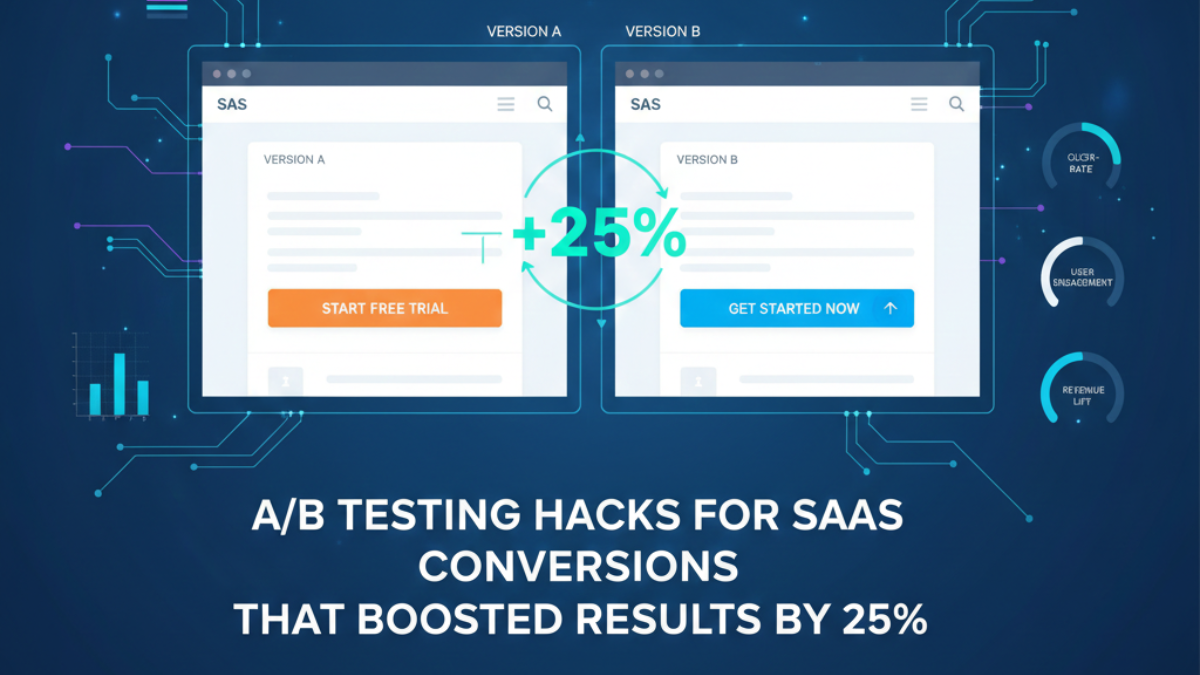
That frustration is where A/B testing hacks for SaaS conversions changed everything. Not flashy redesigns. Not gut feelings. Just disciplined testing, one decision at a time. Over several months, those tests reshaped landing pages, funnels, and onboarding flows. The outcome was clear — a 25% lift in conversions driven by data, not opinions. These A/B testing hacks for SaaS conversions didn’t rely on theory. They came from real experiments, real users, and real trade-offs.
- 1. Why SaaS Conversion Rate Optimization Works Differently
- 2. A/B Testing Hacks for SaaS Conversions That Actually Worked
- 3. B2B SaaS Landing Page Optimization Through Real Tests
- 4. Split Testing SaaS Funnels Beyond the Homepage
- 5. Onboarding Experiments That Improved Activation
- 6. What Influencer Marketing Teaches About SaaS Testing
- 7. Using Data Without Losing Focus
- 8. Scaling A/B Testing Without Breaking Teams
- 9. Where Influencer-Led UGC Fits Inside SaaS CRO
- Conclusion: What Actually Drove the 25% Lift
- About Hobo.Video
1. Why SaaS Conversion Rate Optimization Works Differently
1.1 SaaS Buyers Don’t Buy on Impulse
SaaS users behave nothing like ecommerce shoppers. They evaluate long-term value, trust, and risk. Because of this, saas conversion rate optimization focuses less on urgency and more on reassurance. Trials, demos, and onboarding experiences matter far more than discounts.
During one experiment, a “Start Free Trial” CTA underperformed compared to “See How It Works for Teams Like Yours.” The latter reduced anxiety.According to OpenView,SaaS companies with strong onboarding see 21% higher retention. That insight reframes conversion testing priorities entirely.
1.2 The Hidden Cost of Not Testing
Untested assumptions quietly burn money. Indian SaaS teams often increase ad spend first. However, weak funnels leak revenue. Website experimentation fixes that leak.
Invesp reportsthat companies running structured CRO programs achieve 223% higher ROI than those that don’t. That alone explains why saas conversion rate optimisation services now feel foundational rather than optional.
2. A/B Testing Hacks for SaaS Conversions That Actually Worked
2.1 One Variable Per Test, No Exceptions
Early A/B tests often failed because too many changes ran together. Headlines, layouts, and CTAs were altered simultaneously, which blurred learning and created false confidence. Therefore, the discipline of testing one variable at a time became non-negotiable. In one example, a headline test ran for 14 days across 19,000 sessions, where only the value proposition changed and everything else remained fixed. Consequently, these A/B testing hacks for SaaS conversions produced clean insights, and over time, CRO testing methods became structured, repeatable, and predictable rather than chaotic.

Amplify Your Brand,
One Influence at a Time.
2.2 Micro-Conversions Reveal Real Intent
Final sign-ups matter, yet they rarely tell the full story. Instead, micro-actions such as scroll depth, pricing clicks, and video views reveal intent much earlier in the funnel. As a result, tracking these signals helps teams understand hesitation before it becomes abandonment. Google Analytics benchmarks show that funnels optimised for micro-conversions improve final conversion rates by 20–30%. Therefore, saas funnel optimization must guide testing priorities instead of relying on surface-level metrics like page views.
3. B2B SaaS Landing Page Optimization Through Real Tests
3.1 Outcome-Driven Headlines Win Faster
Indian SaaS buyers decide within seconds whether a page deserves attention. As a result, vague or clever slogans consistently underperform. Testing outcome-driven headlines shifts focus from features to measurable results, which immediately improves engagement. For instance, replacing “Automate Your Workflow” with “Cut Manual Reporting Time by 62% in 30 Days” lifted demo clicks noticeably. That improvement came directly from b2b saas landing page optimization experiments grounded in real user behaviour data rather than creative assumptions.Similar patterns in headline effectivenesscan be seen when focusing on wording impact and user attention metrics from previous tests.”
3.2 Trust Signals Must Appear Early
Trust forms before interest, especially in B2B SaaS. Therefore, logos, testimonials, and certifications often matter more than visual polish. Saaas landing page optimization tests showed that moving trust elements above the fold reduced hesitation during the first scroll. In one experiment, adding recognizable client logos increased demo requests by 17%. This aligns with Nielsen’s finding that 92% of users trust peer recommendations, which explains why many effective growth experiments prioritise credibility before persuasion.
4. Split Testing SaaS Funnels Beyond the Homepage
4.1 Pricing Pages Decide Everything Quietly
Pricing pages rarely shout, yet they influence conversion decisions more than any other page. Subtle friction around clarity, transparency, or reassurance quietly drives users away. Therefore, tests focused on monthly versus annual toggles, feature comparisons, and refund messaging reveal valuable insights. In one split testing SaaS experiment, removing hidden-fee language reduced bounce rates by 24%. Consequently, this single change delivered more revenue impact than months of ad optimisation.
4.2 Fewer Fields, Higher Momentum
Signup flows often kill conversions quietly, one field at a time. Every additional input increases cognitive load and hesitation, especially for first-time users. Therefore, a simple form reduction test consistently delivers outsized gains. HubSpot reports that reducing form fields from four to three can increase conversions by 50%, a result echoed across multiple saas funnel optimization experiments. Consequently, teams that simplify early steps maintain momentum and move users faster into meaningful product experiences.
5. Onboarding Experiments That Improved Activation
5.1 The First Five Minutes Matter Most
Activation determines whether a SaaS product survives or fades. In those first few minutes, users decide if the tool feels intuitive or overwhelming. Hence, welcome emails, contextual tooltips, and visible progress cues play a crucial role in shaping confidence. When guided onboarding replaced open exploration, activation increased by 19% over a 21-day testing period. These A/B testing hacks for SaaS conversions succeeded because they focused on behaviour change and clarity rather than visual flair.
5.2 Personalization Changes Commitment
Personalized onboarding flows based on user role, company size, and industry consistently outperform generic experiences. As a result, users feel understood rather than sold to, which increases early commitment. Salesforce reports that personalization can increase conversions by 202%, making it one of the highest-impact levers in SaaS onboarding. Therefore, modern saas conversion rate optimisation services prioritise segmentation from day one instead of retrofitting it later. Over time, this approach reduces churn and strengthens long-term product adoption.
6. What Influencer Marketing Teaches About SaaS Testing
6.1 Creators Understand Attention Better
Influencer marketing offers a clear window into how users build trust and maintain attention. Hooks, storytelling, and relatability decide whether people continue or scroll away. However, many SaaS teams overlook these behavioural signals and rely only on product-centric messaging. Interestingly, UGC Videos surfaced objections and doubts faster than internal copy reviews ever did. Consequently, insights from influencer marketing India campaigns inspired stronger headline tests and more human onboarding flows.
6.2 AI Influencer Marketing Meets CRO
Platforms like Hobo.Video combine AI with creator intelligence, creating a powerful CRO advantage. Instead of guessing what resonates, teams test influencer-led sections grounded in real audience behaviour. In multiple experiments, influencer-driven landing page content consistently outperformed brand-only messaging. One such test showed influencer testimonials improving sign-ups by 28%, a meaningful lift at scale. This outcome confirms that AI influencer marketing strengthens website experimentation when authenticity leads the message.
7. Using Data Without Losing Focus
7.1 Fewer Metrics, Better Decisions
Too many dashboards often confuse teams instead of guiding them. As a result, focus gets scattered across numbers that rarely influence real decisions. High-growth SaaS companies deliberately track fewer metrics tied directly to revenue and activation. According to Mixpanel, top performers focus on under seven core KPIs, which keeps teams aligned and decisive. Consequently, this clarity strengthens conversion testing outcomes and prevents analysis paralysis.
7.2 Qualitative Insights Complete the Picture
Numbers explain what happened, but they rarely explain why. Therefore, heatmaps, session recordings, and user feedback become essential layers of insight. These tools reveal hesitation points, confusion triggers, and emotional friction that analytics alone cannot capture. By combining Hotjar insights with structured CRO testing methods, teams shorten experiment cycles significantly. Moreover, confidence in test results improves because decisions are grounded in both behaviour and data. Optimising conversion paths often involvesexamining user behaviouracross pages and testing elements that influence decision points.
8. Scaling A/B Testing Without Breaking Teams
8.1 Build a Testing-First Culture
A/B testing fails when teams fear failure. Instead, experimentation must feel safe, iterative, and educational. Not every test wins, yet documenting failures prevents repeated mistakes and wasted effort. Moreover, shared learnings encourage collaboration across product and marketing teams. Unsurprisingly, companies running 50+ tests annually grow faster, a pattern consistently visible across global SaaS benchmarks.
8.2 External CRO Support Accelerates Growth
Internal teams often juggle product, marketing, and customer success together. As a result, experimentation slows under daily pressure. Partnering with saas conversion rate optimization services adds speed because specialists focus only on testing and learning. Moreover, external teams bring objectivity, challenge internal bias, and introduce proven CRO testing methods refined across multiple SaaS funnels. Over time, this discipline shortens test cycles and improves decision quality consistently.
9. Where Influencer-Led UGC Fits Inside SaaS CRO
9.1 Authenticity Converts Better Than Polish
Indian SaaS audiences respond strongly to authenticity over perfection. Influencer-style messaging feels relatable because it mirrors real usage and real problems. Consequently, tests using creator-led narratives outperform polished brand copy in early funnel stages. For instance, AI UGC testimonials placed on pricing pages increased engagement noticeably, aligning with Stackla’s finding that UGC improves conversion rates by 29%.Comparative performance across user-generated formatsoften reveals how authentic audience voices influence engagement metrics.
9.2 Learning From Top Influencers in India
Studying famous Instagram influencers reveals how hooks, pacing, and storytelling hold attention. These patterns translate seamlessly into landing page headlines, demo videos, and onboarding flows. Moreover, creators understand cultural nuance better than most brands, especially in a diverse market like India. Ignoring these insights limits experimentation depth, which is why influencer-driven learnings now shape many high-impact growth experiments.
Conclusion: What Actually Drove the 25% Lift
Key Learnings
- Test behaviour, not assumptions
- Prioritise pricing and onboarding
- Reduce friction before scaling traffic
- Use influencer trust strategically
- Treat testing as a system
Consistent A/B testing hacks for SaaS conversions create compounding growth. Each experiment sharpens understanding. Over time, A/B testing hacks for SaaS conversions replace uncertainty with predictable revenue.
About Hobo.Video
Hobo.Video is India’s leading AI-powered influencer marketing and UGC company. With over 2.25 million creators, it offers end-to-end campaign management designed for brand growth. The platform combines AI and human strategy for maximum ROI.
Services include:
- Influencer marketing
- UGC content creation
- Celebrity endorsements
- Product feedback and testing
- Marketplace and seller reputation management
- Regional and niche influencer campaigns
Trusted by top brands like Himalaya, Wipro, Symphony, Baidyanath and the Good Glamm Group.
Brand growth isn’t about doing more. It’s about doing it right. We’ll help.
Influencers like you are shaping the future — we help make it profitable. Let’s connect.
FAQs
What are A/B testing hacks for SaaS conversions?
They are structured experiments focused on improving sign-ups, demos, and activation using real user behaviour.
How long should SaaS A/B tests run?
Typically 2–4 weeks, depending on traffic and conversion volume.
Which pages should SaaS teams test first?
Landing pages, pricing pages, and onboarding flows deliver the fastest ROI.
Is split testing SaaS expensive?
No. Many tools offer affordable plans suitable for early-stage SaaS.
How does influencer marketing support CRO?
Influencer content builds trust faster, improving conversion testing results.
What metrics matter most?
Conversion rate, activation rate, and retention outperform vanity metrics.
Can AI UGC replace brand videos?
No. AI UGC complements brand content by adding authenticity.
Should Indian SaaS brands localise tests?
Yes. Language, trust signals, and pricing sensitivity vary widely.
How many tests should run yearly?
High-growth teams run 30–50 meaningful experiments annually.
When should SaaS hire CRO experts?
When traffic scales or internal testing slows progress.

 Aqsa Pathan