
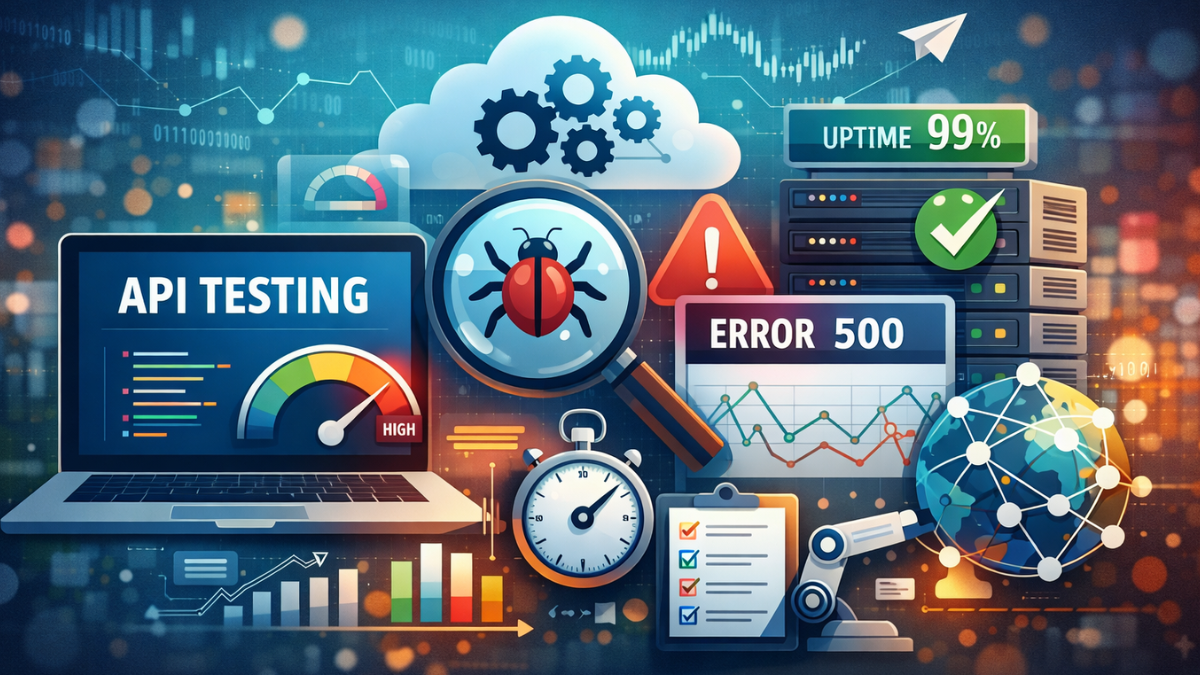
At 11:47 PM, a creator’s reel crossed one million views, and traffic surged almost instantly. In moments like these, api performance testing becomes the difference between controlled growth and silent failure. Dashboards were the first to slow, leaving creators confused and refreshing their screens repeatedly. Within minutes, payouts stalled, real-time metrics stopped updating, and support tickets began stacking up. By midnight, the issue had moved far beyond engineering logs. Performance was no longer a backend concern; it had turned into a visible brand crisis that creators and partners could feel.
Scenes like this are increasingly common across India’s fast-growing creator economy. They explain why platforms that once treated api performance testing as a routine checklist now see it as a core business safeguard. Influencer marketing campaigns, UGC Videos, and AI-driven workflows depend on APIs responding quickly and consistently under pressure. When APIs struggle, trust erodes quietly, creators disengage without warning, and brands question reliability. As digital platforms scale faster than ever, APIs now sit at the center of growth, deciding which products handle success smoothly and which ones collapse under their own momentum.
- 1. Why Product Performance Became a Business Problem
- 2. What API Performance Testing Really Means Today
- 3. Step-by-Step API Performance Testing Workflow (How Teams Actually Do It)
- 4. Experience Block: What Broke First During a Viral Campaign
- 5. API Performance Optimization as a Retention Strategy
- 6. API Monitoring Tools That Changed Visibility
- 7. API Quality Assurance Testing in Real Marketing Flows
- 8. Pattern Interrupt: What Most Teams Get Wrong
- 9. Automated API Validation at Scale
- 10. Creator-Economy Advantage: Why Generic API Testing Fails Here
- 11. Real-World Data That Supports This Shift
- Conclusion
- About Hobo.Video
1. Why Product Performance Became a Business Problem
1.1 Indian Users Are Unforgiving of Delay
Indian users move fast, and their patience runs out even faster. According to Google data, 53% of mobile users abandon experiences that take more than 3 seconds, which makes speed a non-negotiable factor. Moreover, in creator-led platforms, expectations are even higher because creators constantly refresh dashboards and track performance in real time. Meanwhile, brands rely on instant visibility to make campaign decisions without delays. As a result, even minor API slowdowns create frustration and silent drop-offs. That is precisely why api performance testing directly influences user retention, engagement, and long-term platform trust.
1.2 Performance Failures Rarely Announce Themselves
Unlike visible crashes, API failures usually appear gradually and go unnoticed at first. APIs tend to slow down quietly, which causes conversions to dip and user confidence to weaken over time. According to Akamai,a delay of just 100 milliseconds can reduce conversion rates by 7%, making performance degradation extremely costly. Consequently, influencers disengage without complaint, and brands start questioning reliability. Once teams recognized this pattern, api performance optimization moved beyond engineering hygiene and became a form of business insurance against revenue loss and trust erosion.
2. What API Performance Testing Really Means Today
2.1 Testing Is Not Traffic Simulation
Many teams mistake load tests for real testing. True api performance testing measures behavior under stress, chaos, and unpredictability.Cloudflare explainsthat API performance issues often stem from latency, inefficient payloads, and unpredictable traffic rather than raw server capacity.
It tracks:
- p95 and p99 latency
- Error bursts during spikes
- Throughput decay under load
- Recovery time after failures
In India’s creator economy, traffic does not rise slowly. It explodes.Understanding how APIs operate at a deeper levelhelps clarify why testing them thoroughly is crucial under real-world conditions.

Amplify Your Brand,
One Influence at a Time.
2.2 Why Traditional Testing Failed at Scale
Older testing cycles were built for predictable systems, often running weekly or even monthly. However, campaign traffic in creator-driven platforms arrives unpredictably and often within minutes, not days. Viral creators do not follow release calendars, and their audience spikes can overwhelm systems instantly. Because of this mismatch, traditional testing methods consistently failed to catch real-world issues in time. As a result, teams shifted toward API-driven testing, where checks run continuously, problems surface early, and potential damage reduces before users even notice it.
3. Step-by-Step API Performance Testing Workflow (How Teams Actually Do It)
3.1 Step 1: Define Business-Critical APIs
Teams first identify APIs tied to revenue or trust:
- Creator onboarding
- UGC uploads
- Payments and analytics
Not all endpoints matter equally. Before performance testing, teams often needaccess credentials that allow them to safely query endpointswithout compromising security or quotas.
3.2 Step 2: Establish Baseline Metrics
Before optimization, teams measure:
- Average latency
- p95 latency
- Error rates
- Requests per second
These benchmarks guide api performance checks.Platform-level API changesoften alter request limits, response structures, and performance behaviour in ways testing teams must account for.
3.3 Step 3: Simulate Real Traffic Patterns
Instead of linear loads, teams simulate:
- Sudden spikes
- Regional surges
- Concurrent creator actions
This mirrors real campaign behavior.
3.4 Step 4: Monitor Live with Thresholds
Once APIs move into production, continuous API monitoring becomes critical. Instead of reacting to outages, teams define clear performance thresholds for latency, error rates, and timeouts. When these thresholds break, alerts trigger immediately, long before servers actually crash. Consequently, teams gain time to respond while users still experience acceptable performance. Moreover, live monitoring reveals patterns that test environments often miss, such as regional latency or time-based traffic bursts. Over time, this approach shifts teams from firefighting to proactive performance control.
3.5 Step 5: Optimize, Re-test, Repeat
After issues surface, fixes must follow quickly to prevent recurrence. Teams often start by shrinking response payloads, optimizing database queries, or improving cache strategies. Once changes go live, APIs are re-tested under similar traffic conditions to validate improvements. Importantly, optimization is never a one-time task because usage patterns keep evolving. As new creators join and campaigns scale, performance assumptions change again. Therefore, testing becomes a continuous loop rather than a final checkpoint.
4. Experience Block: What Broke First During a Viral Campaign
During one high-volume influencer campaign, traffic tripled within ten minutes. Servers stayed up. APIs did not.
The first failure appeared in analytics refresh endpoints. Creators could not see performance data. Panic followed. Support volume doubled.
After adding Automated API validation and stricter thresholds, similar spikes passed unnoticed. That incident permanently reshaped testing priorities.
5. API Performance Optimization as a Retention Strategy
5.1 Why Speed Retains More Than Features
Features attract. Speed retains. Teams learned that api performance optimization techniques deliver compounding value.
Small changes mattered:
- Smaller response payloads
- Async background processing
- Smarter caching
Each reduced friction across dashboards.
5.2 Proven Optimization Techniques in Practice
High-scale teams focus on:
- Rate limits by user role
- Database index tuning
- Regional routing
- Fail-fast mechanisms
These anchor api performance optimization into daily engineering decisions.
6. API Monitoring Tools That Changed Visibility
6.1 Choosing API Monitoring Tools Wisely
Modern api monitoring tools give teams real-time visibility into latency, error rates, and uptime across critical endpoints. Tools like Datadog and New Relic work well for large teams because they combine monitoring, alerts, and analytics in one place. As a result, teams no longer rely on assumptions or delayed reports to understand performance issues. Instead, problems become visible the moment they begin to form. Moreover, this visibility changes decision-making, as engineers respond with data rather than instinct. Over time, monitoring shifts from a safety net into a strategic advantage.
6.2 Open Source API Monitoring Tools for Startups
Many Indian startups prefer open source api monitoring tools such as Prometheus and Grafana because they offer flexibility without heavy licensing costs. These tools scale effectively as traffic grows and integrate smoothly with modern CI/CD pipelines. Consequently, teams maintain control over their monitoring setup while adapting it to changing needs. Cost efficiency becomes especially important when growth is unpredictable and budgets are tight. Additionally, open-source tools allow teams to customize dashboards based on real business priorities. This balance of control and scalability makes them a practical choice for early-stage platforms.
7. API Quality Assurance Testing in Real Marketing Flows
7.1 Why QA Must Mirror Campaign Reality
Api quality assurance testing now follows real workflows:
- Creator onboarding flows
- UGC upload limits
- Payment cycles
Testing only backend logic is no longer enough.
7.2 API Health Checks Protect Brand Trust
When teams combine quality assurance with regular API health checks, failures surface early instead of during live campaigns. These checks continuously verify whether critical endpoints respond within acceptable limits. As a result, potential slowdowns are identified before creators or brands feel any disruption. Moreover, early detection prevents last-minute firefighting during high-visibility launches. Over time, this consistency builds confidence among influencers and brand partners alike. Ultimately, reliable performance reinforces trust, which is far harder to rebuild than it is to maintain.
8. Pattern Interrupt: What Most Teams Get Wrong
Most teams focus on testing APIs only for load, assuming traffic volume is the primary risk. However, real-world usage rarely behaves in a clean or predictable manner. Creators click rapidly, refresh dashboards repeatedly, and upload content simultaneously. Meanwhile, brands monitor metrics in bursts during campaign peaks. Because of this human chaos, APIs break in ways that lab tests never reveal, making behavior-based testing far more important than controlled simulations.
9. Automated API Validation at Scale
9.1 Removing Manual Bottlenecks
Manual testing often becomes a hidden bottleneck as products scale. It slows down releases, increases human error, and creates gaps between deployments. By contrast, Automated API validation ensures that every deployment passes predefined performance gates without manual intervention. As a result, teams gain confidence to release faster without compromising stability. Moreover, automation brings consistency, since the same checks run every time regardless of team or timeline. Consequently, overall risk drops sharply while development velocity improves.
9.2 Scaling Across Regions and Products
As platforms expand, performance challenges multiply across regions, languages, and product lines. Automated validation scales seamlessly across these dimensions, ensuring consistent behavior everywhere. This becomes especially important when different regions experience traffic spikes at different times. Additionally, validation helps teams maintain uniform standards across multiple APIs and services. AI influencer marketing platforms benefit the most because they handle diverse creator segments simultaneously. Without scalable validation, performance quickly fragments across the system.
10. Creator-Economy Advantage: Why Generic API Testing Fails Here
10.1 Creator Traffic Is Unpredictable
Enterprise traffic usually grows in a planned and predictable manner. Creator-driven traffic behaves very differently and often arrives without warning. A single viral reel can trigger millions of API requests within minutes. Generic testing models fail to account for this sudden burstiness. As a result, systems that perform well under steady load often collapse under creator-driven spikes. Testing must therefore adapt to unpredictability rather than rely on average traffic assumptions.
10.2 APIs Break Faster in Creator Platforms
APIs face far more pressure in creator platforms than in traditional enterprise systems. Dashboards refresh repeatedly as creators track performance in real time, while uploads often happen concurrently during campaign peaks. At the same time, payment requests and analytics calls queue together, creating sudden bursts of demand. Because of this behavior, api performance testing must explicitly account for burstiness rather than average load. Platforms that fail to test for these conditions often experience silent slowdowns instead of clean failures. Eventually, creators feel the friction first and move away long before brands raise concerns.
11. Real-World Data That Supports This Shift
Industry data clearly shows why API performance can no longer be treated lightly. Google reports that a 1-second delay can cut mobile conversions by 20%, which directly impacts campaign outcomes. Meanwhile, Gartner highlights that 75% of outages originate at the API layer, not at the UI or infrastructure level. AWS further notes that optimised APIs can reduce infrastructure costs by up to 25%, proving that performance also affects margins. Together, these figures underline a critical reality: API reliability influences revenue, trust, and scalability at the same time. This data explains why performance testing has become urgent rather than optional.
Conclusion
Key Takeaways
- Treat api performance testing as a growth safeguard
- Test real behavior, not synthetic traffic
- Invest early in api monitoring tools
- Combine QA with marketing reality
- Prepare APIs for viral unpredictability
Strong APIs quietly build strong brands.
About Hobo.Video
Hobo.Video is India’s leading AI-powered influencer marketing and UGC company. With over 2.25 million creators, it offers end-to-end campaign management designed for brand growth. The platform combines AI and human strategy for maximum ROI.
Services include:
- Influencer marketing
- UGC content creation
- Celebrity endorsements
- Product feedback and testing
- Marketplace and seller reputation management
- Regional and niche influencer campaigns
Trusted by top brands like Himalaya, Wipro, Symphony, Baidyanath and the Good Glamm Group.
Your next level of brand growth starts with one simple step. Take it now.
From nano to macro — there’s space for all of us here. Join the platform.
FAQs
What is API performance testing?
API performance testing evaluates how APIs behave under real-world load, spikes, and failures. It measures latency, errors, throughput, and recovery to ensure stability during peak usage.
Why is API testing critical for influencer platforms?
Influencer platforms face unpredictable traffic spikes. Without testing, dashboards, uploads, and payouts fail during viral moments.
How often should API performance checks run?
Continuously. Real-time monitoring catches issues before users experience them.
Are open source API monitoring tools reliable?
Yes. Tools like Prometheus are widely used when configured correctly.
Does API optimization reduce costs?
Yes. Optimized APIs reduce infrastructure strain and cloud spending.

 Aqsa Pathan