
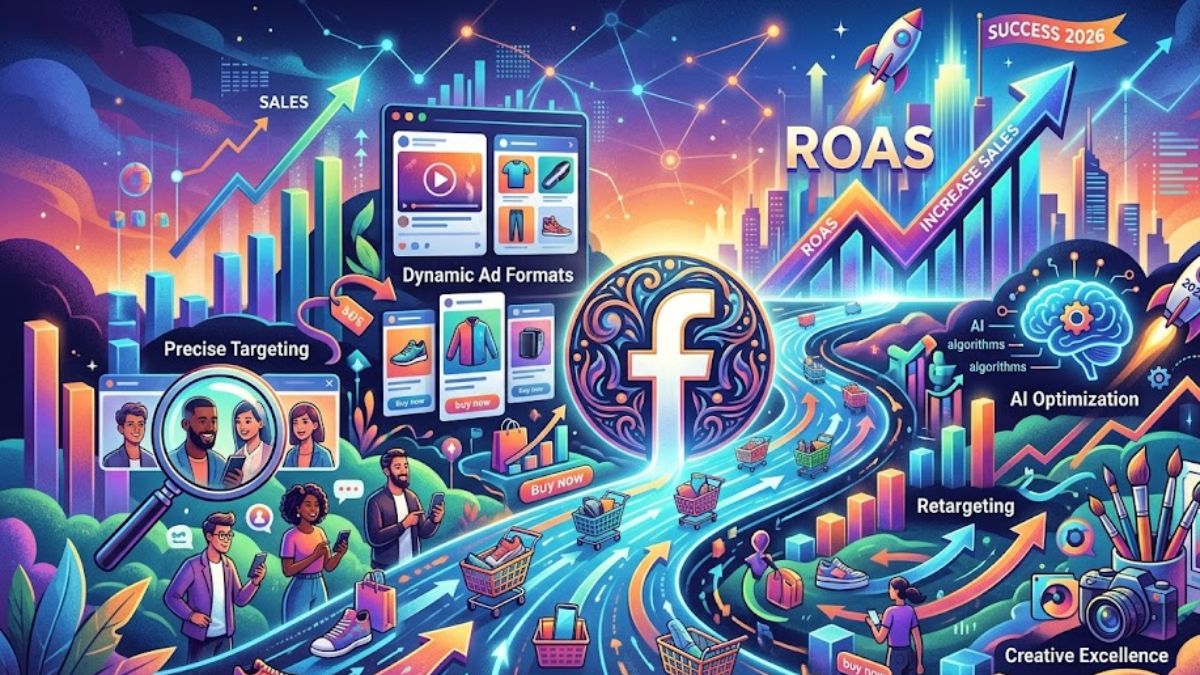
In today’s crowded online marketplace, Facebook Ads are still one of the most reliable tools an ecommerce brand has for getting in front of buyers. It doesn’t matter whether you’re running a D2C label, selling on Shopify, listed on Amazon, or pushing traffic to your own site; Facebook’s ad system gives you a way to find the right customer, push them toward checkout, and keep an eye on what you’re actually getting back for your spend. Plenty of newer platforms have come and gone, but businesses keep coming back to Facebook Ads because the targeting is genuinely advanced, the budgets are flexible enough for a small seller or a large one, and the reporting tells you something useful instead of just vanity numbers.
Meta’s family of apps, Facebook, Instagram, Messenger, and WhatsApp combined
Meta’s family of apps, Facebook, Instagram, Messenger, and WhatsApp combined, now reaches more than 3.4 billion people every month. That’s not a small advertising pool. Meta itself has said that millions of businesses run ads through this ecosystem to reach buyers with campaigns built around who those buyers actually are. For an ecommerce brand, that scale translates into something concrete: a steady stream of qualified visitors, a shot at winning back the customer who abandoned their cart last week, and a channel for building the kind of relationship that brings someone back for a second and third purchase.
This guide walks through what you actually need to know, starting with how Facebook Ads Manager works, moving into creative strategy, audience targeting, and ending with how to push your ROAS higher heading into 2026.
- 1. What Are Facebook Ads?
- 2. Why Facebook Ads Continue to Dominate Ecommerce Marketing
- 3. Understanding Facebook Ads Manager
- 4. Choosing the Right Campaign Objective
- 5. Understanding Your Audience Before Running Ads
- 6. Creating High-Converting Ad Creatives
- 7. Combining Facebook Ads with Influencer Marketing
- 8. Advanced Meta Ads Strategies to Increase ROAS in 2026
- 9. Building a High-Converting Sales Funnel with Facebook Ads
- 10. Using Meta Ads Manager for Better Campaign Optimization
- 11. Retargeting: The Secret Behind Higher Conversions
- 12. Budget Planning for Facebook Ads
- 13. Creating Ad Copy That Sells
- 14. Why UGC Videos Improve Facebook Advertising Performance
- 15. Influencer Marketing and Facebook Ads: A Winning Combination
- 16. A/B Testing: The Key to Continuous Growth
- 17. Tracking Performance with the Right Metrics
- 18. Common Facebook Ads Mistakes That Hurt ROAS
- 19. Future Trends in Facebook Advertising for Ecommerce
- 20. Facebook Ads Optimization Checklist
- 21. Why Influencer Marketing Strengthens Facebook Ads
- Conclusion: Key Takeaways
1. What Are Facebook Ads?
Facebook Ads are paid placements that show up across Meta’s platforms, Facebook, Instagram, Messenger, and the wider Audience Network. Brands use them to put products in front of people, collect leads, drive traffic, and close sales. What sets this apart from a billboard or a print ad is precision. You can target someone based on their age, what they’re interested in, how they’ve behaved online, what they’ve bought before, where they live, and what they’re doing on the apps right now. That specificity is the whole reason Meta’s advertising system has stayed so dominant for ecommerce.
Every campaign you run lives inside Facebook Ads Manager. This is where you build out campaigns, pick your objective, set how much you’re willing to spend, and check how things are performing. Whether you’re a brand-new seller trying to get your first sale or a business that’s already scaling, Ads Manager is the control room for all of it.
2. Why Facebook Ads Continue to Dominate Ecommerce Marketing
A question that comes up a lot: does Facebook still actually work? Yes, it does. The competition for attention has gotten fiercer over the years, but a brand that builds its campaigns with some strategy behind them still finds real opportunity here. A few things explain why it’s stuck around. The reach is enormous, the targeting options go deeper than almost any other platform, and Meta’s AI handles a lot of the optimization work automatically now. You’ve also got several ad formats to choose from, the ability to run across both Facebook and Instagram from one campaign, daily budgets you can adjust on the fly, and performance tracking detailed enough to tell you exactly where your money is going.
Statista has reported that Meta pulled in more than $160 billion in advertising revenue in 2024 alone. That figure says a lot about how much trust businesses continue to place in this platform. Modern campaigns also benefit from Meta’s automatic delivery optimization across Facebook and Instagram together, which tends to mean better engagement and lower costs to acquire a customer than running the two separately.

Amplify Your Brand,
One Influence at a Time.
3. Understanding Facebook Ads Manager
Every campaign that works starts here. Ads Manager is where you build, manage, tweak, and measure everything happening across your account. Inside Ads Manager, you can set up campaigns, choose what you’re trying to achieve, decide who you’re targeting, upload your creative assets, set your budget, schedule when ads run, track which conversions are actually coming through, and pull performance reports to see what’s working.
The current version of the interface also has AI-driven suggestions built in, which can save you time if you’re newer to running ads and aren’t sure where to start. Getting genuinely comfortable with Ads Manager is one of the fastest ways to stop wasting budget on campaigns that were never going to perform.
3.1 Key Sections Inside Ads Manager
- Campaign Level
This is where you set your overall objective, the thing that tells Meta’s algorithm what success looks like for this particular campaign. Most ecommerce brands are choosing between sales, leads, website traffic, brand awareness, engagement, or app promotion. Pick the wrong one and Meta will optimize for the wrong outcome; pick the right one and the algorithm starts working in your favor almost immediately. - Ad Set Level
The ad set is where audience targeting actually happens, along with placement choices, optimization goals, and how your budget gets split. This is also a good place to pull in Facebook Audience Insights before you commit spend, so you’re not guessing at who you’re trying to reach. - Ad Level
This is where the creative comes together: the image or video, the headline, the description copy, the call-to-action button, and a preview before it goes live. Honestly, a strong creative at this level often does more for your results than a bigger budget would.
4. Choosing the Right Campaign Objective
One mistake that shows up constantly with beginners is picking the wrong objective from the start. Meta’s algorithm doesn’t treat every objective the same; it optimizes delivery differently depending on what you tell it you want. If you’re an ecommerce brand trying to drive purchases, a sales campaign is the move, since the algorithm will specifically chase people who are likely to actually buy. launching something new or trying to get eyes on a blog post, a traffic campaign makes more sense. If your goal is more about building a following, getting comments, shares, and video views, that’s what an engagement campaign is built for. And if you just need to collect customer information through an instant form, a leads campaign handles that.
Getting this choice right early on makes a real difference in how efficiently your budget gets spent and how quickly your ROAS improves.
5. Understanding Your Audience Before Running Ads
The truth is, most of what makes a Facebook campaign succeed has less to do with the ad creative and more to do with whether you actually understand who you’re selling to. A lot of brands burn through budget without ever really answering that question. Before you spend a rupee, it’s worth sitting down and figuring out who’s actually buying your product, what problem they’re trying to solve, what interests shape how they spend their time online, what device they’re browsing on, and what ultimately gets them to click “buy.” None of this is glamorous work, but it’s the foundation everything else gets built on.
Facebook Audience Insights is built specifically to help answer these questions. It can show you age breakdowns, gender splits, interests, buying patterns, which devices people are using, where they’re located, and how they tend to engage with content. Brands that take the time to look at this data before launching a campaign tend to write better ad copy, get better click-through rates, and pay less to acquire each customer.
6. Creating High-Converting Ad Creatives
You can have the most precise targeting in the world and still lose if your creative is weak. The two have to work together. A creative that actually stops the scroll usually has a clear product shot or a short video, a headline that says something real instead of something generic, a clear sense of what the customer gets out of buying, some kind of social proof, and a call-to-action that isn’t vague. Video, in particular, tends to outperform static images across most ecommerce categories, and Wyzowl’s research backs this up: video continues to be one of the formats people engage with most online, which is exactly why it’s become such a core part of how brands build out their Facebook ad sets now.
The reason video works so well isn’t complicated. It shows a product doing what it’s supposed to do, in real time, faster than any amount of copy could explain it. People trust what they can see working. That’s also why so many ecommerce brands have shifted away from polished, scripted commercials and toward UGC-style videos, content that looks like it was shot by a real customer rather than a production team. Counterintuitively, that rougher, more authentic look tends to convert better than something that looks too polished.
7. Combining Facebook Ads with Influencer Marketing
The brands seeing the strongest results almost never rely on paid ads alone. They pair Facebook Ads with influencer marketing, and the combination tends to outperform either one running by itself. Creator content works because people trust other people more than they trust a brand talking about itself. Across the influencer marketing space in India, more brands are turning to creators for genuine reviews, tutorials, and unboxing videos, and a lot of that content ends up getting repurposed directly as ad creative inside Ads Manager. It’s a smart move financially too, since it tends to bring production costs down while improving how the campaign actually performs.
Many brands choose to work with an established influencer marketing company rather than trying to find and vet creators on their own, simply because it’s faster and lowers the risk of a bad fit. Platforms like Hobo.Video have built tools specifically around this: AI-assisted influencer matching, creator discovery, campaign management, and AI-supported UGC production. Whether a brand wants to work with some of India’s top influencers, well-known Instagram creators, or smaller emerging ones, there’s a path to building a campaign that scales without starting from zero each time.
Brands that look at companies like Whole Truth, known for being upfront and transparent in how they market themselves, tend to understand something important: honest, real storytelling outperforms over-the-top advertising almost every time. Today’s customers respond more to a creator showing a product honestly than to a heavily produced ad trying to convince them. If you’re a creator wondering how to get into this space, or a brand looking for the right influencer platform to partner with, ecosystems like Hobo.Video exist precisely to connect both sides and make that collaboration easier to manage.
8. Advanced Meta Ads Strategies to Increase ROAS in 2026
Running a successful Facebook Ads campaign in 2026 takes a lot more than picking an objective and boosting a post and hoping for the best. The brands consistently pulling strong returns are the ones leaning into data, testing, and automation. Meta’s machine learning has gotten noticeably better over the years, but it’s still only as good as what you feed it. Give it strong creative, clean tracking, and a clearly defined conversion goal, and it tends to outperform competitors who skip that groundwork.
One thing worth keeping in mind: Meta’s algorithm needs enough data and enough time to actually learn what’s working. Instead of splintering your budget across a dozen small campaigns, it’s usually smarter to consolidate similar audiences into fewer, larger campaigns and let the system run for a while before judging it. Constantly editing a campaign resets its learning phase, which tends to tank performance right when it was starting to stabilize. Patience, in this case, genuinely beats daily tinkering inside Ads Manager.
9. Building a High-Converting Sales Funnel with Facebook Ads
No brand that’s actually winning at this relies on a single ad doing all the work. What they build instead is a funnel, a structured path that takes someone from never having heard of you to actually checking out.
9.1 Top of Funnel (TOFU)
At this point, the person scrolling past your ad has no idea who you are. This is where educational content, product demos, and genuine storytelling do the heavy lifting. Short videos tend to grab attention faster here than a static image ever could. Some of what works well at this stage: a simple introduction to the product itself, useful tips relevant to your industry, a behind-the-scenes look at how things get made, the founder talking about why the brand exists in the first place, or content built around a specific problem your customer has and how your product solves it. None of this is trying to close a sale yet. It’s just getting your product in front of someone in a way that feels natural rather than like an interruption.
9.2 Middle of Funnel (MOFU)
Once someone’s engaged with your content once or twice, it’s time to go a step further: show them the actual benefits and let real customers do some of the talking through reviews. This is exactly where UGC videos earn their keep, since they answer the unspoken questions a buyer has by simply showing someone else already using the product. Comparison videos, short tutorials, and testimonials all fit here too. The goal at this stage isn’t to push for the sale just yet; it’s to build enough trust that the sale feels like an easy decision once it’s offered
9.3 Bottom of Funnel (BOFU)
By now, the customer knows your brand. What’s left is getting them to actually buy. Limited-time offers, discount codes, free shipping, bundled products, and cart reminders all tend to do well here, since the person doesn’t need convincing about the product anymore, just a reason to act now instead of later. Run correctly inside Ads Manager, this stage is usually where the best return on ad spend shows up.
10. Using Meta Ads Manager for Better Campaign Optimization
A lot of advertisers are only scratching the surface of what’s actually available inside Ads Manager. Getting more familiar with these tools is often a faster way to improve results than just throwing more money at the problem.
- Campaign Budget Optimization (CBO)
CBO lets Meta automatically shift your budget between ad sets based on which ones are actually performing. Instead of you manually nudging numbers around every morning, the system routes more spend toward whatever’s already working. - Advantage+ Campaigns
Meta’s Advantage+ Shopping Campaigns take a lot of the manual setup out of the equation by automating audience expansion and creative optimization through AI. A good number of ecommerce sellers have reported real ROAS improvements after switching over to this campaign type. - Automatic Placements
Rather than limiting your ad to just the Facebook News Feed, letting Meta place it automatically across Facebook, Instagram, Messenger, and Audience Network tends to lower your costs while widening your reach at the same time. Taken together, these tools make Ads Manager a lot more powerful for ecommerce sellers than most people realize on a first pass.
11. Retargeting: The Secret Behind Higher Conversions
Hardly anyone buys the first time they see your product. Most people compare a few options, read some reviews, think about it, and come back later, if they come back at all. Retargeting is how you make sure they do. You can build custom audiences out of website visitors, people who looked at a specific product page, anyone who watched part of your video, people who added something to cart and left, past buyers, and anyone who’s engaged with your content on Instagram or Facebook. Industry data consistently shows that retargeting campaigns convert at noticeably higher rates than cold audience campaigns, simply because the person already recognizes who you are. Pulling in Facebook Audience Insights on top of this lets you sharpen these audiences even further based on actual buying behavior and demographics.
11.1 Dynamic Product Ads
Dynamic Product Ads automatically pull up whatever a customer looked at before. Someone browses a pair of running shoes, gets distracted, and leaves without buying; later, Meta shows them those exact shoes again. It’s a small thing, but that level of personalization tends to push purchase probability up noticeably, which is exactly why dynamic ads have become one of the strongest-performing formats for ecommerce right now.
12. Budget Planning for Facebook Ads
There’s a common assumption that you need a huge budget to make Facebook Ads work. That’s not really true. How you allocate what you have matters a lot more than how much you’re spending overall. The smarter approach is to start with a testing budget before scaling anything that works. A rough structure that tends to work well: roughly 20% toward testing different creatives, 30% toward testing different audiences, and the remaining 50% going toward scaling whatever’s already proven itself.
One thing worth avoiding is jacking up your budget overnight. Instead, bump spend gradually, somewhere in the 15% to 20% range every few days, as long as performance is holding steady. This gives Meta’s algorithm room to keep learning without throwing off everything it’s already optimized inside Ads Manager.
13. Creating Ad Copy That Sells
Even the best visuals fall flat without copy that actually speaks to the customer. Good ad copy gets straight to the problem the customer has, in plain, conversational language rather than something stiff and corporate. Lead with benefits over features. Tap into the emotional reason someone wants this product, not just the spec sheet. Make the value obvious, and close with a call-to-action that’s actually clear.
There’s a real difference between saying “our blender has 1200W power” and saying “blend a smoothie in under a minute without standing around in the kitchen.” People aren’t buying wattage. They’re buying the extra five minutes they get back in their morning. This is true across pretty much every category, not just blenders.
14. Why UGC Videos Improve Facebook Advertising Performance
Authenticity has quietly become one of the biggest factors in whether a customer actually trusts an ad. People can spot a traditional, polished advertisement almost instantly now, and that recognition tends to trigger skepticism before the ad even finishes its first second. UGC videos sidestep that, because they look like real people using a product the way real people actually use things. A growing number of ecommerce brands now run entirely separate campaigns built around customer reviews, creator testimonials, and casual product demos, and these tend to outperform the heavily produced commercials precisely because they don’t trigger that same skepticism.
Pairing Facebook Ads with AI-assisted UGC production gives brands a way to produce this kind of content at scale without losing the authentic feel that makes it work in the first place. Platforms like Hobo.Video have built tools around exactly this, simplifying creator discovery, campaign management, and performance tracking through AI-driven influencer marketing.
15. Influencer Marketing and Facebook Ads: A Winning Combination
The most effective version of ecommerce marketing right now has paid ads supporting organic creator content, not replacing it. Instead of investing in expensive television-style production, more brands are turning to influencer marketing campaigns to do that work. Micro-creators in particular tend to bring stronger engagement, mainly because their audiences actually trust their opinions. Within India’s influencer marketing space, brands are working with both niche creators and some of the country’s top influencers to produce educational content, honest reviews, and tutorials, content that often gets repurposed directly as ad creative inside Ads Manager afterward.
Partnering with an established influencer marketing company tends to make this process easier, mostly because they already know which creators fit a given niche and target audience. The strongest campaigns usually mix well-known Instagram names with smaller, everyday creators, balancing reach with the kind of authenticity a bigger name sometimes can’t deliver on its own.
Brands that look to companies like Whole Truth as an example tend to understand something simple: being transparent builds a stronger relationship with customers than overselling ever will. Whether you’re a creator figuring out how to break into this space, a brand searching for an influencer who actually fits your niche, or just looking for the right platform to manage all of it, creator-led advertising is clearly shaping where ecommerce marketing is headed.
16. A/B Testing: The Key to Continuous Growth
Don’t assume your first ad is your best ad. It almost never is. The advertisers who keep winning are the ones who never stop testing. Worth testing: headlines, your primary text, the images you’re using, the video itself, your call-to-action button, the landing page someone lands on, and the audience segment you’re targeting. The key is testing one variable at a time, so when something moves, you actually know why.
Small wins compound. A 5% improvement here and a 5% improvement there, repeated over months, adds up to a meaningfully better ROAS than most businesses ever achieve by just spending more. Brands that test consistently tend to beat competitors who are simply outspending them.
17. Tracking Performance with the Right Metrics
Clicks alone tell you almost nothing about whether a campaign is actually working. What matters is profitability, and that means watching the right numbers. The ones worth checking regularly: ROAS, cost per purchase, conversion rate, click-through rate, cost per click, customer acquisition cost, average order value, and lifetime customer value. Pull these from Ads Manager and Google Analytics on a consistent basis. Decisions made off real data tend to beat decisions made off gut feeling almost every time, and brands that review their numbers weekly tend to improve much faster than ones that just keep raising their budget and hoping.
18. Common Facebook Ads Mistakes That Hurt ROAS
Even advertisers who’ve been doing this a while still make mistakes that quietly eat into their returns. Fixing these doesn’t require a bigger budget, just more attention.
- Targeting an Audience That Is Too Broad
There’s a tempting assumption that reaching more people automatically means more sales. It doesn’t. Showing your ad to people who have no real interest just burns through spend. Audience Insights exists specifically to help you understand who’s actually worth targeting before you launch anything. - Ignoring Creative Fatigue
People get bored of seeing the same ad fast. Refresh your images, videos, headlines, and copy every few weeks, because testing new creative regularly is what keeps engagement from quietly dying off. - Sending Traffic to Poor Landing Pages
A great ad can’t save a slow, confusing website. If the page takes too long to load, hides product information, or makes checkout a hassle, you’re losing people you already paid to get there. - Making Frequent Campaign Changes
Editing your campaign every single day interrupts Meta’s learning phase and keeps the algorithm from ever fully optimizing. Give campaigns enough breathing room to gather real data before touching anything inside Ads Manager.
19. Future Trends in Facebook Advertising for Ecommerce
This space keeps shifting, and the brands that pay attention to where it’s headed tend to stay a step ahead going into 2026 and beyond. AI is taking on more of the optimization work, with Ads Manager increasingly handling audience expansion, budget distribution, and even creative tweaks on its own. That said, none of that replaces genuine storytelling; customers still respond to what feels real over what feels automated.
Short-form video isn’t slowing down anytime soon. Brands leaning into product demos, tutorials, and customer testimonials are seeing stronger engagement than the ones still relying mostly on static images. Personalization keeps growing too. People expect ads that actually reflect what they’re interested in and how they browse. Brands combining their own first-party data with Facebook Audience Insights tend to deliver experiences that feel relevant instead of generic, and that relevance is what drives better conversion rates.
20. Facebook Ads Optimization Checklist
Worth running through this before launching your next campaign. For campaign setup: pick the right objective, make sure the Meta Pixel is actually installed and verified, set a realistic daily budget, and optimize for purchases whenever that’s an option. Audience: do your homework on who you’re actually selling to, check Audience Insights before building anything, set up both Custom Audiences and Lookalike Audiences, and exclude existing customers where it makes sense to.
For creative: use genuinely good images and video, write headlines that say something real, lead with customer benefits, and make sure your call-to-action is unmistakable. Performance: check ROAS weekly, refresh your creative on a regular cadence, keep testing new audiences, and scale anything that’s working gradually rather than all at once. None of this is complicated, but doing it consistently is what separates brands that grow sustainably from ones chasing short-term spikes.
21. Why Influencer Marketing Strengthens Facebook Ads
Paid ads simply work better when there’s real creator content backing them up. That’s the reason the strongest ecommerce brands treat Facebook Ads and influencer marketing as one connected strategy rather than two separate ones. Creators build trust with their audience over time, in a way that a traditional ad just can’t replicate. That’s why brands across India’s influencer marketing scene increasingly lean on micro-creators, who tend to bring strong engagement without the cost of a major name. Plenty of brands also bring in some of India’s top influencers for product launches and seasonal pushes, with that content later getting reused as ad creative inside Ads Manager.
Hobo.Video has built its whole approach around making this easier, handling AI-driven influencer matching, AI UGC production, campaign management, and creator discovery in one place. Whether the goal is partnering with a well-known Instagram name, figuring out how to start as a creator yourself, or finding the specific influencer who actually fits your niche, the platform is built to handle that. Brands that follow Whole Truth’s lead on transparency tend to prove the same point over and over: being honest with customers builds a stronger relationship than any exaggerated claim ever could.
Conclusion: Key Takeaways
Facebook Ads are still one of the strongest channels available to ecommerce brands heading into 2026, but success here was never really about how much you spend. It comes down to understanding your audience, building content that actually connects, optimizing consistently, and letting data guide your decisions instead of guesswork.
A few things worth carrying forward from everything above: get clear on your objective before you launch anything, actually learn how Ads Manager works instead of just clicking through it, dig into Audience Insights before building out your targeting, pair solid creative with genuine UGC, keep testing your headlines and audiences and creative without getting complacent, scale what works gradually instead of jumping the budget overnight, bring influencer marketing into the mix for the trust it builds, and judge everything by ROAS, conversions, and acquisition cost rather than likes or impressions.
Brands that treat advertising as something they build over time, rather than something they’re trying to win quickly, are the ones that end up with results worth keeping. And underneath all of it, Facebook Ads still work best when there’s a genuinely good product and honest messaging behind them, the platform can only do so much if what’s on the other end of the ad isn’t actually worth buying.
Frequently Asked Questions (FAQs)
What are Facebook Ads?
Facebook Ads are paid advertisements displayed across Facebook, Instagram, Messenger, and Meta’s Audience Network. They help businesses increase brand awareness, drive website traffic, generate leads, and boost online sales through precise audience targeting.
What is Facebook Ads Manager?
Facebook ads manager is Meta’s advertising dashboard where businesses create campaigns, manage budgets, monitor performance, and optimize advertisements. It serves as the central platform for running and analyzing all advertising activities.
How does Meta Ads Manager differ from Facebook Ads Manager?
Meta ads manager manages advertising across Facebook, Instagram, Messenger, and Audience Network. While many marketers still use the older name, the platform now supports advertising across Meta’s complete ecosystem.
How much should I spend on Facebook Ads?
Short DThere is no fixed budget. Start with an amount you can comfortably test, analyze performance, and gradually increase spending on campaigns delivering positive ROAS. Consistent optimization matters more than large budgets.escription
How can I improve ROAS?
Improve ROAS by targeting the right audience, creating engaging creatives, testing different ad variations, optimizing landing pages, using retargeting campaigns, and regularly reviewing campaign performance.
About Hobo.Video
Hobo.Video is India’s leading AI-powered influencer marketing and UGC company. With a creator network of more than 2.25 million creators, the platform helps brands build awareness, improve engagement, and achieve measurable business growth through authentic creator collaborations.
By combining advanced AI influencer marketing technology with experienced campaign management, Hobo.Video enables businesses to create impactful digital campaigns that deliver maximum ROI.
Services Include
- Influencer Marketing
- UGC Content Creation
- Celebrity Endorsements
- Product Feedback and Testing
- Marketplace and Seller Reputation Management
- Regional Influencer Campaigns
- Niche Influencer Campaigns
Trusted by leading brands including Himalaya, Wipro, Symphony, Baidyanath, and the Good Glamm Group, Hobo.Video continues to help businesses scale their digital marketing through authentic creator partnerships.
Together, we’ll make your brand growth feel natural and doable. Let’s begin.
Looking for paid collabs that actually match your vibe? Start here.

 Vishnumaya