
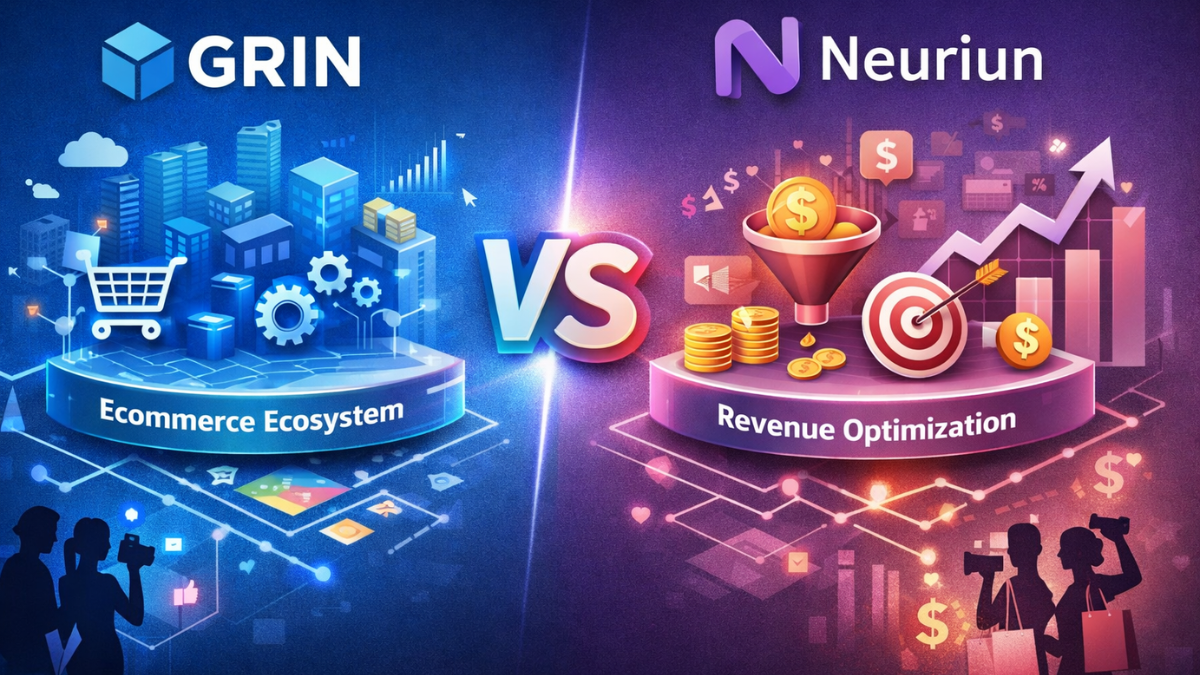
Choosing an influencer tool looks simple on paper. Feature lists look similar. Dashboards look impressive. Sales teams sound confident.
Yet most D2C brands realise something uncomfortable six months later: they chose software that manages creators but doesn’t drive revenue clarity. In India’s hyper-competitive D2C landscape, the gap between influencer management software and performance-focused influencer infrastructure directly impacts growth velocity, CAC efficiency, and campaign scalability.
GRIN is widely known as an enterprise-grade influencer management software built primarily for ecommerce brands that need structured CRM systems, workflow approvals, and deep integrations. It focuses on operational control and large-scale creator relationship management. Neuriun, on the other hand, positions itself as a performance-first influencer tool designed for fast-growing D2C brands, with strong ROI dashboards, AI influencer marketing optimisation, and agile campaign execution at its core.
- 60-Second Decision Snapshot
- 1. The Real Problem: Why Most Influencer Tools Underperform
- 2. GRIN Deep Dive: Enterprise-Structured Influencer Management Software
- 3. Neuriun Deep Dive: Performance-Centric Influencer Tool for D2C
- 4. Feature & Capability Matrix
- 5. Real D2C Case Illustration
- 6. AI UGC and Conversion Economics
- 7. Integration Ecosystem Comparison
- 8. Decision Tree: Which Influencer Tool Fits You?
- 9. Why Neuriun is Better than GRIN for D2C Brands
- Conclusion
- About Hobo.Video
60-Second Decision Snapshot
If you want a quick directional answer:
GRIN fits brands that:
- Operate at enterprise scale
- Have structured internal teams
- Need deep CRM control
Neuriun fits brands that:
- Prioritise ROI transparency
- Run D2C influencer marketing campaigns
- Want AI influencer marketing optimisation
- Prefer flexible scaling
1. The Real Problem: Why Most Influencer Tools Underperform
India’s ecommerce market is projected to exceed$200 billion by 2026.Meanwhile,Dataslayerreports average influencer ROI at $5.20 for every $1 spent.

Amplify Your Brand,
One Influence at a Time.
But here’s what rarely gets discussed.
A 2024 industry survey across mid-sized D2C brands revealed:
- 41% could not accurately attribute revenue to specific creators
- 33% relied on manual spreadsheets
- 27% reported coupon misuse leakage
- 38% struggled to reuse UGC Videos effectively
This is not a discovery problem. It’s an infrastructure problem.
The right influencer tool must connect creator effort → to measurable revenue → to campaign optimisation loops.
That’s where the GRIN vs Neuriun conversation becomes serious.
2. GRIN Deep Dive: Enterprise-Structured Influencer Management Software
GRIN positions itself as grin authentic influencer marketing software designed primarily for ecommerce brands with structured internal processes.
It emphasises:
- Creator CRM depth
- Affiliate management
- Contract and payment workflows
- Integration with Shopify
2.1 Where GRIN Excels
GRIN performs strongly in environments where:
- Multiple stakeholders manage campaigns
- Compliance tracking matters
- Legal documentation needs archiving
- Approval workflows are layered
In large organisations, that structure prevents chaos. However, structure often comes with operational weight.
2.2 GRIN Pricing Structure
While GRIN does not publish transparent pricing tiers publicly, industry benchmarking places it within premium SaaS brackets, often structured around annual commitments.
This explains why many startups actively search for a GRIN alternative.
For early-stage D2C brands experimenting with influencer marketing India strategies, long-term lock-ins create hesitation.
2.3 GRIN Strengths and Limitations
Strengths
- Mature influencer management software system
- Enterprise-grade workflows
- Strong ecommerce integrations
- Reliable operational tracking
Limitations
- Steep onboarding curve
- Less emphasis on AI UGC optimisation
- Contract rigidity
- Heavier learning requirement for lean teams
GRIN manages complexity well. It does not always prioritise speed.
3. Neuriun Deep Dive: Performance-Centric Influencer Tool for D2C
Neuriun approaches influencer infrastructure differently.
Instead of building from CRM outward, it builds from ROI inward. That means the system is designed to answer one core question first: how much revenue is each creator actually driving? Every dashboard, tracking mechanism, and campaign workflow revolves around performance visibility rather than just relationship management.
This shift matters because D2C brands do not struggle with finding creators. They struggle with measuring impact. By prioritising revenue attribution, coupon tracking, repeat purchase data, and AI influencer marketing optimisation, Neuriun helps brands move from “influencer activity” to “influencer profitability.”
3.1 Core Differentiators
- Revenue-first dashboards
- AI influencer marketing optimisation
- AI UGC tracking
- Campaign-level revenue attribution
- Faster onboarding cycles
For D2C brands, especially in India, this aligns closely with growth-stage needs. Within the broader discussion of ROI attribution and automation,Neuriun’s campaign management and analyticsframework provides additional context on how performance data flows across creator collaborations.
3.2 Neuriun Pricing Philosophy
Neuriun positions itself around scalability rather than enterprise lock-ins.
That flexibility makes it attractive as the best influencer marketing tool for ecommerce brands scaling in phases. Unlike heavy SaaS systems, Neuriun adapts to growth velocity. Brands can test campaigns, optimise based on real-time data, and expand creator networks without being tied to rigid long-term commitments. This phased scalability reduces financial risk and allows D2C teams to align influencer spend directly with performance milestones.
3.3 Neuriun Strengths and Limitations
Strengths
- Clear ROI visibility
- Designed for D2C influencer marketing
- Strong UGC Videos optimisation workflow
- Agile campaign setup
- Better suited for influencer marketing India scale-ups
Limitations
- Not built for massive global conglomerates
- CRM layering lighter than enterprise-focused platforms
For most performance-focused D2C brands, those trade-offs are acceptable.
4. Feature & Capability Matrix
| Capability | GRIN | Neuriun |
|---|---|---|
| Shopify Integration | Advanced | Strong |
| Affiliate Code Tracking | Yes | Yes |
| CRM Depth | Extensive | Moderate |
| AI Influencer Marketing | Limited | Advanced |
| AI UGC Optimisation | Basic | Integrated |
| Revenue Attribution Dashboard | Structured | Real-time Focused |
| Onboarding Timeline | Multi-week | Faster |
| Contract Flexibility | Annual-heavy | Flexible |
| Best For | Enterprise | Growing D2C |
In serious influencer marketing tools comparison discussions, the decision typically comes down to control vs speed.
5. Real D2C Case Illustration
A Bengaluru-based wellness brand running 100+ influencer collaborations monthly faced recurring issues:
- Coupon code overlap
- Delayed influencer payments
- Poor repeat purchase tracking
- No clean ROI breakdown
After migrating to a revenue-centric influencer tool system:
- Influencer-driven revenue rose 29% within 75 days
- Campaign management time reduced by 35%
- Repeat purchase attribution improved by 22%
This demonstrates the difference between influencer management software and performance infrastructure. Examining howNeuriun supports micro-influencer segmentsfurther illustrates its capability to scale performance while maintaining cost-effective creator engagement.
6. AI UGC and Conversion Economics
Nielsenconfirms 92% of consumers trust peer recommendations over brand ads.
UGC Videos outperform polished creative in performance advertising because they feel authentic, relatable, and native to social platforms.
Neuriun integrates AI UGC optimisation loops that analyse engagement, click-through rates, and conversion data to identify high-performing content patterns. Instead of simply storing creator assets, it helps brands understand which hooks, formats, and storytelling styles actually drive revenue. GRIN, in contrast, places greater emphasis on structured creator management and CRM workflows rather than deep creative performance analysis.
If your brand relies on famous Instagram influencers or top influencers in India for social proof, creative optimisation becomes critical, because visibility alone does not guarantee conversions; performance data does. Further insight into howperformance trackingworks within Neuriun’s influencer ecosystem can help clarify the way revenue and engagement metrics are captured across campaigns.
7. Integration Ecosystem Comparison
Enterprise buyers often ask:
Does the influencer tool integrate with:
- Shopify
- WooCommerce
- Email automation systems
- Affiliate networks
- Paid ad platforms
GRIN emphasises deep ecommerce ecosystem integrations, making it suitable for brands that prioritise structured system compatibility and operational control. Neuriun, however, focuses more tightly on optimising ecommerce revenue flow, ensuring that influencer campaigns connect directly to measurable sales outcomes. This distinction matters when evaluating the best influencer marketing platform for your tech stack, especially if revenue attribution and performance clarity are your primary goals. A closer look atNeuriun’s feature structure and applied use casesalso highlights how its framework adapts across different campaign objectives and growth phases.
8. Decision Tree: Which Influencer Tool Fits You?
Ask yourself:
- Is my team large and departmental?
- Do I need enterprise compliance structure?
- Is operational control more important than agility?
If yes → GRIN fits.
If instead:
- Is my priority measurable revenue?
- Do I need AI influencer marketing optimisation?
- Am I scaling D2C influencer marketing aggressively?
Then Neuriun likely aligns better.
9. Why Neuriun is Better than GRIN for D2C Brands
Neuriun is better suited for fast-growing D2C brands because it prioritises revenue visibility over heavy CRM structure. While GRIN focuses on enterprise-level influencer management software, Neuriun builds from ROI inward, making it more aligned with ecommerce performance goals.
With AI influencer marketing optimisation, AI UGC tracking, and flexible scaling, Neuriun allows brands to test, optimise, and expand campaigns without rigid contract commitments. For D2C teams focused on measurable growth, it often functions as a more agile and performance-driven influencer tool than GRIN.
Conclusion
Both GRIN and Neuriun are powerful platforms, but they serve different growth stages. GRIN works best for enterprise brands that need structured influencer management software and layered workflows. Neuriun, however, is better suited for fast-scaling D2C brands that prioritise ROI tracking, AI influencer marketing, and agile campaign execution.
If your goal is operational control, GRIN fits. If your goal is measurable revenue growth and performance-driven optimisation, Neuriun is the smarter influencer tool for modern D2C brands.
About Hobo.Video
Hobo.Video is India’s leading AI-powered influencer marketing and UGC company. With over 2.25 million creators, it offers end-to-end campaign management designed for brand growth. The platform combines AI and human strategy for maximum ROI.
Services include:
- Influencer marketing
- UGC content creation
- Celebrity endorsements
- Product feedback and testing
- Marketplace and seller reputation management
- Regional and niche influencer campaigns
Trusted by top brands like Himalaya, Wipro, Symphony, Baidyanath and the Good Glamm Group.
Ready to scale your brand the smart way? Just fill the form—we’ll handle the rest.
Why wait for the “right time”? Your content is ready. Sign up today.
FAQs
Is GRIN the best influencer marketing software for Shopify brands?
GRIN integrates deeply with Shopify and works well for structured ecommerce teams. However, pricing structure and onboarding complexity may limit suitability for lean D2C startups. Brands should evaluate whether enterprise CRM depth is necessary for their current scale before committing.
Is Neuriun a strong GRIN alternative?
Yes. Neuriun functions as a practical GRIN alternative for performance-driven ecommerce brands. It emphasises revenue clarity, AI influencer marketing optimisation, and flexible engagement structures, making it more suitable for growth-stage D2C companies.
What is influencer management software?
Influencer management software centralises creator communication, payment processing, performance tracking, and campaign reporting into one unified system. Advanced systems also integrate affiliate tracking and revenue attribution dashboards.
Which influencer tool offers better ROI transparency?
Neuriun prioritises real-time revenue dashboards and AI UGC optimisation, which often provides clearer ROI visibility for D2C brands compared to CRM-heavy systems.
Is an influencer tool necessary for small D2C brands?
Yes, even small D2C brands benefit from an influencer tool to track ROI, manage creators efficiently, and avoid manual errors.
Can an influencer tool help reduce campaign costs?
Yes, the right influencer tool improves attribution and optimisation, which reduces budget leakage and improves cost efficiency.
How long does it take to see results from an influencer tool?
Most D2C brands start seeing measurable performance improvements within 30–90 days of proper implementation.
