
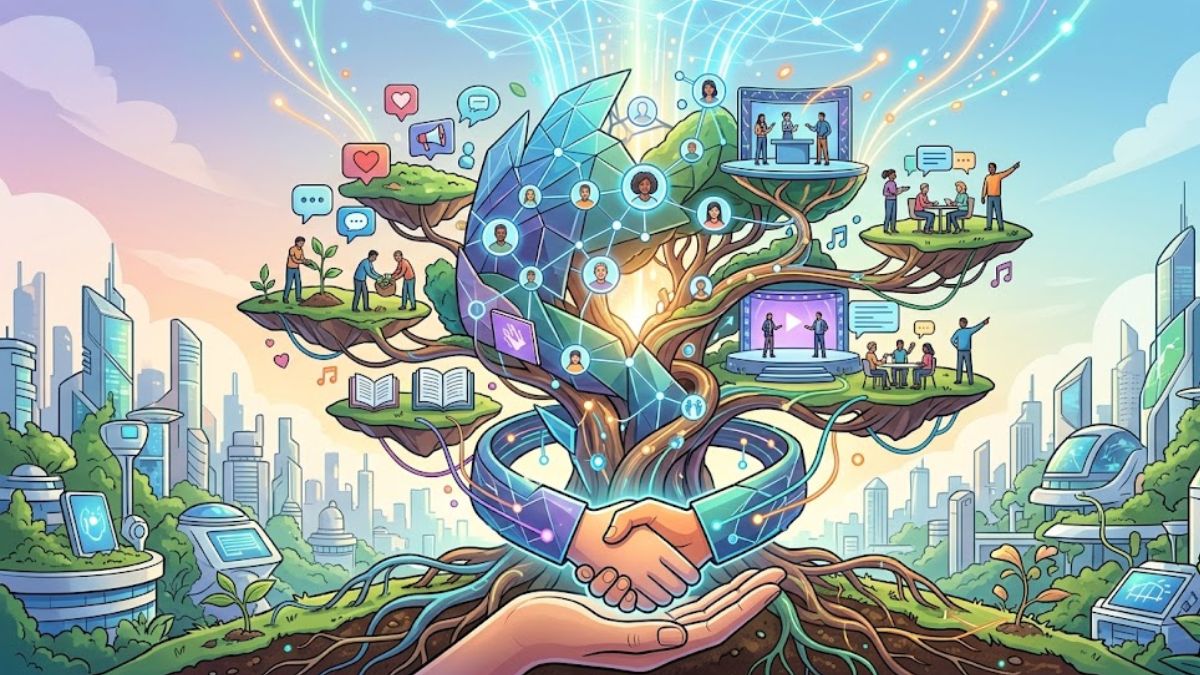
Why a Social Media Community Matters More Than Ever in 2026
In 2026, a Social Media Community is no longer something brands experiment with on the side. It has quietly become the core of how modern businesses grow, survive, and stay relevant. The way people connect with brands has changed completely. They are no longer satisfied with one-way communication. They don’t want to be spoken at. Want to be part of something, to interact, to feel included in a shared space where their voice actually matters.
This shift is very visible in India’s digital behavior. With more than 820 million internet users, attention is everywhere but trust is rare. What stands out is that over 75% of users now engage with brands through social platforms regularly, not just through ads or websites. That tells you something important. People are not just consuming content anymore, they are building relationships through it. And in that environment, a strong Social Media Community becomes more valuable than any single marketing campaign. It becomes the place where trust is built slowly, through repeated interaction, not forced messaging.
There is also a very human truth behind this shift
There is also a very human truth behind this shift. People remember spaces where they feel seen, not just sold to. When a community is built properly, it stops feeling like marketing and starts feeling like belonging. Users begin to recognize each other, share experiences, and interact without needing constant prompts from the brand. That kind of organic interaction creates loyalty that no advertisement can buy. This is why brands that invest seriously in community building often see around 3x higher engagement compared to those that rely only on promotional content. Because connection always outperforms interruption.
So the real question has changed. It is no longer about whether a Social Media Community is important. That is already clear. The real challenge is understanding how to build one that doesn’t just exist, but actually stays alive, grows naturally, and becomes part of people’s daily digital life.
- Why a Social Media Community Matters More Than Ever in 2026
- 1. What is a Social Media Community and Why It Works
- 2. Step-by-Step Guide: How to Build a Social Media Community
- 3. Role of Influencer Marketing and UGC in Community Building
- 4. Common Mistakes to Avoid
- 5. Long-Term Growth Strategy
- 6. Summary: Key Learnings
- About Hobo.Video
1. What is a Social Media Community and Why It Works
A Social Media Community is not a list of followers or a number on a dashboard. It is a living group of people connected by shared interest, emotion, or purpose around a brand or idea. The key difference is participation. Followers watch. Community members interact, respond, and contribute. That shift from passive consumption to active involvement is what makes communities so powerful.
Traditional marketing speaks to people. Community building speaks with them. And that difference changes everything about how trust is formed. Instead of pushing messages outward, brands start creating spaces where conversations happen naturally. Over time, users stop seeing the brand as just a company and start seeing it as part of their digital environment. That emotional shift is subtle, but extremely powerful.
1.1 Emotional Connection Drives Growth
Most brands underestimate how emotional digital behavior actually is. People rarely remember the exact content they saw. What they remember is how it made them feel. Did it feel helpful? Did it feel relatable? Feel like someone understood their situation? These emotional signals are what decide whether someone engages once or stays long-term.

Amplify Your Brand,
One Influence at a Time.
A strong social media engagement strategy is built around this emotional layer. For example, when a skincare brand shares real customer journeys instead of polished advertisements, the message changes completely. It stops being marketing and becomes reassurance. When a fintech startup simplifies financial concepts in a way that feels human and non-technical, it builds comfort instead of confusion. These are not just content formats. They are emotional experiences delivered through digital platforms. Over time, this emotional connection compounds. Users begin to trust the brand not because of what it sells, but because of how consistently it shows up in their lives in a useful way. That trust is what eventually turns into retention, referrals, and long-term loyalty.
1.2 Data Insight
When you look at data, the emotional impact becomes even clearer. Brands with active Social Media Communities consistently report stronger business outcomes. Studies show up to 60% higher customer retention, 2.5x more organic referrals, and around 30% lower acquisition costs compared to brands that focus only on paid promotion or one-way communication.
But the real insight is not just the numbers. It is what causes them. Retention increases because users feel connected. Referrals increase because people naturally share experiences they trust. Acquisition costs drop because the community itself starts driving awareness without constant ad spend. This is what makes digital community management so important. It is not just about engagement metrics. It directly influences business efficiency and growth stability.
2. Step-by-Step Guide: How to Build a Social Media Community
2.1 Step 1: Define Your Purpose Clearly
Before anything else, a community needs a reason to exist. This is where many founders silently struggle. They start posting, creating, and engaging without ever answering a simple question: why should someone care enough to join this space?
Without clarity of purpose, a community becomes random. It attracts attention but not loyalty. People may visit once, but they rarely return. A strong purpose gives direction to everything else content, tone, engagement style, even platform choice. It could be education, problem-solving, entertainment, or building a niche identity. But it must feel real and specific, not generic. When purpose is clear, everything changes. Content becomes focused. Audience expectations become aligned. And most importantly, people start understanding what they are part of. That sense of clarity is what turns passive viewers into active community members.
2.2 Step 2: Understand Your Audience Deeply
Most community failures don’t come from bad execution. They come from shallow understanding of the audience. Founders often assume they know their users, but in reality, they only know surface-level traits. Real understanding requires observation, patience, and listening.
You need to understand what problems your audience wakes up with, what content they naturally consume without being told, and where they already spend their attention. Different groups behave differently. Gen Z gravitates toward short, expressive content. Professionals lean toward structured insights. Creators prefer interactive and visual platforms. These differences are not minor. They define how your Social Media Community will grow. Strong audience engagement tactics are built on listening first, speaking later. When you understand your audience deeply, content stops feeling like guessing. It starts feeling like conversation.
2.3 Step 3: Choose the Right Platforms
Platform choice is one of the most underestimated decisions in community building. Not every platform supports every type of community. Each one has its own rhythm, attention span, and emotional tone. Instagram works best for visual storytelling and quick emotional connection. LinkedIn supports structured thinking and professional trust-building. Discord enables deep, ongoing conversations. YouTube builds long-term trust through sustained attention. Choosing correctly is not about being present everywhere. It is about being effective where your audience naturally behaves.
This is why community building for startups often succeeds or fails at this stage itself. If you choose the wrong platform, even great content struggles. But when platform and audience align, growth feels smoother and more organic.
2.4 Step 4: Build a Content System, Not Just Posts
Random posting is one of the fastest ways to kill momentum. Communities don’t grow through isolated content pieces. They grow through systems that create consistency and expectation. A strong system includes educational content that builds value, relatable content that builds emotional connection, interactive content that drives participation, and user-generated content that builds trust through real experiences. UGC videos are especially powerful because they remove the gap between brand and user perception.
This is also where AI UGC and AI influencer marketing are quietly changing how content is scaled. They help identify patterns, creators, and content formats faster. But the foundation still remains human experience. AI can support structure, but authenticity still drives connection.
2.5 Step 5: Focus on Conversations, Not Just Reach
Reach can make a community look alive, but conversations make it actually alive. A post that gets views but no responses is empty attention. A post that starts discussions, replies, and shared experiences is real engagement. Communities grow when people feel heard. Replying to comments, asking questions, and encouraging discussion turns content into interaction. Over time, users stop seeing content as broadcasted messages and start seeing it as a space to participate in. This shift is what defines strong digital community management. It is not about controlling conversations. It is about enabling them.
2.6 Step 6: Collaborate with Influencers
Influencers today are not just marketing channels. They are trust bridges. People already follow them, trust them, and engage with their content regularly. When they collaborate with a brand, they bring that trust along with them.
In India, influencer ecosystems have grown rapidly, especially with micro and niche creators becoming more important than just large accounts. These creators often have deeper engagement even with smaller audiences. Working with the right mix of creators helps accelerate Social Media Community growth significantly. Platforms that connect brands with creators simplify this process by matching relevance, not just reach. This makes influencer collaborations more natural and effective.
2.7 Step 7: Use Data to Improve
A community that is not measured eventually becomes guesswork. Data is not about limiting creativity. It is about understanding direction. Tracking engagement rates, saves, comments, shares, and conversions helps identify what actually resonates with people. Over time, patterns emerge. Some topics create deeper discussions. Some formats drive more participation. Posts convert better into community actions. This feedback loop is what transforms community building from intuition into refinement. It doesn’t remove emotion. It strengthens it by showing what truly connects with people over time.
3. Role of Influencer Marketing and UGC in Community Building
3.1 Why Influencers Matter
Influencer marketing has stopped being just a marketing tactic. It has become a trust shortcut in a world where attention is overloaded and skepticism is high. In India, the influencer marketing industry is expected to cross ₹3,500 crore by 2026, but the real story behind that number is not growth in spending. It is growth in belief. People are slowly trusting individuals more than institutions, creators more than brands, and lived experiences more than polished advertisements.
There is a simple emotional truth behind this shift. People don’t wake up wanting to believe ads. They wake up wanting to believe other people like them. That is why influencer content often performs better even when production quality is lower. It feels real. It feels unfiltered. And in a digital environment filled with noise, “real” becomes more valuable than “perfect.” This is exactly why working with the right influencer ecosystem or platform can accelerate Social Media Community growth so quickly. It doesn’t just increase visibility. It transfers credibility.
But what many founders learn after experience is that influencer marketing is not just about reach. It is about alignment. When the creator’s voice naturally matches the brand’s tone, the message flows without resistance. It doesn’t feel like promotion. It feels like recommendation. And that emotional difference is what determines whether an audience listens once or starts trusting repeatedly. The strongest communities are often built when influencer relationships feel less like transactions and more like shared belief systems.
3.2 Power of UGC Videos
User-generated content is where community stops being theory and becomes visible reality. UGC Videos are powerful not because they are professionally made, but because they are not. They carry imperfections, spontaneity, and honesty. And those small imperfections are exactly what make them believable. When a real user shares their experience with a product or service, it creates something traditional advertising cannot replicate: unfiltered validation. There is no script, no polished brand voice, just genuine experience. And audiences respond to that instinctively. They don’t analyze it. They feel it. That feeling of “this is real” builds trust much faster than any branded campaign.
Over time, UGC becomes a growth engine on its own. It feeds online community growth naturally because users begin participating, not just consuming. They start sharing their own experiences, their own stories, and their own interpretations of the brand. This creates a loop where the community starts producing content for itself. And once that happens, growth becomes less dependent on the brand pushing and more dependent on users contributing.
The emotional shift here is important. When users see people like themselves being part of a brand’s story, they don’t feel marketed to. They feel included. And inclusion is one of the strongest drivers of long-term engagement in any Social Media Community.
3.3 AI is Changing the Game
Artificial intelligence has added a new layer to influencer marketing and UGC, but not in the way most people assume. It is not replacing creativity. It is organizing and accelerating it. With AI influencer marketing tools, brands can now identify creators who actually match their audience, predict campaign performance, and reduce the trial-and-error that used to take months. This shift is significant because earlier influencer selection was often based on intuition or surface-level metrics like follower count. Now, AI can analyze engagement quality, audience overlap, content style, and even sentiment to suggest better matches. This makes campaigns more efficient and less random. It also helps smaller brands compete with larger ones by making creator discovery more accessible and data-driven.
But there is an important limitation that experienced marketers understand deeply. AI can optimize structure, but it cannot create emotional resonance. It can tell you who to work with, but it cannot replace the human connection that makes content believable. The moment influencer content feels overly optimized or artificial, audiences disconnect. People can sense when something is engineered too heavily. So the real winning approach is balance. Use AI to reduce friction, improve targeting, and scale decisions. But let humans handle storytelling, emotion, and authenticity. Because at the end of the day, communities are not built by algorithms. They are built by feelings that algorithms help distribute.
4. Common Mistakes to Avoid
Most Social Media Community failures don’t happen suddenly. They happen slowly, through small mistakes repeated over time. One of the biggest mistakes is posting without direction. When there is no clear content plan, everything starts feeling disconnected. The audience sees activity, but not meaning. And without meaning, engagement naturally fades. Another common mistake is ignoring audience feedback. Communities are not one-way channels. They are conversations. When brands stop listening, users slowly stop responding. Comments get ignored, suggestions are overlooked, and over time, the community begins to feel invisible. That emotional distance is hard to recover from once it sets in.
A third major issue is focusing only on sales. When every piece of content feels like a pitch, people disengage quickly. Users don’t join communities to be sold to. They join to learn, connect, or feel part of something. If that experience is constantly interrupted by sales pressure, trust weakens. And once trust breaks, no amount of content can fully restore it easily. Inconsistent posting is another silent killer. Not because algorithms punish it, but because people forget. Communities are built on familiarity. If you disappear too often, you stop existing in the user’s mental space. And once you stop being remembered, engagement naturally drops.
Avoiding these mistakes is not just about improving performance. It is about protecting the emotional consistency of your Social Media Community. Because communities don’t collapse from one big failure. They fade from repeated small disconnects.
5. Long-Term Growth Strategy
A strong Social Media Community is never built quickly. It is not a campaign or a launch phase. It is a slow accumulation of trust, interaction, and shared experience. At the beginning, growth feels uncertain. Engagement fluctuates. Some posts work, others don’t. That unpredictability is part of the process, not a sign of failure. Over time, something important begins to change. Consistency starts building recognition. People begin to recognize your tone, your ideas, and your presence. Even before they fully engage, they start expecting your content. That expectation is the first real sign that a community is forming. Because it means you are no longer just appearing randomly. You are becoming part of their digital routine.
Sustainable growth comes from three things that seem simple but are difficult to maintain: consistency, value creation, and real conversations. Consistency ensures you remain visible. Value ensures people have a reason to stay. Conversations ensure the relationship becomes two-sided instead of one-sided. When all three align over time, the community starts to grow on its own. At that stage, something very powerful happens. Your community stops depending entirely on your output. Users start interacting with each other. They start sharing experiences without being prompted. They start defending, recommending, and expanding the ecosystem naturally. That is when your Social Media Community stops being just an audience and becomes a living network.
6. Summary: Key Learnings
At the core of everything, one truth stands out clearly. A Social Media Community is not built through content alone. It is built through trust, repetition, and emotional connection over time. Content is just the entry point. The real value comes from what happens after attention is captured. The strongest communities are not the ones that post the most. They are the ones that focus on value instead of volume. They don’t chase every trend. Build around clarity and consistency. Influencers and UGC help speed up trust, but they only work when there is already a strong foundation of authenticity underneath.
Most importantly, engagement matters more than reach. Reach shows how many people saw you. Engagement shows how many people felt something. And communities are not built on visibility alone. They are built on feeling, interaction, and belonging. In the end, a Social Media Community is not just a growth strategy. It is a long-term relationship with people who choose to stay connected because they see value in being part of your space.
FAQs
What is a Social Media Community?
A Social Media Community is a group of engaged users connected around a brand or shared interest. It focuses on interaction, not just followers.
How to build a social media community?
Start with a clear purpose, understand your audience, create valuable content, and engage consistently.
Which platform is best for community building?
It depends on your audience. Instagram, LinkedIn, and Discord are popular choices in 2026.
How long does it take to grow a community?
It usually takes 3–6 months to see initial traction and 12+ months for strong growth.
Why is UGC important?
UGC builds trust and authenticity. Users trust real experiences more than brand ads.
About Hobo.Video
Hobo.Video is India’s leading AI-powered influencer marketing and UGC company. With over 2.25 million creators, it offers end-to-end campaign management designed for brand growth. The platform combines AI and human strategy for maximum ROI.
Services include:
- Influencer marketing
- UGC content creation
- Celebrity endorsements
- Product feedback and testing
- Marketplace and seller reputation management
- Regional and niche influencer campaigns
Trusted by top brands like Himalaya, Wipro, Symphony, Baidyanath and the Good Glamm Group.
Let’s create a growth roadmap built just for your brand. We’re listening – register now.
Your reach deserves rewards. Let’s make that happen. Tap to sign up.

 Neeti Katyal
 Ankita Saha