
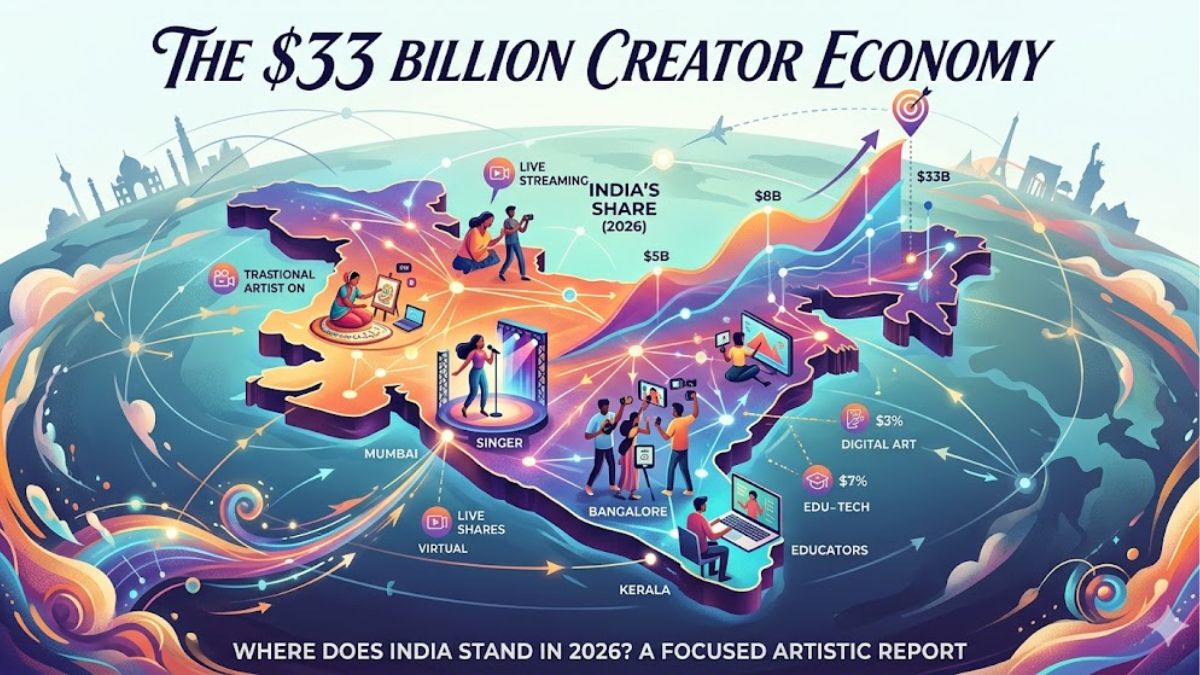
The digital world has witnessed many revolutions over the past two decades. However, few have transformed careers, businesses, and consumer behavior as dramatically as the Creator Economy. What started as a handful of bloggers, YouTubers, and social media personalities has evolved into a global industry worth approximately $33 billion in 2026. Today, millions of individuals earn income by creating content, building communities, and influencing purchasing decisions. The Creator Economy is no longer a niche trend. It has become a major economic force shaping the future of marketing, entertainment, education, and commerce.
India sits at the center of this transformation. With one of the world’s largest internet populations and rapidly growing smartphone adoption, the Creator Economy has created opportunities for creators across cities, towns, and rural regions. From technology reviewers and finance educators to lifestyle vloggers and regional content creators, India’s creator ecosystem is expanding at an extraordinary pace. Yet an important question remains: where does India truly stand in the global Creator Economy in 2026?
- 1. Understanding the Creator Economy
- 2. How the Global Creator Economy Reached $33 Billion
- 3. India’s Journey into the Creator Economy
- 4. Why India Is Uniquely Positioned for Growth
- 5. The Rise of Regional Creators
- 6. The Role of Influencer Marketing in Creator Growth
- 7. Creator Economy Platforms Driving Growth
- 8. Shopify and Creator Commerce
- 9. The TikTok Effect on Global Creator Growth
- 10. Creator Economy Companies Building the Future
- 11. AI and the Future of Content Creation
- 12. India’s Biggest Opportunities in 2026
- 13. Challenges Facing the Indian Creator Economy
- 14. The Role of Venture Capital and Startup Funding
- 15. How to Become an Influencer in the Creator Economy
- 16. Where India Stands in the Global Creator Economy
- About Hobo.Video
1. Understanding the Creator Economy
1.1 What is the Creator Economy?
At its core, the Creator Economy is what happens when individuals can build an audience online and earn a living from it. That’s the whole thing. The platforms, the agencies, the brand deals, the monetization tools, all of it sits on top of that basic dynamic. Creators distribute content across YouTube, Instagram, podcasts, newsletters, blogs, community platforms, and live streaming. They build audiences who trust them. And increasingly, they operate less like hobbyists and more like small businesses, with teams, revenue streams, and intellectual property that extends well beyond any single platform. That last shift matters. When researchers writing about the creator economy describe creators as entrepreneurs rather than entertainers, they’re pointing at something real. The mental model of “person who posts videos” has been replaced, at least at the professional level, by something closer to “media company run by one person with distributed ownership of their audience relationship.”
1.2 Why It Matters
Institutions have a trust problem. Brands have a trust problem. Creators, the ones who’ve built genuine relationships with their audiences, largely don’t. That asymmetry is what drives the entire influencer marketing industry and a significant portion of how consumer decisions get made in 2026. When someone with 200,000 engaged followers recommends a product, a meaningful percentage of those followers will act on it. The same brand spending the same money on display advertising won’t come close to that conversion rate. That’s not an opinion. It’s why brand spending on creator partnerships keeps growing while other digital ad budgets face more scrutiny.
2. How the Global Creator Economy Reached $33 Billion
The growth wasn’t linear and it wasn’t driven by one thing. Affordable smartphones brought hundreds of millions of people online who previously didn’t have consistent internet access. Faster mobile data made video consumption practical for those users. Social platform expansion gave creators distribution without requiring them to build their own audiences from scratch. And as creator audiences grew, brands followed with budgets, which gave creators revenue, which enabled more professional content, which attracted larger audiences.
That flywheel has been spinning for about a decade and it hasn’t stopped. What’s also changed is the revenue mix. Creator income used to mean primarily ad revenue from platforms. Now it spans subscriptions, memberships, online courses, consulting, affiliate income, product sales, brand partnerships, and licensing. A creator with 500,000 YouTube subscribers might derive less than a third of their income from YouTube’s ad share. The rest comes from everything they’ve built around that audience. Business Insider’s creator economy coverage has tracked this diversification for years. The numbers in 2026 reflect an industry that has matured past dependence on any single revenue mechanism.
2.1 Key Numbers Defining 2026
The global creator economy sits at approximately $33 billion. YouTube has over 2 billion logged-in monthly users. India has crossed 900 million internet users. Global influencer marketing spend continues growing annually. Millions of creators now generate meaningful income through digital platforms. These figures explain why serious investors are funding creator economy companies and creator-focused infrastructure, not as a bet on a trend, but as a bet on a structural shift in how media and commerce work.

Amplify Your Brand,
One Influence at a Time.
3. India’s Journey into the Creator Economy
3.1 The Early Days
Ten years ago in India, content creation as a career was a punchline in a lot of households. Parents pushed engineering, medicine, finance. Brands barely looked at creators. The idea that someone could build a sustainable income making YouTube videos or Instagram posts was viewed with the same skepticism reserved for people who said they wanted to be musicians. That view wasn’t entirely unreasonable given the infrastructure at the time. Monetization was limited, brand deals were rare, and the platforms themselves hadn’t fully figured out their creator economics.
3.2 The Shift Toward Professional Creation
What exists now is categorically different. Indian creators operate businesses. They hire editors, managers, and social media coordinators. Launch merchandise lines and courses. They build startups off the back of audience trust. Creators who started on Instagram have expanded into YouTube, podcasts, and physical products. The famous Instagram influencers of five years ago are in many cases running multi-channel media operations today. The professionalization happened faster than most people expected, and it’s still accelerating.
4. Why India Is Uniquely Positioned for Growth
4.1 Massive Internet Penetration
India’s digital audience is enormous and still growing. Affordable smartphones and genuinely cheap mobile data, cheaper than almost anywhere else in the world, changed the access equation for hundreds of millions of people. Content consumption that previously required a laptop and a broadband connection now happens on a phone with a ₹200 monthly data plan. That accessibility doesn’t just expand the audience. It expands the pool of potential creators, people who can now produce and distribute content without significant infrastructure investment.
4.2 Diverse Languages Create Opportunities
Most large content markets are linguistically unified in a way India simply isn’t. That fragmentation, which can look like a complication, is actually one of the most interesting structural features of India’s creator economy. A Tamil-speaking creator in Chennai building an audience of Tamil speakers understands that audience’s cultural references, humor, and concerns in a way that national English-language media never will. The engagement numbers from regional-language creators consistently reflect this. Audiences connect more deeply when the content feels like it was made for them specifically rather than adapted from something broader.
5. The Rise of Regional Creators
Hindi dominates in volume, but the story of India’s creator economy in 2026 is increasingly a regional story. Tamil, Telugu, Bengali, Marathi, Punjabi, Malayalam, and Kannada creators are all growing rapidly. They’re not growing as a secondary tier below the Hindi and English creators. In many categories and for many brands, they’re the primary target. Brands have noticed. Influencer marketing India campaigns that once defaulted to a handful of national creators with large followings now routinely include regional creators as core components of the strategy rather than afterthoughts.
The audience is there, the trust is there, and the conversion rates from highly specific community relationships tend to justify the investment. This is genuinely good for the creator ecosystem overall. It means the earning opportunity isn’t concentrated in a handful of metros and a handful of languages. A creator building an audience in Coimbatore or Patna or Kochi has a real path to brand partnerships and sustainable income that didn’t exist five years ago.
6. The Role of Influencer Marketing in Creator Growth
6.1 Brands Need Authentic Communication
Direct advertising has a diminishing returns problem. Consumers have seen enough ads to know when they’re being sold to, and their response is increasingly to tune out. The brands that have figured out creator partnerships as an alternative aren’t doing it because it’s trendy. They’re doing it because it works better. Creators provide something brands can’t manufacture internally: an authentic relationship with a specific audience. Brands provide resources and products worth talking about. When the fit is right, both parties benefit and the audience gets a recommendation they can actually trust.
6.2 Why Businesses Are Investing More
The organizations allocating serious budget to creator partnerships are making that decision based on performance data, not marketing intuition. Return on influencer spend, especially with mid-tier and micro creators who maintain high engagement, regularly outperforms equivalent spending on conventional digital advertising. Business Insider’s creator economy coverage has consistently documented rising brand investment in this space. The direction of that trend hasn’t changed. If anything, the shift from experimental budget to core marketing budget is accelerating.
7. Creator Economy Platforms Driving Growth
7.1 Technology Powers Modern Creation
The platforms are easy to take for granted because they’re ubiquitous, but the infrastructure they provide is what makes professional creation at scale possible. YouTube handles distribution and monetization for video. Instagram handles discovery and brand connection. Patreon and Discord enable direct monetization and community management. Shopify lets creators with audiences turn those audiences into customers for physical and digital products. Creator marketplaces connect brands with creators efficiently. Each of these tools would have required significant independent infrastructure to build a decade ago. Now they’re accessible to anyone with a phone and something worth saying.
7.2 The Importance of Infrastructure
The Creator Economy is not just about the creators. The platforms, the payment systems, the analytics tools, the brand partnership marketplaces, and the creator management agencies form an ecosystem that enables creators to operate professionally without having to solve every problem themselves. That infrastructure is why investors continue funding creator economy companies even as the market matures. The tooling around creators, the picks and shovels of this particular gold rush, remains a meaningful opportunity precisely because the creator class it serves keeps growing.
8. Shopify and Creator Commerce
Ad revenue was always an unstable foundation for a creator business. Platform algorithms change, CPM rates fluctuate, and you’re essentially renting access to your own audience through whatever monetization structure the platform decides to offer that quarter. The shift toward creator commerce changes that equation. Creators who sell merchandise, courses, memberships, digital products, and physical goods directly to their audiences are building something more durable than an ad-dependent income stream. The Shopify creator economy isn’t just a revenue diversification story, it’s a structural shift in the relationship between creator and audience. Instead of the audience being the product sold to advertisers, the audience becomes the customer.
Creator-led commerce is growing faster than most other segments of the creator economy for a reason that isn’t complicated: trust converts. An audience that follows a creator because they genuinely value what that person makes is a far more receptive customer than a cold audience seeing a brand ad. The creator has already done the relationship-building. The commerce is an extension of that.
9. The TikTok Effect on Global Creator Growth
TikTok’s direct impact in India was cut short, but its influence on how content gets made and consumed here didn’t disappear with the ban. The format won. What TikTok demonstrated at scale was that short-form video could be produced by almost anyone, distributed to massive audiences without an existing following, and consumed in quantities that longer formats couldn’t match. The production barrier dropped dramatically. A compelling fifteen-second clip shot on a phone could outperform polished content from established creators. That changed the calculus for who could realistically enter the creator economy.
YouTube Shorts and Instagram Reels absorbed those lessons quickly. Indian creators adapted just as fast. The audience behavior that TikTok cultivated globally, habitual short-form video consumption, had already taken root before the platform left India. What remained was a format expectation that the surviving platforms were happy to fill.
10. Creator Economy Companies Building the Future
The conversation about the creator economy tends to focus on the creators, which makes sense. But the companies building infrastructure around them are where a significant portion of the economic value is accumulating. Creator marketplaces connect brands with relevant creators more efficiently than manual outreach. Analytics providers help creators and brands understand what’s actually working beyond surface metrics. Payment platforms handle the complexity of creator monetization across multiple revenue streams. AI tools are reducing production overhead. Campaign management software makes it possible for small teams to run what would previously have required agencies.
Investor interest in this layer of the ecosystem reflects a straightforward bet: the creator class keeps growing, the tools serving them will grow with it, and the infrastructure companies serving millions of creators have scale potential that any individual creator doesn’t. The picks-and-shovels logic applies here as clearly as it does anywhere.
11. AI and the Future of Content Creation
The practical impact of AI on creator workflows is already significant and largely unglamorous. Editing that took hours moves faster. Research that required manual searching gets compressed. Caption generation, thumbnail testing, analytics interpretation, these are real time costs that AI tools are reducing in ways that make a meaningful difference to a solo creator or small team. AI UGC platforms are helping brands and creators scale content production without proportionally scaling headcount. That’s a genuine operational improvement.
What AI hasn’t changed, and what the evidence suggests it won’t change in any near-term timeframe, is why audiences follow specific creators. They follow people whose perspective they find interesting, whose honesty they trust, whose specific way of seeing things resonates with them. Those are human qualities. The creators who understand AI as a production tool rather than a creative replacement tend to use it better and worry about it less. The future in this space belongs to creators who use the efficiency gains from AI to make more and better human content, not to those trying to automate the human element out of the equation.
12. India’s Biggest Opportunities in 2026
12.1 Untapped Regional Markets
The regional creator opportunity in India is still early despite how much has already been built. Creators serving specific linguistic communities with genuine local understanding are consistently finding audiences that national content wasn’t reaching. The engagement in these communities tends to run deep. Brand interest is following.
12.2 Education-Based Content
Financial literacy, career guidance, technology education, and business content are categories where Indian audiences are genuinely hungry and underserved by formal institutions. Creators who can explain complex topics in accessible, culturally relevant ways attract highly engaged audiences. Brands in adjacent categories pay attention to that engagement because the intent signal is strong.
12.3 Creator-Led Businesses
The most ambitious development in India’s creator economy right now is creators who treat their audience as a launchpad rather than an endpoint. A creator with 500,000 genuinely engaged followers has something most startups spend years trying to build: a customer base that already trusts them. The creators who recognize that and build products and services around it are building something substantially more valuable than a content channel.
13. Challenges Facing the Indian Creator Economy
13.1 Income Stability
Inconsistent earnings remain the reality for the majority of working creators. Brand deals fluctuate. Platform algorithm changes affect revenue. Viral moments don’t reliably repeat. Revenue diversification helps, but building multiple income streams takes time and most creators are operating with limited runway while they figure it out.
13.2 Platform Dependency
Concentration risk is real. A creator whose income is heavily tied to one platform is exposed to decisions made by that platform’s product and policy teams. Algorithm changes that reduce organic reach, monetization policy shifts, or platform-level regulatory issues can significantly affect a creator’s business through no fault of their own. Building owned channels, email lists, direct communities, is the mitigation, but it takes sustained effort that not every creator prioritizes.
13.3 Market Competition
The barrier to entry in content creation is low, which is what makes it accessible and also what makes it crowded. As the number of creators grows, the importance of a genuine point of view and a specific audience relationship grows with it. Generic content has always been replaceable. In 2026, the market makes that reality more visible faster.
None of these challenges are unique to India. They’re present in every mature creator economy. The difference is that India’s ecosystem is still developing the support structures, creator education, financial products designed for variable income, better monetization infrastructure, that help individual creators navigate them.
14. The Role of Venture Capital and Startup Funding
Investor interest in creator-focused businesses has moved from exploratory to committed in the last few years. Firms like Antler have made the creator economy an explicit focus, and the broader VC community has followed. The investment thesis is straightforward enough. Creator-driven businesses often have lower customer acquisition costs because the creator has already built the trust that acquisition spend tries to manufacture. The audience relationships are durable. And the infrastructure serving those creators scales efficiently. Funding is flowing into platform development, monetization solutions, creator education, and commerce infrastructure. Each of these strengthens the ecosystem in ways that benefit individual creators even when the investment isn’t going directly to them.
15. How to Become an Influencer in the Creator Economy
The question gets asked constantly and the answer hasn’t changed much: build something real for people who actually care about it, and do it consistently for longer than feels comfortable. The specific steps matter less than the underlying orientation. Creators who approach content as a genuine service to a specific audience, people who care about X thing, and I’m going to help them understand or enjoy or navigate X thing better, tend to build more durable careers than creators chasing formats or trends.
The practical requirements are real though. You have to understand your audience well enough to know what they actually need, not just what gets clicks. Have to develop expertise in something specific enough to be worth following. You have to create consistently enough to stay present. You have to build trust through honesty, including about what you don’t know. And you have to adapt as platforms, formats, and audience expectations evolve. The creators who treat this like a business from the beginning, thinking about revenue diversification, audience ownership, and long-term relationship building rather than just content output, tend to be the ones still operating at scale five years later.
16. Where India Stands in the Global Creator Economy
India is not catching up to the global creator economy. It’s a central part of it. The audience scale is among the largest in the world. The creator population is growing faster than most comparable markets. Regional content is producing engagement that challenges the assumption that English-language or Hindi-language content represents the whole picture. And creators who started by building influence are increasingly building businesses, launching products, founding companies, and creating media brands with reach and durability that go well beyond any individual platform.
The road ahead has real challenges, income volatility, platform dependency, market saturation in some categories. But the structural conditions, internet penetration still growing, regional markets still underdeveloped, brand spending on creator partnerships still increasing, point in the same direction they’ve been pointing for several years. India’s creator economy in 2026 is large, diverse, and still early in its full potential. The creators, brands, and infrastructure companies that understand that clearly are better positioned than those still treating it as a trend to monitor rather than a reality to build within.
Frequently Asked Questions
What is the Creator Economy?
The Creator Economy is an ecosystem where individuals earn income by creating content and building online audiences across digital platforms.
How large is the Creator Economy in 2026?
Industry estimates place the Creator Economy at approximately $33 billion globally, with continued growth expected.
Why is India important to the Creator Economy?
India has one of the world’s largest internet populations, making it a significant contributor to creator growth and audience development.
What is a creator economy platform?
A creator economy platform provides creators with tools for content distribution, monetization, audience engagement, and business growth.
How does influencer marketing support creators?
Brands pay creators to promote products and services, creating a major revenue source within the creator ecosystem.
About Hobo.Video
Hobo.Video is India’s leading AI-powered influencer marketing and UGC company. With over 2.25 million creators, it offers end-to-end campaign management designed for brand growth. The platform combines AI and human strategy for maximum ROI.
Services include:
- Influencer marketing
- UGC content creation
- Celebrity endorsements
- Product feedback and testing
- Marketplace and seller reputation management
- Regional and niche influencer campaigns
Trusted by top brands like Himalaya, Wipro, Symphony, Baidyanath and the Good Glamm Group.
Together, we’ll make your brand growth feel natural and doable. Let’s begin.
Your reach deserves rewards. Let’s make that happen. Tap to sign up.

 Neeti Katyal
 Jyoti Pandey