
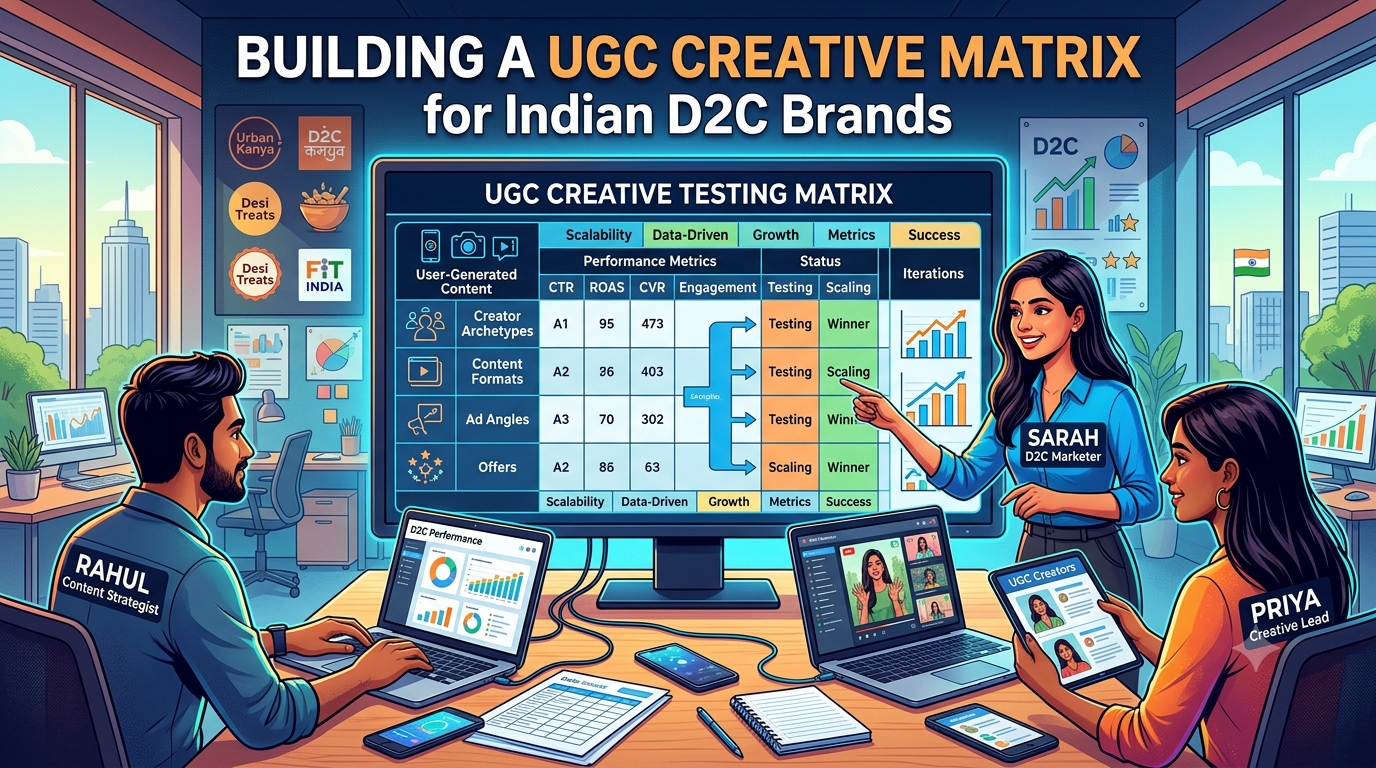
Imagine you run a skincare brand selling products through your website. Your team creates a UGC video featuring a creator explaining how to use your moisturizer. You launch the video as a paid advertisement. Initially, the creative attracts attention, and people visit your website. However, you are unsure whether the results come from the creator, the opening hook, the product demonstration, or the offer.
Your team creates another video with a different creator. It performs differently, but nobody knows exactly why.
Soon, your advertising folder contains dozens of videos. Some generate clicks, others attract comments, and a few lead to purchases. Yet, your team struggles to identify which creative elements deserve more investment. The problem is not necessarily a lack of content. It is a lack of structured testing.
This is where a UGC creative testing matrix becomes useful. A creative testing matrix helps marketers organise advertising experiments around specific variables. These variables might include opening hooks, creator styles, product demonstrations, customer objections, video formats, and calls to action. Instead of producing advertisements based on guesswork, teams can develop a repeatable process for learning what resonates with their audiences.
For Indian direct-to-consumer (D2C) brands, this approach can make creative production more organised. It can also help teams use their existing advertising budgets more deliberately. In this guide, we explain how to build a UGC creative testing matrix, select the right variables, evaluate performance, and turn campaign findings into practical creative decisions.
- 1. What Is a UGC Creative Testing Matrix?
- 2. Why Indian D2C Brands Need a Structured Creative Testing Process
- 3. Choose the Right Variables for Your UGC Creative Testing Matrix
- 4. Build Your First UGC Creative Testing Matrix in Google Sheets
- 5. Select Metrics That Match Your Campaign Objective
- 6. Run Better Creative Experiments Without Wasting Your Budget
- 7. A Practical UGC Creative Testing Matrix for an Indian D2C Brand
- 8. How to Turn Testing Results Into a Repeatable Creative Workflow
- 9. Common Mistakes to Avoid When Building a Creative Testing Matrix
- 10. Conclusion: Make Every Creative Test Teach You Something
- About Hobo.Video
1. What Is a UGC Creative Testing Matrix?
A UGC creative testing matrix is a structured framework for planning, testing, and comparing different versions of user-generated content (UGC) advertisements. It organises creative elements into categories so marketers can identify what they want to test and measure. For example, a skincare brand might test three different opening hooks:
- A problem-focused hook about dry skin.
- A product-focused hook demonstrating a moisturiser.
- A question-based hook about choosing the right skincare routine.
The brand can then compare these hooks while keeping the remaining elements as consistent as possible. The objective is to understand which variation performs better against the campaign’s chosen goal. A matrix can be created in Google Sheets, Microsoft Excel, or another spreadsheet application. You do not need specialised software to begin.

Amplify Your Brand,
One Influence at a Time.
1.1 How does the matrix work?
A simple matrix could contain these columns:
| Test ID | Variable | Version A | Version B | Primary metric | Result |
|---|---|---|---|---|---|
| T01 | Opening hook | Problem-focused | Question-based | CTR | Pending |
| T02 | Product demonstration | Talking-head video | Demonstration video | Landing-page views | Pending |
| T03 | Creator presentation | Direct-to-camera | Voice-over | Purchase conversion rate | Pending |
| T04 | CTA | Shop the product | Explore the collection | Cost per acquisition | Pending |
| T05 | Video structure | Tutorial | Customer-problem narrative | Purchases | Pending |
This is a planning template, not a report of actual campaign results. Each row represents a specific experiment. The team records the creative variations, defines the relevant metric, and evaluates the findings after the test. The most important principle is simple: every test should have a clear question.
Testing two videos without knowing what you want to learn makes the results harder to interpret. For instance, if you change the creator, hook, offer, video length, and CTA simultaneously, you might discover that one advertisement performs better. However, you will not know which change contributed to the difference. A structured matrix makes the learning process more deliberate.
1.2 Why is this different from a regular content calendar?
A content calendar answers questions such as:
- What content should we publish?
- When should we publish it?
- Which platform should receive the content?
- Who is responsible for creating it?
A creative testing matrix answers a different set of questions:
- Which advertising element should we test?
- What is our hypothesis?
- Which metric will help evaluate the test?
- What did the results teach us?
- What should we test next?
Both tools are useful, but they serve different purposes. A content calendar manages production and publishing. A testing matrix manages experimentation and learning. Brands can use both together to connect creative production with performance marketing. For a broader introduction to UGC and its role in digital campaigns, see Hobo.Video’s article on UGC in Digital Marketing: Full Funnel Strategy for Growth.
2. Why Indian D2C Brands Need a Structured Creative Testing Process
Indian D2C businesses often advertise across several digital channels while serving audiences with different preferences, budgets, and shopping habits. A beauty brand may target customers looking for affordable skincare. A food brand may focus on convenience and taste. A home-products business may need to demonstrate product functionality before customers feel comfortable purchasing. These differences influence the types of creative messages a brand should explore.
A single advertising format might not communicate every product’s value effectively. For example, a short product demonstration may be useful for a kitchen gadget. A personal-experience narrative may better communicate how a skincare product fits into a routine. A comparison video might help explain the differences between two product variants. The right format depends on the product, the audience, the offer, and the campaign objective. A structured testing process helps teams investigate these differences instead of relying entirely on assumptions.
2.1 Problem 1: Teams produce more videos without building on previous learning
Imagine a brand creates 20 UGC advertisements in a month. Each video has a different creator, script, opening hook, background, and product demonstration. The team publishes them but does not document the creative differences.
At the end of the month, it may know which advertisements generated purchases. However, it may struggle to explain why they performed differently. The following month’s production could repeat the same trial-and-error process. A creative matrix provides a record of the experiments and their outcomes. This makes previous findings easier to use when planning new advertisements.
2.2 Problem 2: Creative decisions become subjective
Marketing teams sometimes choose advertisements because they look professional, feature an attractive creator, or receive positive internal feedback. These considerations may help assess creative quality, but they do not automatically establish advertising effectiveness.
An advertisement can look polished and still struggle to generate qualified traffic. A simple demonstration can attract fewer comments but produce more purchases. The appropriate evaluation depends on the campaign’s objective.
For an awareness campaign, reach and brand-lift measures may be relevant. For a sales campaign, purchases, conversion rate, and acquisition cost may be more useful. A matrix encourages the team to agree on its evaluation criteria before the experiment begins.
2.3 Problem 3: Brands confuse creative problems with other campaign problems
A decline in advertising performance does not always mean the video needs replacing. The problem could involve:
- A change in audience composition.
- A product price that no longer feels competitive.
- A discount or offer that has ended.
- A slow-loading landing page.
- A product that is out of stock.
- A checkout process that creates friction.
- A tracking or attribution issue.
If a brand changes its creative without investigating these factors, it might spend money solving the wrong problem. A creative testing matrix should therefore sit alongside campaign, website, and conversion data. Creative testing is not about producing endless variations. It is about reducing uncertainty and making better decisions.
3. Choose the Right Variables for Your UGC Creative Testing Matrix
The effectiveness of a testing matrix depends on the variables you include. If you track too few variables, you may miss important differences. If you test everything simultaneously, interpreting the results becomes difficult. The solution is to group creative elements into practical categories.
3.1 Opening hooks
The hook is the opening element designed to capture attention and establish why the viewer should continue watching. It could be a spoken statement, a visual demonstration, a question, or a relatable situation. For an Indian skincare brand, possible hooks include:
- Problem-focused: “Does your skin feel dry even after moisturising?”
- Demonstration-focused: Show the product’s texture immediately.
- Question-based: “What should you look for in a daily moisturiser?”
- Routine-focused: Show where the product fits into a morning routine.
- Objection-focused: Explain how to evaluate whether a product suits a particular skin type.
These examples are creative concepts, not claims about product effectiveness. A brand should ensure that all statements are truthful, supportable, and appropriate for its product. Testing recommendation: Start by testing two or three hooks while keeping the creator, offer, body of the video, and CTA as consistent as practical. This helps the team investigate the opening message rather than comparing completely different advertisements.
3.2 Creator presentation
The creator’s presentation style can influence how viewers experience the advertisement. Possible variations include:
- A creator speaking directly to the camera.
- A voice-over accompanying product footage.
- A step-by-step tutorial.
- A demonstration filmed from the user’s perspective.
- A creator answering a common customer question.
- A first-person product experience.
The goal is not to assume that one format works universally. Instead, identify the presentation style that communicates the product’s value most effectively to the intended audience. A brand selling kitchen products might test a demonstration against a direct-to-camera explanation. A fashion brand might compare a styling tutorial with an outfit-transition video. These tests should reflect the actual buying questions customers have.
3.3 Product demonstration
A product demonstration shows the product in use or explains a relevant feature. The appropriate demonstration depends on what customers need to understand before purchasing. For example:
| Product category | Possible demonstration |
|---|---|
| Skincare | Texture, application method, and routine placement |
| Kitchen appliances | Setup, controls, and everyday use |
| Fashion | Fit, styling combinations, and garment details |
| Home organisation | Before-and-after organisation, where accurate |
| Food products | Preparation, serving, ingredients, or packaging |
| Consumer electronics | Setup, features, and practical operation |
The demonstration should be accurate. Avoid editing footage in ways that misrepresent product performance. For categories involving health, beauty, food, or other regulated claims, verify that statements and demonstrations comply with the applicable requirements.
Testing recommendation: Compare a feature-led demonstration with a use-case-led demonstration. The first explains what the product does. The second shows how the product fits into a customer’s situation.
3.4 Messaging and customer objections
Customers may hesitate to purchase because they have unanswered questions. Common concerns include price, convenience, product suitability, maintenance, delivery, and compatibility. A brand can use its creative testing matrix to explore different ways of addressing these concerns.
For example, an electronics brand might test a feature-focused message against an ease-of-use message. A home-products brand might compare a convenience-led explanation with a durability-focused explanation, provided its durability claims are substantiated. The best message should reflect genuine customer concerns rather than invented problems.
Useful sources for identifying those concerns include:
- Customer reviews.
- Customer support conversations.
- Product questions on the website.
- Search queries.
- Returns and refund reasons.
- Feedback from sales and service teams.
This approach connects creative development to actual customer experience.
3.5 Calls to action
A call to action (CTA) tells viewers what to do next. Examples include:
- Explore the collection.
- View product details.
- Shop the product.
- Compare available options.
- Discover the full range.
Different CTAs may suit different stages of the buying journey. Someone encountering a brand for the first time may need more information. Someone already comparing product variants may be ready to view a specific product page. Test CTAs in the context of the campaign’s objective. A change in CTA wording alone may not explain performance if the landing page or offer also changes.
3.6 Video structure and format
UGC advertisements can use different narrative structures.
For example:
| Structure | How it works | Potential use |
|---|---|---|
| Problem–solution | Introduces a problem and explains a relevant solution | Products addressing a clear customer need |
| Tutorial | Demonstrates how to use a product | Products requiring explanation |
| Frequently asked question | Answers one specific customer question | Products with common purchase objections |
| Comparison | Explains differences between options | Products with several variants |
| Day-in-the-life | Shows the product in a realistic routine | Lifestyle and everyday-use products |
| Unboxing | Introduces packaging and included items | Products where presentation and contents matter |
The purpose is not to copy a popular format simply because another brand uses it. Choose structures that help customers understand your product.
3.7 Offers and landing pages
Offers and landing pages are important campaign variables, but they should be handled carefully. If the goal is to test creative performance, changing the discount and landing page simultaneously can make the outcome harder to interpret. Whenever possible, keep these factors consistent during a creative test. If you specifically want to investigate whether an offer improves conversion, create a separate experiment with a clearly defined hypothesis. This distinction helps prevent a common mistake: attributing every change in campaign performance to the video itself.
4. Build Your First UGC Creative Testing Matrix in Google Sheets
You do not need a complicated analytics platform to begin. A well-organised spreadsheet can serve as a central record of creative experiments, results, and decisions. Here is a practical structure you can adapt for your brand.
Step 1: Create a testing register
Create a spreadsheet with the following columns:
| Column | What to record |
|---|---|
| Test ID | Unique identifier for the experiment |
| Campaign | Campaign or product being tested |
| Audience | Intended audience or audience segment |
| Objective | Awareness, traffic, leads, or purchases |
| Hypothesis | What you expect the test to reveal |
| Variable | The creative element being tested |
| Control | Existing creative or baseline version |
| Variation | New creative version |
| Primary metric | Main measure used to evaluate the test |
| Secondary metrics | Additional diagnostic measures |
| Start date | When the experiment begins |
| End date | When the evaluation period ends |
| Spend | Advertising spend associated with the test |
| Result | Observed outcome |
| Decision | Keep testing, revise, scale cautiously, or stop |
| Learning | What the team learned from the experiment |
This structure helps teams move beyond storing creative files in folders. The spreadsheet becomes a record of the decisions behind the advertisements.
Step 2: Write a hypothesis before producing the variation
A useful hypothesis connects a creative change to a specific customer response. For example:
Hypothesis: A product-demonstration hook will generate more qualified product-page visits than a question-based hook because viewers will understand the product’s purpose earlier. This hypothesis identifies:
- The creative change.
- The expected outcome.
- The reasoning behind the expectation.
- The metric that will help evaluate the outcome.
The hypothesis could be wrong. That is acceptable. An experiment is useful when it produces actionable learning, even if the preferred variation does not outperform the existing advertisement. Avoid hypotheses such as “This video will go viral.” They are difficult to evaluate because they do not specify the expected business outcome.
Step 3: Choose a control creative
A control is the baseline against which you compare a variation. It could be an existing advertisement with established performance or a version that remains unchanged during the test.
For example:
- Control: An existing product video with a question-based opening.
- Variation: The same video with a product-demonstration opening.
Where practical, keep the remaining elements consistent. This makes it easier to interpret the results. However, a control is not automatically a perfect benchmark. Existing performance may vary with audience, placement, seasonality, campaign objective, and delivery conditions. Record those details so you do not compare results without considering the context.
Step 4: Assign a unique creative ID
Use a naming system that identifies the main elements of each creative. For example:
SKIN_HOOK_DEMO_CREATOR01_V01
This might indicate:
- Product category: skincare.
- Hook type: demonstration.
- Creator: creator 01.
- Version: 01.
You can expand the naming convention to include format, language, campaign, or audience when needed. Keep the naming system consistent across your spreadsheet, creative folder, and advertising account. This makes reporting and troubleshooting easier.
Step 5: Create a manageable number of variations
Start with a small experiment that answers one meaningful question. For example, produce three versions of the same advertisement with different opening hooks. Keep the core product explanation, offer, and CTA consistent where possible. Once the results provide useful direction, use the learning to plan the next experiment. Do not produce 50 variations simply because the spreadsheet can accommodate them. The size of the test should reflect your budget, production capacity, traffic, and the amount of evidence required to make a decision.
Step 6: Define the decision before launching
Before the test begins, document how the team will interpret the results.
For example:
- Which metric determines success?
- Which secondary metrics help explain the outcome?
- How will differences in spend and delivery be handled?
- What evidence is needed before choosing a winner?
- What happens if the result is inconclusive?
This reduces the risk of changing evaluation criteria after seeing the results. It also prevents teams from selecting whichever metric makes a preferred creative look successful.
Practical rule: Decide what you are testing, how you will measure it, and how you will interpret the outcome before launching the experiment.
5. Select Metrics That Match Your Campaign Objective
A creative testing matrix is only useful when its metrics reflect the decision you need to make. A video can generate strong engagement without producing purchases. Another might attract fewer interactions but generate more qualified visitors. Neither result can be interpreted properly without understanding the campaign objective.
5.1 Awareness campaigns
For awareness-focused advertising, useful measures may include:
- Reach.
- Impressions.
- Frequency.
- Video views.
- Video completion rate.
- Brand-lift measures, where available.
These metrics help evaluate whether the advertisement is reaching people and attracting attention. However, views alone do not establish that viewers remember the brand or intend to purchase. If brand awareness is the objective, consider whether the available measurement approach captures the outcome you actually care about.
5.2 Traffic campaigns
For campaigns designed to bring people to a website, consider:
- Link click-through rate.
- Cost per click.
- Landing-page views.
- Cost per landing-page view.
- Engagement with the destination page.
A high click-through rate can indicate that the creative encourages people to click. However, the clicks may not produce valuable visits. For this reason, it helps to examine landing-page views and downstream behaviour. A creative that attracts curiosity without communicating the product accurately may generate traffic without meaningful commercial value.
5.3 Conversion campaigns
For purchase-focused campaigns, useful measures include:
- Purchases.
- Purchase conversion rate.
- Cost per acquisition.
- Revenue attributed to advertising.
- Return on ad spend.
- Average order value, where relevant.
These metrics help connect creative performance with commercial outcomes. However, attribution has limitations. The reported results may depend on the platform’s attribution settings, conversion tracking, customer journey, and reporting window. Avoid comparing results from different measurement setups as though they were directly equivalent.
5.4 Understand the basic calculations
Several common advertising metrics can be calculated using straightforward formulas.
Click-through rate (CTR)
CTR = (Clicks ÷ Impressions) × 100
If an advertisement receives 200 clicks from 10,000 impressions, its CTR is 2%.
Cost per click (CPC)
CPC = Advertising spend ÷ Clicks
If the campaign spends ₹2,000 and generates 200 clicks, the average CPC is ₹10.
Purchase conversion rate
Purchase conversion rate = (Purchases ÷ Relevant visits) × 100
If 10 purchases occur from 200 relevant visits, the conversion rate is 5%.
Be consistent about the denominator. For example, a conversion rate calculated using landing-page views may differ from one calculated using all website sessions.
Cost per acquisition (CPA)
CPA = Advertising spend ÷ Acquisitions
If ₹6,000 in advertising spend generates 30 attributed purchases, the CPA is ₹200.
Return on ad spend (ROAS)
ROAS = Attributed advertising revenue ÷ Advertising spend
If ₹20,000 in attributed revenue comes from ₹5,000 in advertising spend, ROAS is 4.0x.
ROAS does not equal profit. It does not automatically account for product costs, shipping, returns, agency fees, or other business expenses.
A brand should interpret these metrics alongside its margins and business objectives.
5.5 Avoid choosing winners based on a single metric
Suppose two UGC advertisements produce the following illustrative results.
| Metric | Creative A | Creative B |
|---|---|---|
| Impressions | 20,000 | 20,000 |
| Clicks | 600 | 400 |
| CTR | 3% | 2% |
| Purchases | 12 | 16 |
| Spend | ₹6,000 | ₹6,000 |
| CPA | ₹500 | ₹375 |
Creative A generates more clicks. Creative B generates more purchases at a lower CPA.
If the objective is to acquire customers efficiently, Creative B looks more promising in this example.
However, these figures alone do not establish that the difference is statistically reliable. The team should also consider the experimental design, conversion volume, audience conditions, and other relevant factors.
The key lesson is that the best-performing creative depends on the outcome the business is trying to achieve.
5.6 Use diagnostic metrics to understand the customer journey
When performance declines at a particular stage, investigate that stage instead of automatically replacing the whole video.
For example:
| Observation | Possible explanation to investigate |
|---|---|
| Low engagement with the opening | The hook may not be relevant or clear |
| Clicks without meaningful website visits | Page loading, accidental clicks, or traffic quality may be concerns |
| Website visits without purchases | Price, product information, trust, or checkout friction may need investigation |
| Purchases at a high CPA | Conversion efficiency, targeting, offer, or creative quality may need review |
| Strong initial attention but weak completion | The video may not sustain interest or deliver its promised value |
These are diagnostic possibilities, not definitive explanations. Use the available campaign and website data to identify what is actually happening.
For guidance on conducting controlled advertising experiments, consult Google’s official documentation on Google Ads Experiments.
6. Run Better Creative Experiments Without Wasting Your Budget
A spreadsheet does not guarantee a good experiment. The quality of your conclusions depends on how the test is designed, delivered, and evaluated.
6.1 Test one main variable at a time
Suppose a brand compares two advertisements. The first features a male creator, a demonstration hook, a product tutorial, and a discount. The second features a female creator, a question-based hook, a personal story, and a different offer. If the second advertisement performs better, the reason remains unclear.
Was it the creator? The hook? The story? The offer? Or the combination?
Testing one main variable at a time provides a clearer interpretation. This does not mean every creative test must change only one pixel or word. Some concepts naturally involve multiple connected elements. However, when the goal is to isolate a particular factor, keep the other important factors as consistent as practical.
6.2 Avoid changing the experiment halfway through
Once a test begins, changing budgets, audiences, offers, or landing pages can complicate comparisons. Sometimes adjustments are necessary, particularly when a campaign encounters operational problems. If a material change occurs, document it. Do not treat results from substantially different conditions as though they came from one consistent experiment. Where possible, separate the original test from the revised test.
6.3 Give the experiment enough time and data
A common mistake is to declare a winner after a few hours or a handful of conversions. Early results can fluctuate considerably, especially when conversion volumes are low. The appropriate test duration depends on factors such as:
- Available budget.
- Traffic volume.
- Conversion frequency.
- Expected effect size.
- Audience size.
- Platform delivery.
- The time customers typically need to purchase.
There is no universal rule that every UGC creative should run for three days or seven days. Google’s guidance on experiments explains that advertisers should allow sufficient time for results to become interpretable. The appropriate duration depends on the experiment and its available evidence.
Read the official Google Ads Experiments guidance before deciding how to evaluate your tests.
6.4 Distinguish between a directional result and a reliable result
Imagine one creative generates five purchases and another generates seven. The second creative has more purchases, but the difference may be due to ordinary variation. Without enough data and an appropriate comparison method, you should not automatically conclude that the second creative is better. A directional result can help you decide what to investigate next. It should not be presented as conclusive evidence when the sample is too small. For important decisions, consider an appropriate statistical method or platform-supported experiment.
6.5 Avoid comparing campaigns with different delivery conditions
If one advertisement receives a substantially different audience or placement mix, the resulting metrics may not be directly comparable. For example, a video shown mostly to people already familiar with a brand may perform differently from one shown to a broader, colder audience. Where the platform supports controlled experiments, use them to create a more meaningful comparison. Google Ads provides experiment tools for testing selected campaign changes and comparing outcomes. See its official experiment documentation.
For social advertising, consult Meta’s official resources on Reels advertising, including its guidance on testing creative and placements.
6.6 Do not confuse correlation with causation
Suppose an advertisement featuring a particular creator generates more sales. That observation does not automatically prove that the creator caused the improvement. The creative might also have had a better opening, stronger product demonstration, more favourable delivery conditions, or a more relevant audience. A controlled test can help isolate these factors, but the quality of the conclusion depends on the test design. Record what changed and what remained constant. This discipline is particularly important when presenting campaign findings to clients or management.
6.7 Keep a record of failed tests
A variation that underperforms can still teach the team something useful. For example, a brand might discover that its audience responds better to product demonstrations than abstract lifestyle footage. Another test might reveal that a particular opening attracts clicks but does not communicate the product’s value clearly enough. Record these findings alongside successful experiments. Otherwise, the team risks repeating the same unsuccessful ideas.
The objective is not to make every experiment win. It is to make every well-designed experiment informative.
7. A Practical UGC Creative Testing Matrix for an Indian D2C Brand
Let’s apply the framework to a fictional Indian D2C skincare brand. The company sells a daily moisturiser and wants to understand which creative approach attracts qualified customers. Its team has an existing product video, access to several creators, and a limited production budget. Instead of commissioning dozens of unrelated videos, the team starts with a focused experiment.
Phase 1: Define the business question
The team identifies the problem: The existing advertisement attracts website visits, but the marketing team wants to investigate whether a clearer product demonstration could improve the quality of those visits.
It develops the following hypothesis: A demonstration-led opening may attract more relevant product-page visitors because it shows the product before introducing the broader story.
The team selects landing-page views as an initial diagnostic metric. It also monitors downstream purchases and CPA to understand whether any improvement in traffic translates into commercial value.
Phase 2: Build the initial test matrix
| Test ID | Creative variable | Control | Variation | Primary evaluation |
|---|---|---|---|---|
| SK01 | Opening hook | Question-based | Demonstration-led | Landing-page views |
| SK02 | Video structure | Direct explanation | Step-by-step tutorial | Qualified website engagement |
| SK03 | Product messaging | Feature-focused | Routine-focused | Purchase conversion |
| SK04 | CTA | Explore the collection | Shop the product | Purchases and CPA |
| SK05 | Creator presentation | Direct-to-camera | Voice-over demonstration | Campaign objective metrics |
These are proposed experiments, not actual campaign findings. The team does not need to run all five tests simultaneously. It can prioritise the first test, assess the available evidence, and use the results to decide what to investigate next.
Phase 3: Start with the highest-priority question
The first experiment compares two opening hooks. Both versions use the same creator, product, offer, and core video wherever possible.
The team records:
- The original creative ID.
- The variation’s creative ID.
- Campaign settings.
- Dates and spend.
- Impressions and clicks.
- Landing-page views.
- Purchases and CPA, where sufficient data is available.
The purpose is to compare the two hooks under reasonably comparable conditions.
Phase 4: Interpret the outcome
Consider three possible outcomes.
Outcome A: The demonstration hook improves qualified traffic and purchase efficiency.
The team has a promising result. It can test the demonstration approach in another creative or investigate whether it works across additional audience segments. It should still check whether the result is sufficiently reliable before making a large budget decision.
Outcome B: The demonstration hook increases clicks but not purchases.
The opening may attract attention without adequately communicating the product’s value. Alternatively, the website, offer, audience, or purchase journey may be creating friction. The team investigates these possibilities before producing more versions.
Outcome C: Both versions perform similarly.
The test has not identified a clear advantage for either hook. The team can review whether the test had enough data, consider whether the hypothesis needs refining, or test a different variable. A lack of clear improvement is not a reason to invent a winner.
Phase 5: Turn findings into the next experiment
Suppose the team finds that demonstration-led openings attract more qualified visits, but purchase conversion remains unchanged. Its next experiment could investigate the product explanation or the information available on the landing page. If the team instead discovers that the existing hook performs well, it might test a new creator presentation while retaining the established opening. This creates a sequence of connected experiments. Each test builds on what the team has already learned.
7.1 What should the brand avoid?
It should avoid immediately scaling a creative based on a small difference in early results. It should also avoid assuming that one winning creative will perform equally well across every audience, placement, language, and product category. The findings should be treated as evidence for a specific campaign context, not as universal rules.
For more context on the relationship between UGC and campaign economics, read Hobo.Video’s article on How UGC Is Helping Brands Cut Customer Acquisition Costs.
8. How to Turn Testing Results Into a Repeatable Creative Workflow
A matrix becomes more valuable when its findings influence future production. Without a documented workflow, the team may collect performance data without using it to improve subsequent campaigns. The following process connects experimentation with creative development.
Step 1: Review the existing creative library
Start by gathering advertisements that have already been produced.
Organise them by:
- Product or product category.
- Campaign objective.
- Creator.
- Hook.
- Video structure.
- Core message.
- CTA.
- Performance period.
This gives the team a clearer picture of the creative assets it already has. It may also reveal that several advertisements use nearly identical hooks or storytelling structures. The goal is not to discard these assets automatically. It is to understand the existing library before commissioning additional work.
Step 2: Identify the largest knowledge gap
Ask what the team does not yet understand.
For example:
- Which opening communicates the product’s value most clearly?
- Does a tutorial outperform a general product introduction?
- Which customer objection deserves a dedicated creative?
- Does the audience respond differently to a demonstration and a personal narrative?
- Does a specific CTA improve purchase behaviour?
Prioritise questions that could materially influence future decisions.
Step 3: Turn the knowledge gap into a hypothesis
Write a clear hypothesis and choose the main variable to test. Avoid combining several unrelated questions in one experiment. If the team wants to understand both creator presentation and messaging, it may need separate tests or a carefully designed experiment that accounts for both variables.
Step 4: Produce variations using existing assets where appropriate
Not every test requires a completely new video. Depending on the original footage and usage permissions, the team may be able to test different openings, edit lengths, subtitles, or CTAs. However, repurposing footage must comply with the creator agreement, platform requirements, and applicable advertising rules. A brand should not assume that permission to publish one piece of content automatically includes permission to modify it, use it in paid advertising, or reuse it indefinitely.
For more on this issue, see Hobo.Video’s guide to UGC rights in influencer marketing.
Step 5: Run the test and document the conditions
Record the experiment settings and results in the same place. If the audience, offer, or campaign settings change materially, document those changes. This helps the team distinguish creative learning from other factors that may influence performance.
Step 6: Record the decision
Every completed test should lead to a documented next step.
Possible decisions include:
- Use the variation for another controlled test.
- Develop a second variation based on the findings.
- Keep the existing creative.
- Investigate a landing-page or offer problem.
- Retest because the evidence is inconclusive.
- Stop investing in the concept.
The team should record the reason for the decision. This turns the matrix into a practical knowledge base rather than a spreadsheet full of isolated numbers.
Step 7: Review patterns across multiple experiments
A single experiment can provide a useful observation. Repeated findings across comparable tests can provide stronger direction. For example, a brand may find that demonstrations consistently outperform abstract product introductions for a particular product category. It can use that finding to inform future creative briefs. However, the team should continue testing when the audience, product, offer, or advertising environment changes. The goal is to build a learning system, not a permanent list of creative rules.
9. Common Mistakes to Avoid When Building a Creative Testing Matrix
Even a carefully designed matrix can produce misleading conclusions if the team uses it incorrectly.
Here are some common mistakes and how to avoid them.
Mistake 1: Testing too many variables at once
When multiple elements change simultaneously, it becomes difficult to identify the source of a performance difference.
What to do instead: Define one primary variable for each test when the goal is to isolate its effect.
Mistake 2: Selecting a winner too early
Small samples and early fluctuations can make an advertisement appear stronger than it really is.
What to do instead: Establish evaluation criteria before launching and allow sufficient time and data for meaningful comparisons.
Mistake 3: Optimising for clicks when the goal is sales
A high CTR may look impressive, but it does not automatically translate into purchases.
What to do instead: Select a primary metric aligned with the campaign objective and use supporting metrics to understand the customer journey.
Mistake 4: Ignoring the landing page
A strong advertisement can generate interest that the website fails to convert.
What to do instead: Check page speed, product information, pricing, stock availability, trust signals, and checkout functionality when conversion performance is weak.
Mistake 5: Treating every audience as identical
A creative that works for one customer segment may not produce the same results for another.
What to do instead: Document the audience and test relevant differences when the budget and data support the comparison.
Mistake 6: Producing variations without a hypothesis
Creating many videos does not automatically produce useful learning.
What to do instead: Give every experiment a question, a variable, and a defined evaluation method.
Mistake 7: Ignoring usage rights
A brand may have the footage but lack permission for a particular paid advertising use or extended usage period.
What to do instead: Confirm creator permissions, advertising usage rights, modification rights, and applicable contractual terms before repurposing content.
Mistake 8: Treating ROAS as profit
A positive ROAS does not necessarily mean the campaign is profitable after product costs, fulfilment, returns, and other expenses.
What to do instead: Evaluate advertising results alongside contribution margin and other relevant business costs.
Mistake 9: Forgetting what the team has already learned
When experiments are not documented, teams may repeat unsuccessful ideas or lose the context behind successful ones.
What to do instead: Maintain a shared creative testing register and record the reasoning behind each decision.
Mistake 10: Making unsupported claims in UGC advertisements
A creator’s personal experience does not automatically substantiate a product claim.
What to do instead: Verify claims, maintain appropriate evidence, and ensure that the content follows relevant advertising and platform requirements.
In India, brands and marketers should consult the Advertising Standards Council of India’s official website for relevant advertising guidance and codes.
10. Conclusion: Make Every Creative Test Teach You Something
For Indian D2C brands, UGC creative testing is not simply about producing more advertisements.
It is about building a repeatable process that connects customer understanding, creative development, and campaign measurement.
A well-designed UGC creative testing matrix helps teams identify what they want to learn, compare relevant variations, document results, and use the findings to guide future production.
Start with a manageable experiment.
Choose one meaningful question. Establish a baseline. Select a relevant metric. Keep other important conditions consistent where possible. Then evaluate the results in context.
Most importantly, do not confuse an interesting observation with conclusive evidence.
Some tests will identify promising creative directions. Others will reveal that a popular assumption does not hold up under testing. Both outcomes can improve future decisions when the team documents and uses what it learns.
Over time, the process can help brands create more informed briefs, manage creative production more efficiently, and make better-supported advertising decisions.
How Hobo.Video Can Support Your Creator Marketing Strategy
Hobo.Video combines AI-powered technology with human strategy to support influencer marketing and user-generated content campaigns.
Its services include influencer marketing, UGC campaigns, celebrity endorsements, product feedback and testing, marketplace and seller reputation management, and regional or niche creator campaigns.
With a network of 2.25 million creators and end-to-end campaign management, Hobo.Video helps brands plan and manage creator-led marketing initiatives.
For businesses exploring UGC as part of their advertising strategy, the next step is to connect creative production with a clear campaign objective and a practical measurement framework.
Want to explore creator-led campaigns for your brand? Visit Hobo.Video to learn more about its influencer marketing and UGC services.
Frequently Asked Questions
1. What is a UGC creative testing matrix?
A UGC creative testing matrix is a framework for planning and comparing user-generated content advertisements. It organises variables such as hooks, creator presentation, product demonstrations, messaging, and CTAs. It also records the metrics and findings associated with each experiment.
2. How do I create a UGC creative testing matrix?
Start by defining your campaign objective and identifying one question you want to investigate. Select a baseline creative, choose a variable to test, and define the primary metric. Record the variations, campaign conditions, results, and decisions in a spreadsheet.
3. Which UGC advertising elements should I test first?
Prioritise the element most relevant to your current performance problem. You might test opening hooks, product demonstrations, messaging, or creator presentation. If your advertisements attract clicks but generate few purchases, investigate the wider conversion journey before assuming the hook is the problem.
4. Which metrics should I track when testing UGC ads?
The right metrics depend on the campaign objective. Awareness campaigns may use reach and video-view measures. Traffic campaigns may track CTR and landing-page views. Purchase campaigns may prioritise purchases, conversion rate, CPA, and ROAS. Interpret each metric alongside relevant supporting data.
5. How many UGC creatives should I test at once?
There is no universal number. The appropriate quantity depends on budget, traffic, production capacity, and the experimental design. Begin with a manageable number of variations that allow you to answer a clear question. Avoid spreading your budget across so many creatives that the results become difficult to interpret.
6. How long should a UGC creative test run?
The duration depends on the campaign, traffic, conversion volume, and evidence required. A few hours or a handful of purchases may not provide a reliable basis for choosing a winner. Define the evaluation criteria before launching and allow sufficient time for meaningful results.
7. Can I use Google Sheets to track UGC creative tests?
Yes. Google Sheets can record test IDs, creative variables, hypotheses, campaign settings, spend, metrics, results, and decisions. A spreadsheet is often sufficient for organising early experiments, although larger teams may need additional reporting and workflow tools.
8. What is the difference between creative testing and A/B testing?
Creative testing is the broader process of evaluating advertising concepts and creative elements. A/B testing is a structured comparison between versions under defined conditions. Creative testing may use A/B tests, platform experiments, or other appropriate evaluation methods.
9. Why can a UGC advertisement have a high CTR but low sales?
The advertisement may attract attention without attracting sufficiently qualified visitors. Alternatively, price, product information, website performance, stock availability, or checkout friction may affect conversion. Investigate the full customer journey before concluding that the creative alone is responsible.
10. How can brands use UGC testing to improve campaign decisions?
Brands can use testing to investigate creative hypotheses, identify promising approaches, and document findings for future campaigns. The value comes from repeated, well-designed experiments and careful interpretation—not from assuming that one successful creative will work in every situation.
About Hobo.Video
Hobo.Video is India’s leading AI-powered influencer marketing and UGC company. Backed by more than 2.25 million creators, it delivers end-to-end campaign management designed for brand growth. The platform blends AI with human strategy to help brands reach maximum ROI.
Services include:
- Influencer marketing
- UGC content creation
- Celebrity endorsements
- Product feedback and testing
- Marketplace and seller reputation management
- Regional and niche influencer campaigns
Top brands such as Himalaya, Wipro, Symphony, Baidyanath, and the Good Glamm Group trust Hobo.Video.
Need a Strategy plan that actually works for your brand? Let’s build it together.
Influencer life is different when you’re backed by the right crew. Let’s grow.

 Vishnumaya
 Rohit Thapa