
Introduction
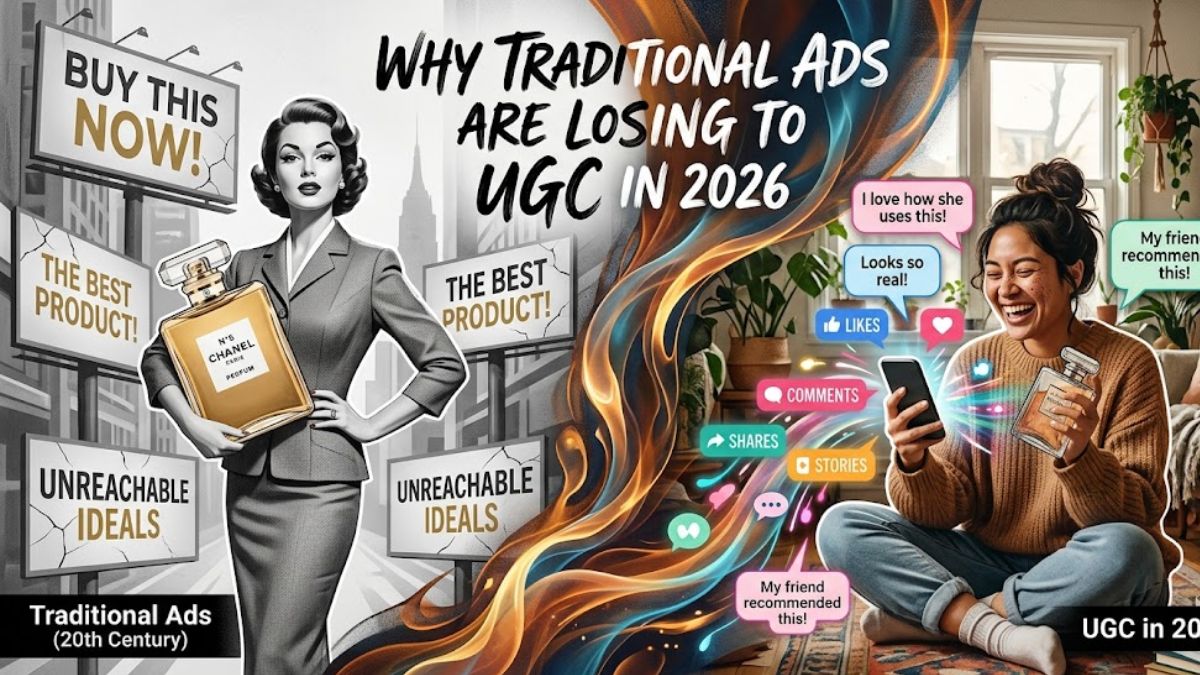
Television commercials built some of the most recognized brands in history. Newspaper placements, billboards, magazine spreads. For decades, that was the game, and companies that played it well dominated their categories. Some of those companies still exist. Most of the playbook doesn’t. In 2026, the average consumer spends more time with creators, social feeds, and short-form video than with any traditional advertising channel. That’s not a trend that snuck up on anyone. It’s been building for years, and the brands that saw it coming and adapted are in a fundamentally different position than the ones that kept allocating budget the old way while wondering why performance kept declining.
To be clear, advertising isn’t dying. The shift is more specific than that. Consumers have gotten better at filtering out messages that feel like advertising and paying attention to content that feels like a genuine human perspective. They trust people. They’re skeptical of brands. They want to hear from someone who actually used the product before they decide whether to buy it. That behavioral reality is why UGC consistently outperforms traditional advertising creative in engagement and conversion tests. It’s why creator partnerships have moved from experimental budget line to core strategy for brands that pay attention to performance data. The brands seeing stronger results understand something straightforward: consumer trust has become the actual unit of marketing currency, and creators have more of it than most brands ever will.
- Introduction
- 1. Understanding the Shift from Traditional Advertising to UGC
- 2. The Rising Power of UGC Videos
- 3. Traditional Advertising Costs Continue Rising
- 4. Influencer Marketing Has Changed the Game
- 5. How AI UGC Is Accelerating Growth
- 6. Why Consumers Ignore Traditional Ads
- 7. The Role of Top Influencers in India
- 8. Why Brands Prefer the Best Influencer Platform
- 9. The Future of Marketing Belongs to Communities
- About Hobo.Video
1. Understanding the Shift from Traditional Advertising to UGC
1.1 What Changed in Consumer Behavior?
Information access changed everything. Before making a purchase today, most consumers read reviews, watch videos of the product being used, compare experiences from multiple sources, and look for recommendations from people who seem trustworthy and unsponsored. Nielsen research puts the numbers behind what most people already sense intuitively: roughly 88% of consumers trust recommendations from people they know over direct brand advertising. That trust gap hasn’t narrowed. It keeps widening as consumers become more sophisticated about recognizing when they’re being marketed to.
Traditional TV advertising can still generate awareness at scale. What it struggles to generate is credibility. Consumers know advertisements are designed to persuade them. That knowledge creates a filter the message has to fight through before it even lands. Authentic creator content doesn’t have that problem because it doesn’t feel like advertising. It feels like a person talking about something they actually have an opinion on.
1.2 Why Authenticity Matters More Than Production Quality
The assumption that expensive production guaranteed marketing success made sense for a long time. It doesn’t anymore. A creator video shot on a phone, in natural light, with genuine enthusiasm and an honest assessment of the product’s actual tradeoffs, routinely outperforms a professionally produced commercial in engagement and conversion metrics. That’s not an occasional anomaly. It’s a pattern consistent enough that it’s changed how serious marketing teams allocate creative budgets.
The mechanism is straightforward. People connect with real experiences. They can sense the difference between someone who genuinely uses something and someone delivering scripted messaging, and they respond to those two things very differently.
2. The Rising Power of UGC Videos
2.1 Why UGC Feels More Trustworthy
UGC videos work because they center a real person rather than a brand. The consumer watching isn’t hearing from the company that makes the product. They’re hearing from someone who bought it, tried it, and formed an actual opinion. That shift in source changes the entire trust dynamic of the message.

Amplify Your Brand,
One Influence at a Time.
When a potential customer watches someone they perceive as a real user describing their genuine experience, the confidence to purchase follows more naturally than it does from any amount of polished brand communication. The conversion rate data reflects this consistently.
2.2 The Social Media Advantage
Platform algorithms don’t favor advertising. They favor engagement, because engagement is what keeps users on the platform. Content that generates conversation, shares, and genuine reactions gets distributed. Content that looks like an ad gets scrolled past. UGC sits on the right side of that dynamic naturally. It fits into feeds because it looks like the content users chose to be there for, not like the commercial break they’re tolerating.
The performance gap between a traditional banner ad and creator content that earns genuine attention isn’t marginal. It’s substantial, and it compounds because distributed organic content doesn’t stop performing when the budget runs out.
3. Traditional Advertising Costs Continue Rising
3.1 Higher Costs, Lower Attention
The economics of traditional advertising have moved in exactly the wrong direction for brands trying to justify the spend. Television placements keep getting more expensive. Print budgets are hard to defend on performance grounds. Outdoor advertising is competitive enough in key markets that costs have risen significantly. All of this while consumer attention fragments further across more apps, more platforms, and more content than any previous generation has consumed.
Reaching a consumer through traditional channels costs more than it did five years ago and delivers less reliable attention than it used to. That combination is making budget conversations at a lot of companies increasingly uncomfortable.
3.2 Better ROI Through Creator Partnerships
The comparison that’s changing marketing budget allocations is straightforward. Run a creator campaign involving micro creators across a relevant niche. Compare the engagement, the conversions, and the cost per acquisition against a comparable spend on television. The results regularly surprise brands doing this analysis for the first time. A campaign that costs a fraction of a TV placement generates more measurable interaction and often produces better bottom-of-funnel results because the audience it reaches was self-selected rather than broadly targeted.
That comparison isn’t the only factor, and traditional advertising isn’t worthless for every objective. But the ROI conversation has shifted, and the brands updating their budget allocations to reflect the data are seeing it in their numbers.
4. Influencer Marketing Has Changed the Game
4.1 The Growth of Influencer Marketing India
India’s creator ecosystem has grown to a scale that makes it one of the most important markets in the world for influencer marketing, not a regional subcategory of global strategy. Millions of consumers follow creators across beauty, technology, finance, education, fitness, and lifestyle. These aren’t passive followers. They’re engaged audiences that have actively chosen to trust specific voices in specific domains. When a creator in that ecosystem recommends something, it carries the weight of a trusted friend’s advice in a way that a television commercial fundamentally cannot.
The brands that have figured out how to access that trust, through authentic partnerships with creators who genuinely fit their product and audience, have built customer acquisition channels that outperform traditional alternatives on almost every metric that matters.
4.2 AI Influencer Marketing Creates Better Results
Selecting creators manually, based on follower counts and gut feel, was always imprecise. At the scale and complexity of the current Indian creator ecosystem, it’s operationally untenable. AI influencer marketing solves the selection problem by replacing estimation with data. Audience overlap analysis, engagement quality scoring, content-brand affinity measurement, predicted performance modeling. The decisions get better, the wasted partnerships decrease, and the overall return on creator investment improves. Working with a top influencer marketing company that combines these technological capabilities with human creative expertise tends to produce significantly better campaign outcomes than either approach alone.
5. How AI UGC Is Accelerating Growth
5.1 AI Meets Authenticity
The content production challenge for brands running serious creator programs is volume. One expensive commercial isn’t a content strategy anymore. Brands need a steady stream of varied creative across different formats, different messages, and different audience segments.
AI UGC changes the production economics of that challenge. Instead of a single polished asset that costs significantly and takes weeks to produce, brands generate multiple creator-focused content variations tailored to specific audiences, at a fraction of the time and cost. The performance data on those variations then informs what gets scaled. That model outperforms traditional advertising production cycles on flexibility, speed, and cost per performing asset.
5.2 Faster Testing and Optimization
The comparison between testing creator content and modifying a traditional campaign is stark. With AI UGC, brands test dozens of variations simultaneously, identify what’s working within days, and scale successful formats immediately. The feedback loop is tight enough that campaigns improve in real time rather than after a lengthy post-mortem. Modifying a traditional commercial requires reshooting, re-editing, new approvals, and additional production budget. By the time the revised ad runs, the market insight that prompted the change may already be stale.
6. Why Consumers Ignore Traditional Ads
6.1 Advertisement Fatigue
The volume of marketing messages the average consumer encounters daily is genuinely staggering. Estimates vary, but thousands per day is a reasonable working figure. The human response to that volume is filtering, and consumers have gotten very good at it. Traditional banner ads, television commercials, and display campaigns all suffer from this filtering behavior. The consumer’s brain has learned to deprioritize content that pattern-matches to advertising before conscious attention is even engaged. Brands are paying for impressions that aren’t really landing.
6.2 Trust Has Become the New Currency
The brands winning in this environment share a common characteristic. They’ve figured out how to earn trust rather than just buy attention. Creator recommendations, customer testimonials, community-driven content. These work because they come from sources the consumer has already decided to trust, before the brand’s message is even delivered. That pre-existing trust is what makes the influencer economy keep growing while trust in traditional advertising methods keeps declining.
People trust people. That isn’t new information. What’s new is that the infrastructure for leveraging that trust at scale now exists and the brands using it are measurably outperforming the ones that haven’t updated their playbook.
7. The Role of Top Influencers in India
7.1 Creator-Led Commerce
The impact of top influencers in India goes well past brand awareness, which is where a lot of traditional advertising stops. Creators in skincare, technology, finance, fitness, and virtually every other consumer category are driving measurable purchase behavior. Their audiences don’t just become aware of products. They buy them, often quickly, because the recommendation came from someone whose judgment they’ve tested over time and found reliable. That conversion effect is what makes creator partnerships a different kind of marketing investment than traditional advertising. The bottom-of-funnel impact is real and measurable, not just the awareness metrics at the top.
7.2 Famous Instagram Influencers and Consumer Decisions
The audiences that famous Instagram influencers have built are genuinely different from television viewership in one crucial way. They chose to be there. A television viewer doesn’t choose to see a commercial. A creator’s audience chose to follow that creator, often because they trust their taste and perspective on a specific domain. When a product recommendation comes from that context, it carries weight that passive advertising exposure never generates. Brands shifting budget from display advertising toward creator collaborations are responding to that reality in the most rational way available to them.
8. Why Brands Prefer the Best Influencer Platform
8.1 Better Measurement
The measurement capabilities of modern influencer platforms are significantly better than what traditional advertising channels typically provide. Reach, engagement, click-through, conversion, cost per acquisition. All tracked accurately, in real time, against actual campaign spend. That transparency changes how marketing leaders justify and optimize creator budgets. The reporting brands receive from traditional advertising agency engagements often can’t match this level of granularity. When the measurement is better, the decisions that follow are better.
8.2 Scalable Growth
A serious creator program eventually hits a ceiling if it’s managed manually. There are only so many partnerships a human team can manage effectively without the right infrastructure behind them. The best influencer platforms remove that ceiling by centralizing discovery, contracting, communication, and reporting in one place. Brands expand creator networks across regions and categories without the operational complexity multiplying proportionally. That’s what allows creator marketing to become a primary growth channel rather than staying a supplementary experiment.
9. The Future of Marketing Belongs to Communities
9.1 Community Creates Loyalty
The distinction between what advertising does and what community does is worth being precise about. Advertising creates awareness. It tells people a product exists and makes a case for it. That’s valuable and sometimes necessary. Community creates something different. It creates belonging, shared identity, and a relationship with the brand that outlasts any individual campaign.
Brands with genuine communities retain customers better, generate more organic word-of-mouth, and achieve higher lifetime value because the customer relationship has depth that a transactional advertising relationship never develops. UGC is central to building that because it invites participation. Customers who contribute content aren’t passive audiences anymore. They’re stakeholders.
9.2 How to Build Stronger Brand Communities
The question of how to build deeper customer relationships has a consistent answer across the brands doing it well. Listen to customers publicly. Engage with their content genuinely. Give them something worth participating in. Empower them to contribute to the brand story rather than just receive it. UGC programs that are designed to invite and celebrate customer voices, rather than just harvest content for advertising, build the kind of community that makes traditional advertising increasingly unnecessary. The customers become the distribution. Their trust becomes the brand’s most durable asset. That outcome compounds in a way that no campaign budget ever does.
FAQs
What is UGC?
UGC stands for user-generated content. It includes reviews, videos, photos, and testimonials created by consumers rather than brands.
Why are Traditional Ads becoming less effective?
Consumers increasingly trust real experiences and creator recommendations more than polished advertising campaigns.
How do UGC Videos improve conversions?
UGC Videos build credibility and provide authentic product experiences, helping consumers make confident purchasing decisions.
What is AI influencer marketing?
AI influencer marketing uses artificial intelligence to identify suitable creators, analyze audiences, and improve campaign performance.
Are traditional advertising methods still useful?
Yes. However, brands often achieve better engagement when combining traditional channels with creator-led content strategies.
About Hobo.Video
Hobo.Video is India’s leading AI-powered influencer marketing and UGC company. With over 2.25 million creators, it offers end-to-end campaign management designed for brand growth. The platform combines AI and human strategy for maximum ROI.
Services include:
- Influencer marketing
- UGC content creation
- Celebrity endorsements
- Product feedback and testing
- Marketplace and seller reputation management
- Regional and niche influencer campaigns
Trusted by top brands like Himalaya, Wipro, Symphony, Baidyanath and the Good Glamm Group.
Stop wondering what’s next. Let’s unlock your true brand growth potential. We’re just a click away.
If you’re an influencer creating awesome content, brands should see it. Let’s make that happen.

 Neeti Katyal
 Ankita Saha