
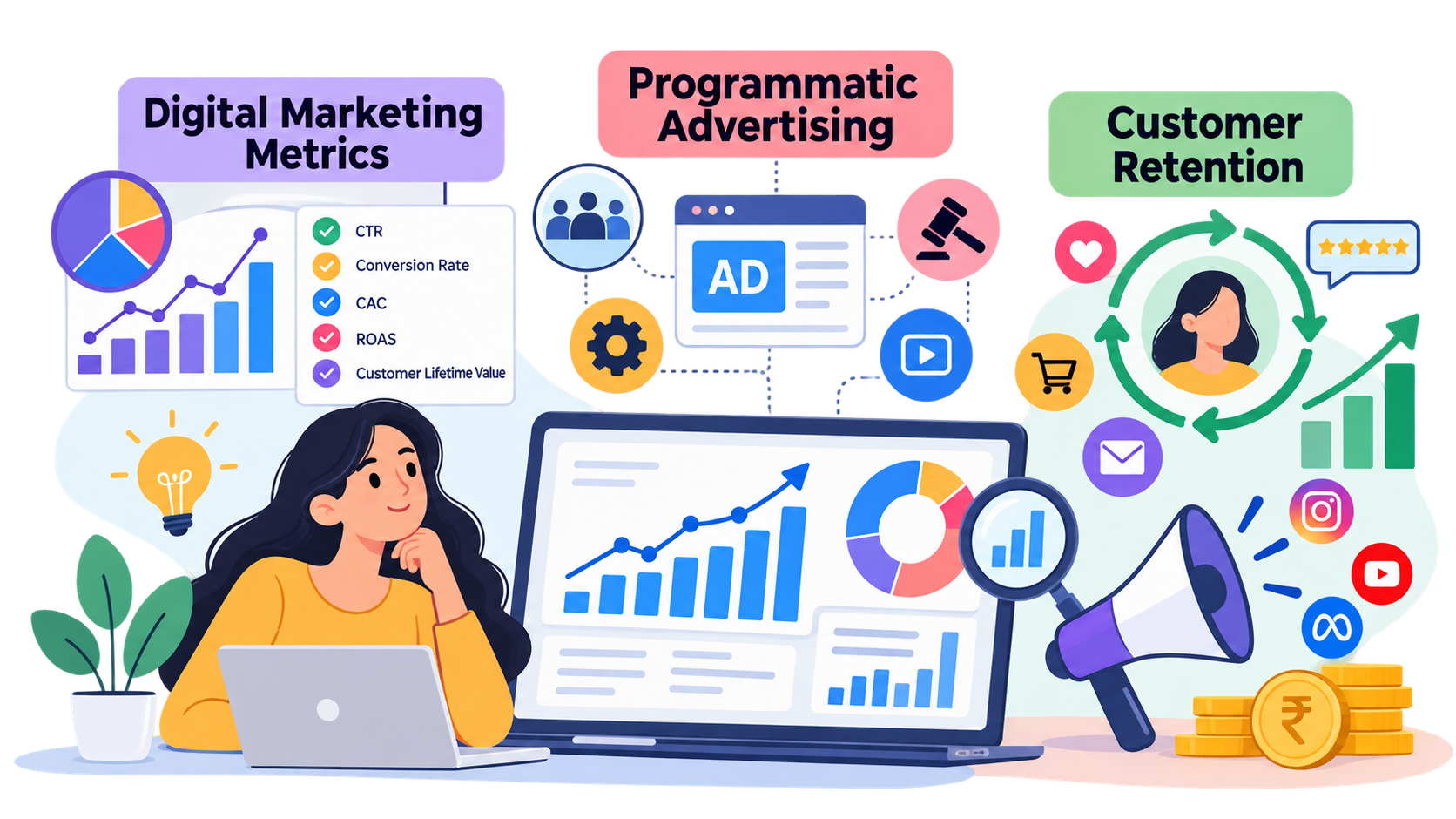
Digital marketing has moved far beyond posting on social media, running advertisements, and checking website visits. Today, brands need to understand what customers do after seeing an ad, which channels influence their decisions, and what makes them return. These are the advanced digital marketing concepts that separate activity from measurable business growth.
Understanding advanced digital marketing concepts helps businesses move beyond surface-level numbers and make smarter decisions. By connecting marketing data, advertising technology, and customer behaviour, brands can identify what drives sales and builds lasting relationships. This approach also helps Indian businesses use their marketing budgets more effectively.
For Indian businesses, the challenge is especially practical. Customers discover products through search engines, Instagram Reels, YouTube videos, creators, marketplaces, and recommendations from friends. However, a view does not guarantee a sale, and a first purchase does not guarantee loyalty. Brands must connect their marketing data, advertising decisions, content, and customer experience.
This guide explains how to measure marketing performance, use programmatic advertising, improve customer retention, and connect these activities into one strategy. It also explores influencer marketing, UGC Videos, AI influencer marketing, and customer data practices relevant to India’s changing digital market.
- 1. What Are Advanced Digital Marketing Concepts?
- 2. Digital Marketing Metrics That Measure Business Performance
- 3. Attribution and Marketing Measurement
- 4. Programmatic Advertising Explained
- 5. Customer Retention: Turning First Purchases Into Relationships
- 6. Connecting Acquisition, Advertising, and Retention
- 7. Influencer Marketing, UGC Videos, and Advanced Digital Marketing
- 8. Privacy, First-Party Data, and Responsible Personalisation
- 9. A 90-Day Roadmap for Implementing Advanced Digital Marketing Concepts
- 10. Common Mistakes That Undermine Advanced Digital Marketing
- Practical Advanced Digital Marketing Checklist
- Summary: Key Lessons to Apply
- About Hobo.Video
1. What Are Advanced Digital Marketing Concepts?
Advanced digital marketing concepts are methods, technologies, and measurement frameworks that help businesses make better marketing decisions. They move beyond individual campaigns and focus on the entire customer journey, from discovery to purchase and repeat business.
Traditional digital marketing often asks, “How many people saw our campaign?” Advanced marketing asks, “Which audience responded, what did the campaign cost, and did those customers create lasting value?”
That difference matters because marketing channels rarely work independently. A customer might watch a creator’s product review, search for the brand later, compare prices on a marketplace, and finally purchase through a website. Last-click reporting might credit only the final search visit. A more complete analysis examines the journey and the role each interaction played.

Amplify Your Brand,
One Influence at a Time.
The goal is not to use every available tool. Instead, it is to connect the right data, audience, message, and business outcome. When teams understand these relationships, they can reduce waste, improve customer experiences, and allocate budgets with greater confidence.
1.1 The three pillars of advanced digital marketing
Most advanced digital strategies combine three connected areas:
- Measurement: Tracking the actions that matter, including qualified leads, purchases, repeat orders, and profit.
- Media and technology: Using search, social advertising, programmatic advertising, automation, and audience data responsibly.
- Customer relationships: Improving onboarding, satisfaction, loyalty, repeat purchases, and long-term customer value.
Consider an Indian skincare brand launching a new moisturiser. It might use creators to demonstrate the product, paid media to reach relevant audiences, analytics to measure purchases, and email or WhatsApp communication to support existing customers where they have consented.
Each activity has a different role. Creator content may introduce the product, advertising may increase qualified reach, analytics may identify effective messages, and retention campaigns may encourage a second purchase. The strongest strategy measures these activities together instead of judging every channel in isolation.
1.2 Why these concepts matter in India
India’s digital advertising market continues to expand. The ET Brand Equity–Ipsos State of Digital Marketing in India 2025–26 report estimated total advertising expenditure at ₹1.11 lakh crore in FY2025. Digital advertising accounted for ₹49,000 crore, or 44% of the market, according to the report.
The same report projected digital advertising expenditure of ₹56,400 crore in FY2026. These figures are market estimates and projections, not a guarantee that every business will see similar growth.
For brands, the message is clear: digital marketing deserves serious measurement and planning. Mobile-first experiences, regional-language content, creator partnerships, and online shopping all create opportunities. However, competition also makes it easier to waste money on broad targeting, weak creative, and poorly measured campaigns.
A business does not need an enterprise-sized budget to adopt advanced practices. Even a small brand can define conversion events, calculate acquisition costs, segment customers, and run controlled experiments. The important step is to replace assumptions with evidence.
2. Digital Marketing Metrics That Measure Business Performance
Metrics help marketers understand what happened and why it matters. However, a large dashboard can create confusion when teams track numbers without connecting them to business goals.
A social media team might celebrate higher reach while the sales team sees no increase in qualified enquiries. An e-commerce team might report rising revenue while discount costs and advertising expenses reduce margins. Advanced measurement connects these different views.
Start by defining the business outcome. An online store, that could be profitable orders. A B2B company, it might be qualified leads that progress into the sales pipeline. Also for a subscription business, the focus may include activation, renewal, and churn.
Once the outcome is clear, select a small group of supporting metrics. Every metric should answer a specific question or help someone make a decision. If a number does not change your understanding or next action, it may not deserve space on the main dashboard.
2.1 Reach, impressions, and engagement
Reach estimates the number of unique people exposed to content or advertising. Impressions count exposures, including multiple exposures to the same person. Engagement measures actions such as likes, comments, shares, saves, or clicks, depending on the platform and report.
These metrics are useful for awareness and creative evaluation. However, they do not prove that an audience remembers a brand or intends to purchase.
For example, a creator’s Reel might generate 200,000 views but very few product-page visits. Another Reel might receive 35,000 views and produce many qualified visitors. The second video could be more commercially useful, even with fewer views.
Marketers should examine the content’s purpose before comparing results. Awareness campaigns need reach and frequency analysis. Consideration campaigns may require meaningful video completion, saves, profile visits, or website sessions. Conversion campaigns need stronger evidence, such as purchases, qualified leads, or incremental revenue.
Avoid comparing metrics across platforms without checking their definitions. A view on one platform may require a different viewing duration from a view elsewhere. Consistent reporting begins with understanding what each number actually represents.
2.2 Click-through rate and conversion rate
Click-through rate, or CTR, measures the share of impressions that produce clicks. A common calculation is:
CTR = Clicks ÷ Impressions × 100
If an advertisement receives 500 clicks from 25,000 impressions, its CTR is 2%.
Conversion rate measures the share of a defined audience or visitor group that completes a desired action. The denominator matters. Some teams use sessions, others use users, clicks, or leads. Always state which definition you use.
Conversion rate = Conversions ÷ Eligible visits or users × 100
Suppose 1,000 product-page visitors generate 40 purchases. The session-based conversion rate would be 4% if those 1,000 visitors represent the relevant sessions in the reporting period.
CTR helps diagnose whether the message and audience generate interest. Conversion rate helps assess what happens after the click. A high CTR with a low conversion rate may point to a mismatch between the advertisement and landing page, an unexpected price, weak trust signals, or checkout friction.
Neither metric provides the full answer alone. Compare them with traffic quality, order value, margins, and customer behaviour after the first purchase.
2.3 Cost per click, cost per lead, and customer acquisition cost
Cost per click (CPC) shows the average amount paid for each click. Cost per lead (CPL) measures the cost of generating a lead. Customer acquisition cost (CAC) estimates the cost of acquiring a customer.
These metrics answer different questions. CPC evaluates traffic costs, while CPL evaluates lead-generation efficiency. CAC connects acquisition spending to customers gained.
A simple blended CAC calculation is:
CAC = Total acquisition costs ÷ New customers acquired
Imagine a brand spends ₹1,20,000 on paid media, agency support, and other included acquisition costs during a month. It gains 300 new customers. Its blended CAC is ₹400 per customer.
This calculation is only meaningful when the cost definition and customer count use the same period and scope. A paid-media-only CAC will differ from a fully loaded CAC that includes salaries, creative production, software, and agency fees.
For a B2B company, leads may take months to become customers. Therefore, CPL should not replace lead quality or revenue analysis. A campaign generating inexpensive but unqualified leads can cost more in the long run than a campaign producing fewer, better prospects.
2.4 Return on ad spend and marketing return on investment
Return on ad spend (ROAS) compares attributed revenue with advertising expenditure.
ROAS = Attributed revenue ÷ Advertising spend
If a campaign generates ₹5 lakh in attributed sales from ₹1 lakh in ad spend, its reported ROAS is 5:1.
However, ROAS is not the same as profit. Revenue must cover product costs, shipping, returns, discounts, payment fees, and other operating expenses. A campaign can report strong ROAS while losing money on low-margin products.
Marketing return on investment (ROI) attempts to compare the incremental financial return with the investment required. Teams must define which costs and benefits they include.
ROI = (Incremental profit − Marketing investment) ÷ Marketing investment × 100
This formula requires care because some organisations use revenue rather than profit in simplified ROI calculations. State your method clearly and avoid comparing figures calculated under different definitions.
For e-commerce brands, contribution margin often provides a more useful decision-making view than revenue alone. For B2B businesses, pipeline value and closed-won revenue may be important, but sales-cycle length and lead quality must also be considered.
2.5 Customer lifetime value
Customer lifetime value (CLV or LTV) estimates the value a customer generates over the relationship with a business. Depending on the model, it may refer to revenue or contribution profit.
A practical starting point for a repeat-purchase business is:
Estimated lifetime contribution = Average contribution per order × Expected orders during the relationship
The model should account for customer retention, order frequency, refunds, discounts, service costs, and the period being forecast. Subscription businesses may use monthly contribution and expected customer lifespan, while retailers may use purchase cohorts.
Suppose a customer makes four purchases over a year. Each order generates ₹350 in contribution after variable costs. The customer contributes ₹1,400 before acquisition costs and other excluded expenses.
If the acquisition cost is ₹500, the business has ₹900 remaining before those additional costs. This is more informative than comparing the customer’s total revenue with advertising spend.
LTV estimates are not facts about future behaviour. They depend on assumptions and historical patterns. Recalculate them as customer cohorts mature, and avoid assuming new customers will behave exactly like older cohorts.
2.6 Build a metrics dashboard that leads to action
A useful dashboard should not be a wall of numbers. It should help a team identify problems and decide what to do next.
Organise the dashboard into four levels:
- Business results: Contribution profit, revenue, new customers, qualified pipeline, and retention.
- Acquisition: CAC, CPL, ROAS, channel mix, and lead quality.
- Customer behaviour: Conversion rate, repeat-purchase rate, churn, and cohort performance.
- Creative and delivery: Reach, frequency, CTR, video completion, and landing-page performance.
For each metric, show its definition, reporting period, data source, target, and responsible owner. Where possible, compare performance with a meaningful baseline rather than an arbitrary industry benchmark.
Add a short commentary section explaining changes. For example, “CAC increased because mobile checkout conversion fell after the shipping fee changed” is more useful than “CAC increased by 18%.”
Finally, separate observed results from hypotheses. The dashboard shows what changed; controlled tests and further investigation help explain why.
One of the most practical advanced digital marketing concepts is connecting performance metrics with business decisions. A dashboard should explain more than whether numbers increased or decreased. For instance, rising customer acquisition costs alongside falling conversion rates may indicate a problem with targeting, creative quality, or the landing page. Therefore, marketers should investigate the cause before increasing their budgets. Regular analysis helps teams identify waste, prioritise improvements, and measure whether those changes deliver meaningful results.
3. Attribution and Marketing Measurement
Customers rarely purchase after seeing just one advertisement. They may discover a product through an influencer, revisit it through search, compare options on a marketplace, and purchase after receiving an email. Attribution attempts to distribute credit across these interactions.
The challenge is that no single attribution model perfectly explains every customer decision. A model is a way of interpreting available data, not a complete record of what would have happened without marketing.
Advanced digital marketing concepts therefore include understanding both attribution and its limitations. Teams should use attribution reports to identify patterns, then supplement them with experiments, customer research, and commercial outcomes.
3.1 Common attribution models
Last-click attribution assigns credit to the final eligible click before a conversion. It is easy to understand, but it may undervalue channels that introduced the customer.
First-click attribution gives credit to the first recorded touchpoint. It highlights discovery but may ignore later interactions that helped close the sale.
Linear attribution distributes credit evenly across eligible touchpoints. This can provide a simple overview, although equal credit may not reflect each interaction’s actual influence.
Position-based attribution gives additional weight to selected points in the journey, such as the first and last interactions. Its results depend on the weighting rules chosen.
Data-driven attribution uses observed conversion paths and statistical modelling to estimate the contribution of different interactions. Google Analytics documents how its data-driven approach evaluates converting and non-converting paths. The model and available data affect the results.
No model should be treated as unquestionable truth. Compare models, inspect the customer journey, and check whether the conclusions make commercial sense.
3.2 Why influencer marketing complicates attribution
Influencer campaigns often generate delayed and indirect effects. A person may watch a creator’s video, remember the product, and purchase several days later through a search engine or marketplace.
A unique discount code can help track some orders. UTM parameters can identify campaign traffic. Dedicated landing pages can make visits easier to distinguish. Post-purchase surveys can ask customers how they discovered the brand.
Each method has limitations. Discount codes may be shared beyond the intended audience. UTM parameters can be lost when people switch devices or channels. Surveys depend on customer recall and response rates.
For a stronger view, combine several measurement methods. Track direct campaign responses, compare branded search trends carefully, analyse new-customer orders, and use holdout tests where practical.
Do not automatically claim that every sale during an influencer campaign came from the creator. Instead, report what the tracking shows, identify blind spots, and explain what additional evidence would improve confidence.
3.3 Incrementality: what would have happened anyway?
Incrementality asks whether marketing caused additional results beyond what would have happened without the activity.
Imagine a brand retargets customers who already visit its website frequently. The campaign records many purchases, but some customers might have purchased without seeing the ads. Attributed revenue alone cannot answer that question.
A controlled holdout experiment can help. Eligible users are divided into a treatment group that receives the campaign and a comparison group that does not. The team then compares outcomes, accounting for the experiment’s design and uncertainty.
The basic idea is:
Incremental lift = Treatment outcome − Comparison outcome
For rates, compare conversion rates. For revenue, compare revenue per eligible user or another suitable measure. A sound experiment needs comparable groups, enough observations, a defined time window, and protection against contamination.
Not every business can run a perfect experiment. Still, even modest holdouts or geographic tests can reveal whether a campaign adds value. This is especially useful for retargeting, loyalty discounts, and channels that tend to receive generous attribution credit.
4. Programmatic Advertising Explained
Programmatic advertising uses technology to automate the buying and selling of digital advertising inventory. Depending on the arrangement, the process can involve real-time auctions, private marketplaces, preferred deals, or automated guaranteed placements.
Instead of negotiating every impression manually, advertisers use platforms and rules to identify eligible opportunities. They can consider factors such as audience signals, context, budget, bid limits, campaign objectives, and inventory quality.
Programmatic advertising can support display, online video, connected TV, audio, and other digital environments. However, automation does not automatically make a campaign efficient. Results still depend on strategy, creative quality, audience selection, data quality, and controls against unsuitable placements.
4.1 How programmatic advertising works
The programmatic ecosystem includes several participants:
- Advertisers and agencies: Set goals, budgets, audience strategies, and creative requirements.
- Demand-side platforms (DSPs): Help buyers evaluate and bid on available advertising opportunities.
- Publishers: Offer advertising inventory across websites, apps, and other digital properties.
- Supply-side platforms (SSPs): Help publishers manage and sell inventory.
- Ad exchanges: Facilitate transactions between buyers and sellers.
- Data and measurement providers: Supply approved audience signals, verification, and reporting services.
In a real-time bidding process, a publisher’s page or app may create an advertising opportunity. Information about the opportunity travels through the relevant systems. Eligible buyers evaluate it, submit bids, and the winning creative is delivered under the auction’s rules.
This process can happen very quickly. However, not every programmatic purchase uses an open auction. Private marketplace deals and guaranteed transactions may follow different terms and controls.
The practical advantage is the ability to manage many buying decisions through technology. The practical risk is that a buyer may not understand where ads appear, which fees apply, or how effectively the campaign reaches the intended audience.
4.2 Programmatic advertising by the numbers
Industry reports help explain why programmatic buying deserves attention. The IAB and PwC’s Internet Advertising Revenue Report: Full Year 2024 reported US programmatic advertising revenue of $134.8 billion, up 18% from 2023. The report also described a mix of real-time bidding and programmatic direct transactions.
These figures describe the US market, not India. They should not be used as an estimate of Indian programmatic spending. Still, they illustrate how central automated buying has become within a major digital advertising market.
For Indian brands, the right question is not whether programmatic advertising is fashionable. It is whether the channel can reach the intended audience with suitable controls and measurable business value.
A local D2C business may begin with search and social advertising because the setup is simpler and demand is easier to capture directly. A larger brand seeking reach across premium websites, online video, and connected TV may have stronger reasons to test programmatic buying.
The decision should follow the audience, campaign objective, budget, and available measurement—not the technology’s reputation.
4.3 Real-time bidding and private marketplaces
Real-time bidding (RTB) allows advertising opportunities to be sold through automated auctions. It can offer scale and flexible buying, but buyers need to monitor placement quality, bid efficiency, and transparency.
A private marketplace (PMP) gives selected buyers access to specified inventory under agreed conditions. It can offer more control over publisher access and deal terms, although the exact benefits depend on the agreement.
Programmatic direct deals automate parts of the buying process while using agreed pricing or delivery arrangements. They may suit campaigns that need specific inventory, predictable delivery, or a closer publisher relationship.
No buying method is automatically superior. Open auctions may provide reach and flexible pricing. Private deals may offer access to selected inventory. Direct arrangements may support specific delivery requirements.
Before choosing, compare the total cost, audience quality, inventory transparency, viewability, fraud controls, and reporting. Ask vendors to explain fees and identify which measurements come from independent verification.
4.4 What is a demand-side platform?
A demand-side platform is a technology platform that helps advertisers buy digital media across supported inventory sources. It provides campaign controls, bidding tools, targeting options, and reporting features.
DSP capabilities vary. Some support multiple channels and exchanges, while others focus on particular formats or ecosystems. Access to a DSP does not guarantee that a brand will reach every publisher or audience.
A buyer should evaluate a platform against clear requirements. Does it provide the necessary inventory? Can the team control frequency? Are reporting and conversion tracking compatible with existing analytics? Can it exclude unsuitable placements? Does it offer transparent billing and usable support?
For smaller advertisers, using a specialist agency or managed service may be more practical than operating a platform directly. The choice depends on internal skills, campaign complexity, minimum commitments, and expected media spend.
Always ask how the platform’s performance claims are calculated. A lower CPM may look attractive, but inexpensive impressions have limited value if they reach irrelevant users or appear in low-quality environments.
4.5 Choosing the right programmatic metrics
Programmatic campaigns require more than a low cost per thousand impressions (CPM). CPM measures the cost of one thousand impressions, but it does not prove that people saw or remembered the advertisement.
Useful measures include:
- Viewability: Whether an impression met the applicable viewability standard.
- Reach and frequency: How many people were exposed and how often.
- Brand safety: Whether ads appeared in environments that meet the brand’s requirements.
- Invalid traffic: Whether activity was generated by bots or other non-genuine sources.
- View-through and click-through conversions: Tracked actions following qualifying ad exposures or clicks, subject to the platform’s rules.
- Incremental outcomes: Additional conversions or revenue associated with the campaign.
Define the metrics before launch. Agree on the measurement source, reporting window, and exclusions. For example, a view-through conversion window can influence how many conversions a campaign claims.
Where the budget allows, use independent verification and controlled experiments. A vendor dashboard is useful, but it should not be the only evidence supporting a major budget decision.
Advanced digital marketing concepts also help advertisers evaluate programmatic campaigns beyond impression volume. Although automated buying can improve reach and campaign management, marketers must examine audience quality, placement suitability, invalid traffic, and conversion outcomes. For example, a campaign with inexpensive impressions may still perform poorly if those impressions fail to reach relevant customers. By combining transparent reporting with suitable verification and incrementality testing, businesses can make better decisions about where to invest their advertising budgets.
4.6 Brand safety, fraud, and transparency
Automated buying can place advertisements across large and changing sets of inventory. That scale creates opportunities, but it also creates risks.
Ads may appear beside content that conflicts with a brand’s values. Invalid traffic may inflate impression or click counts. Complex supply chains can make it difficult to understand which fees are deducted before media reaches the publisher.
Build controls before launch. Create inclusion and exclusion rules, use suitable verification tools, review placement reports, and establish escalation procedures. Check whether the campaign uses domain-level reporting, app-level reporting, or more limited visibility.
Ask partners to explain supply-path decisions, data sources, platform fees, and verification methods. Review suspicious spikes rather than assuming all reported traffic is genuine.
Brand safety is not the same as avoiding every controversial topic. Each brand should define its risk tolerance and exclusions clearly. Overly broad blocking can reduce useful reach, while weak controls can create reputational and financial harm.
A sensible programmatic strategy balances scale with accountability. Automation should make buying more manageable, not remove human responsibility.
5. Customer Retention: Turning First Purchases Into Relationships
Customer acquisition brings people into a business, while retention gives them reasons to stay. By delivering consistent value and a positive experience, brands can encourage repeat purchases and build lasting customer relationships.
Retention matters because the first purchase often includes the cost of attracting the customer, introducing the product, and resolving initial questions. Repeat purchases can improve the economics of the relationship, provided the business maintains healthy margins and customer satisfaction.
However, retention does not mean sending more messages or offering constant discounts. Customers return when the product meets their needs, the buying experience feels reliable, and the brand continues to provide value.
For Indian e-commerce brands, retention may depend on delivery reliability, product quality, language, customer support, payment options, returns, and post-purchase communication. For a SaaS business, onboarding, product adoption, support, and renewal value may matter more.
A retention strategy starts with understanding why customers return, why they leave, and which interventions can make a measurable difference.
5.1 Key customer retention metrics
Customer retention rate measures the share of existing customers who remain customers over a defined period. The formula must account for new customers acquired during that period.
A common formula is:
Retention rate = (Customers at end − New customers acquired) ÷ Customers at start × 100
Suppose a business starts the quarter with 1,000 customers, ends with 1,100, and acquired 300 new customers. Its retention rate under this formula is 80%.
Churn rate measures the share of customers who stop buying, cancel, or otherwise leave during the period. The exact definition depends on the business model. Subscription cancellation and retail inactivity are not identical behaviours.
Repeat-purchase rate measures the share of customers who buy again within a defined period. It is useful for retailers, but the time window should reflect the product’s natural purchase cycle.
Time to second purchase measures how long customers take to make their next order. A long delay may be normal for durable products but concerning for frequently replenished items.
Revenue retention measures how much revenue a business retains from an existing customer group. Subscription businesses may distinguish gross revenue retention from net revenue retention, which can include expansion revenue.
Choose the metrics that match the business model. Then examine them by customer cohort, product category, acquisition source, and first-purchase month.
5.2 Why customer experience drives retention
A loyalty programme cannot compensate for a consistently poor product. Discounts may encourage another order, but they do not necessarily create trust or satisfaction.
Consider a customer ordering a personal-care product. The product arrives late, packaging is damaged, and support takes days to respond. A promotional coupon may encourage one more purchase, but the underlying problem remains.
Now consider the opposite experience. The product matches its description, delivery updates are clear, support resolves a question quickly, and the brand offers useful instructions after delivery. The customer has more reasons to trust the next purchase.
Measure the parts of the experience that customers actually encounter. Review complaints, return reasons, delivery performance, product reviews, support resolution time, and repeat behaviour.
Customer surveys can reveal problems that behavioural data cannot explain. However, survey responses represent the people who answer, not necessarily every customer. Combine them with operational data and observed outcomes.
Retention is a cross-functional responsibility. Marketing can communicate value, but operations, product, logistics, and customer support must deliver the promise.
5.3 Build a useful onboarding journey
Onboarding helps a new customer understand how to get value from a product or service. It is especially important for subscriptions, software, complex products, and categories where correct usage affects satisfaction.
Start by identifying the first meaningful success moment. For a SaaS platform, that might be completing setup or publishing a first report. For a skincare brand, it could be understanding the product’s intended use and following the instructions safely.
A simple onboarding journey might include:
- Confirmation: Provide an order or signup confirmation with clear next steps.
- Guidance: Explain how to use the product or complete setup.
- Support: Make it easy to find answers or contact the team.
- Feedback: Ask whether the customer encountered any difficulty.
- Relevant follow-up: Offer useful advice based on the product and customer needs.
Avoid sending every message immediately after signup. Give people time to act and use behavioural triggers where appropriate. Someone who has completed setup does not need repeated reminders to complete the same step.
Measure onboarding completion, time to first value, support requests, refunds, and subsequent retention. These indicators show whether the journey helps customers succeed rather than merely increasing message engagement.
5.4 Customer segmentation and personalisation
Segmentation groups customers according to relevant characteristics or behaviours. Personalisation uses suitable information to make an experience more relevant to an individual or group.
Useful segments may include first-time customers, repeat purchasers, high-value customers, customers approaching a normal replenishment date, and customers who have not returned within an expected period.
For example, a tea brand may communicate differently with a new customer who needs brewing instructions and a regular customer who already understands the product. A B2B platform may provide setup guidance to new users and advanced feature tips to active teams.
Segmentation should have a clear purpose. Collecting more data does not automatically create better marketing. Excessive personalisation can feel intrusive, particularly when a brand uses information customers did not expect it to use.
Use data with an appropriate legal basis, clear notices, suitable consent where required, and reasonable access controls. Give customers a practical way to manage communication preferences.
Start with a small number of useful segments. Test whether the tailored experience improves meaningful outcomes compared with a general message. If the difference is negligible, simplify the approach.
5.5 Win-back campaigns that respect the customer
A win-back campaign aims to re-engage customers who have stopped purchasing or interacting. The first task is defining inactivity correctly.
A customer who buys a washing machine every eight years should not receive the same treatment as someone who normally orders groceries weekly. Inactivity windows must reflect expected behaviour and the product’s natural replacement or replenishment cycle.
Before sending a win-back message, investigate possible causes. Did delivery fail? Was the product unavailable? Did the customer complain? Did a subscription become too expensive? Different causes require different responses.
A thoughtful campaign might acknowledge a service issue, provide an update about a relevant product, or offer a useful reminder. A discount may help in some cases, but constant incentives can train customers to delay purchases until the next offer.
Among the most valuable advanced digital marketing concepts is the use of customer behaviour to improve retention. Businesses can analyse repeat purchases, customer feedback, and inactivity patterns to identify where relationships weaken. For example, an online retailer might send helpful product guidance after delivery and a relevant replenishment reminder when customers are likely to need another order. However, these messages should reflect genuine customer needs rather than simply increase communication frequency. Measuring repeat purchases and contribution margin helps determine whether retention activities create lasting value.
6. Connecting Acquisition, Advertising, and Retention
Advanced digital marketing concepts become more useful when teams connect their activities into a complete system. Acquisition, conversion, and retention should not operate as isolated departments with separate definitions of success.
A campaign may bring in inexpensive customers who rarely return. Another campaign may attract fewer customers but generate higher contribution over time. If the business measures only first-order revenue, it may choose the wrong campaign.
Build a shared measurement framework that connects the first marketing touchpoint with later customer outcomes. This does not require perfect individual-level tracking. Cohort analysis, consistent campaign tagging, and appropriate experiments can provide useful insight.
6.1 Create a full-funnel measurement plan
A funnel is a practical way to organise customer progress, although real journeys often move back and forth between stages.
| Stage | Business question | Example metrics |
|---|---|---|
| Awareness | Are relevant people discovering us? | Reach, qualified impressions, video completion |
| Consideration | Are people exploring the offer? | Engaged visits, product views, enquiries |
| Conversion | Are interested people taking action? | Conversion rate, CAC, contribution per order |
| Activation | Are new customers reaching initial value? | Setup completion, first-use rate |
| Retention | Are customers returning or renewing? | Repeat rate, churn, cohort retention |
| Advocacy | Are customers recommending us? | Referral purchases, reviews, customer referrals |
The table should guide decisions rather than create a reporting burden. Select a small number of metrics for each stage and assign an owner.
Define how each event is captured. For example, a product view should have a consistent event name and parameters. A purchase event should avoid duplicate counting and use a consistent revenue definition.
Review the funnel by channel, audience, device, and cohort where the data supports it. A high-level average can hide important differences. Mobile visitors may struggle with a form that works well on desktop, while customers from one channel may require more support after purchasing.
6.2 Align creative testing with business outcomes
Creative testing compares different messages, formats, or executions to understand which performs better. It works best when the team begins with a clear hypothesis.
For example: “Showing the product’s use in a real household will increase qualified product-page visits compared with a studio-only image.” This hypothesis is more actionable than “Let’s try a different creative.”
Test one important variable at a time when practical. That might be the opening hook, product demonstration, testimonial, offer, or call to action. Ensure the test receives enough exposure and time to produce useful evidence.
For creator campaigns, test different content angles rather than judging every creator only by follower count. One creator may explain the product clearly, while another creates strong emotional connection. Their roles can differ within the same campaign.
Do not stop tests whenever a dashboard briefly favours one option. Consider sample size, variability, seasonality, and the cost of making the wrong decision. Record the hypothesis, audience, creative, result, and next action so the team can build on earlier learning.
6.3 Use cohort analysis to understand quality
Cohort analysis groups customers who share a starting point, such as their first purchase month or acquisition campaign. It then tracks their behaviour over time.
Imagine two campaigns generate 500 new customers each. Campaign A produces a high first-week revenue figure, while Campaign B starts more slowly. After three months, Campaign B’s customers may have a higher repeat-purchase rate and better contribution.
A cohort table can reveal this difference. Rows represent customer groups, and columns show the weeks or months since acquisition. Metrics may include repeat purchases, revenue per customer, refunds, and retained customers.
Use consistent cohort definitions. Compare customers over the same length of time, and account for seasonality where possible. A festival campaign may attract different buying patterns from a normal month.
Cohort analysis is especially useful when deciding whether to increase acquisition spend. It helps teams distinguish campaigns that produce temporary sales spikes from those that bring customers who continue to find value in the product.
7. Influencer Marketing, UGC Videos, and Advanced Digital Marketing
Creator partnerships are no longer limited to awareness campaigns. Brands can use creator content to explain products, address objections, demonstrate real-world usage, and develop creative assets for different stages of the customer journey.
However, influencer marketing requires clear objectives and suitable measurement. A popular creator may generate attention without attracting the right audience. A smaller creator may have stronger relevance for a specific category or region. The right choice depends on the campaign’s goal.
In India, language, culture, location, product price, and platform habits can shape how audiences respond. A national campaign and a regional launch may need different creator mixes, content styles, and distribution plans.
Brands can build a more effective influencer marketing strategy by combining creator research, audience insights, and data-driven campaign planning.
7.1 What is influencer marketing?
Influencer marketing is a partnership between a brand and a creator whose content or audience can help communicate a product or message. Campaigns may involve product demonstrations, reviews, tutorials, event coverage, storytelling, or paid amplification.
A strong brief explains the audience, objective, product facts, required disclosures, deliverables, timeline, usage rights, and measurement plan. It should give creators enough room to communicate naturally while protecting accuracy and brand requirements.
Before selecting a creator, examine audience relevance, content quality, engagement patterns, past brand work, and suitability for the product. Review unusual engagement spikes and the consistency of comments rather than relying on one headline number.
Set clear expectations for paid partnerships and disclosure. In India, brands and creators should consult applicable Advertising Standards Council of India guidance and relevant consumer-protection requirements. Disclosure should be easy for the audience to notice and understand.
The goal is a credible partnership, not merely a large number of views. Good campaign planning connects creator selection, creative execution, distribution, and outcome measurement.
7.2 How UGC Videos support the customer journey
User-generated content (UGC) usually refers to content created by customers or users, while brands also commission creator-made assets designed to resemble authentic customer experiences. These categories can overlap in practice, but they should not be presented as identical without clarification.
UGC Videos can help answer practical questions. How does a product look in normal lighting? Does a bag fit everyday essentials? How does a tool work in a small kitchen? Such demonstrations can reduce uncertainty when the content is truthful and relevant.
Brands should obtain appropriate permissions before using customer or creator content in advertising. They should not invent testimonials, hide material relationships, or imply that a paid creator is an independent customer.
Measure the content’s role rather than assuming it will outperform polished advertising. Compare qualified visits, product-page engagement, conversion rates, customer questions, and incremental sales where practical.
A creative testing matrix can organise assets by hook, format, audience, benefit, objection, and call to action. This makes it easier to learn which messages work for discovery, consideration, and conversion.
7.3 AI influencer marketing and AI UGC
AI tools can support creator discovery, content planning, audience analysis, translation, editing, and campaign reporting. AI-generated presenters and synthetic content can also create new production options. However, these tools introduce questions about authenticity, disclosure, intellectual property, and factual accuracy.
AI influencer marketing should begin with a defined use case. A brand might use AI to generate regional-language script drafts, summarise campaign comments, or organise creator performance data. Human reviewers should check claims, cultural context, brand safety, and compliance before publication.
AI UGC may help teams explore different creative concepts quickly, but speed alone does not establish quality. Synthetic testimonials or invented customer experiences can mislead viewers. A generated character should not be presented as a real customer who used a product unless that representation is truthful.
Brands should review platform rules, applicable laws, creator agreements, and consent requirements before deploying synthetic media. They should also test whether audiences understand the content’s nature.
The most effective approach combines automation with human judgement. AI can help teams work faster, but people remain responsible for what the brand promises and how it treats its audience.
7.4 Choosing the right influencer marketing company or platform
When evaluating a top influencer marketing company or the best influencer platform for a campaign, avoid selecting a provider based on a headline creator count alone. The useful question is whether the provider can deliver the right creators, reliable workflows, and measurable outcomes for your needs.
Review the following criteria:
- Creator fit: Audience relevance, language, geography, niche, and content quality.
- Verification: Methods for checking audience signals and suspicious activity.
- Campaign operations: Briefing, contracting, approvals, timelines, and payments.
- Content rights: Clear terms for organic reposting, paid media usage, duration, and territory.
- Measurement: Reporting for reach, engagement, qualified traffic, conversions, and business outcomes.
- Compliance: Support for disclosures, brand rules, and data handling.
- Commercial clarity: Transparent fees, deliverables, cancellation terms, and reporting responsibilities.
Ask providers for examples that resemble your category, audience, and budget. A successful beauty campaign may not predict results for a financial service or industrial product.
For Hobo.Video, position the service according to its actual capabilities and current verified offering. Avoid unsupported superlatives or promises of guaranteed reach, sales, or return on investment.
8. Privacy, First-Party Data, and Responsible Personalisation
Digital marketing relies on data, but not every available data point should be collected or used. Customers need clear information about how a business handles their details, and marketers need processes that respect applicable requirements.
First-party data is information a business collects directly through its own customer relationships and interactions. Examples include purchases, account preferences, consented email subscriptions, support conversations, and product usage data. The appropriate collection method depends on the context and applicable rules.
First-party data can help businesses understand customer needs without relying entirely on external audience signals. However, it does not automatically grant unlimited permission for every marketing use. A purchase record, for example, should not be treated as blanket consent for every communication channel.
8.1 Create a practical data governance process
A data governance process should answer four questions: what data do we collect, why do we need it, who can access it, and how long should we retain it?
Start with a data inventory. Record the purpose of each field, its source, the systems that use it, and the team responsible. Remove data that has no clear business or legal purpose.
Review consent and communication preferences across email, SMS, WhatsApp, and other channels. A customer who opts out should not continue receiving the same marketing messages through a different system because the suppression list was not synchronised.
Limit access to sensitive information. Use appropriate security controls, vendor reviews, retention schedules, and incident procedures. Marketing teams should coordinate with legal, privacy, and security specialists where needed.
India’s Digital Personal Data Protection Act, 2023, and subsequent rules and implementation details may affect how organisations handle personal data. Businesses should check the current legal position and obtain qualified advice rather than relying on a marketing article as legal guidance.
8.2 Personalisation without crossing the line
Personalisation should help the customer, not demonstrate how much the brand knows. Product recommendations, relevant reminders, and useful onboarding messages can improve the experience when they match customer expectations.
An online store might recommend related products based on a recent purchase. A subscription service might send a setup guide after signup. These messages are easier to justify when their purpose is clear and the customer can manage preferences.
By contrast, highly specific references to sensitive behaviour can feel intrusive. Overly frequent reminders can also create fatigue, even when each message is technically relevant.
Set frequency limits and monitor unsubscribes, complaints, and engagement quality. Use preference centres or other suitable controls where available. Explain personalisation in plain language and provide a straightforward way to change communication settings.
The aim is not maximum personalisation. It is useful personalisation that respects the customer and supports a better experience.
9. A 90-Day Roadmap for Implementing Advanced Digital Marketing Concepts
A practical roadmap helps teams move from scattered reports to a consistent operating system. The sequence below suits many growing businesses, but the exact timing should reflect available resources and campaign complexity.
9.1 Days 1–30: Fix measurement foundations
Begin by reviewing current analytics, advertising accounts, CRM data, and sales reporting. Identify where metrics use inconsistent definitions or duplicate events.
- Define the primary business outcome and supporting KPIs.
- Audit purchase, lead, signup, and other key events.
- Standardise UTM naming and campaign documentation.
- Establish consistent CAC, ROAS, and retention definitions.
- Review consent, data access, and vendor arrangements.
- Create a simple dashboard with clear ownership.
Do not start by buying more tools. First confirm that the current systems capture the events needed for decisions. If data quality is poor, adding another dashboard will make the confusion harder to diagnose.
At the end of this phase, the team should be able to explain how campaign activity connects to business outcomes and where measurement remains incomplete.
9.2 Days 31–60: Test acquisition and creative
Choose a limited number of campaigns or audience groups. Develop hypotheses about which message, offer, landing page, or audience could improve results.
- Test creative variations with defined success metrics.
- Review audience and placement quality.
- Compare channel performance using consistent definitions.
- Analyse landing-page friction and mobile experience.
- Evaluate creator content against campaign objectives.
- Introduce a holdout or other incrementality test where practical.
Avoid changing multiple major variables simultaneously if the goal is to learn which change mattered. Document the audience, budget, dates, and outcome of each test.
Use the results to reallocate spend gradually. A single promising result may justify further testing, but it does not automatically prove the campaign will scale profitably.
9.3 Days 61–90: Improve retention and customer value
With more reliable acquisition data, examine what happens after the first conversion. Identify the customer groups with strong repeat behaviour and those who struggle to reach value.
- Build customer cohorts by acquisition month or source.
- Map onboarding and post-purchase communication.
- Review refund, complaint, and churn reasons.
- Test a relevant repeat-purchase or win-back journey.
- Compare customer value with acquisition costs.
- Set a regular cross-functional performance review.
Use a holdout group for retention messages when feasible. Measure additional contribution, not only message opens or attributed orders.
At the end of 90 days, review which changes produced evidence of improvement, which remain uncertain, and what needs further investment. A roadmap should create a cycle of learning, not a one-time reporting exercise.
10. Common Mistakes That Undermine Advanced Digital Marketing
Even sophisticated tools cannot compensate for weak strategy. The following mistakes often make campaigns harder to evaluate and scale.
10.1 Treating every metric as a success metric
High reach, low CPC, and strong engagement can be useful signals, but they do not guarantee profit. Define the intended outcome before launch and evaluate supporting metrics in that context.
10.2 Scaling before validating measurement
If purchase events are duplicated or attribution settings are misunderstood, a campaign may appear more successful than it is. Audit tracking before increasing budgets.
10.3 Using discounts as the default retention strategy
Discounts can encourage purchases, but they can also reduce contribution margin and train customers to wait for offers. Improve product value and experience before relying on repeated incentives.
10.4 Assuming automation removes the need for oversight
Programmatic bidding and AI tools can improve speed, but they still require clear rules, quality checks, and accountability. Monitor placements, claims, data use, and outcomes.
10.5 Comparing unlike campaigns
A brand-awareness campaign and a direct-response campaign serve different purposes. Compare them using objectives appropriate to each campaign, then examine their combined contribution to business goals.
10.6 Ignoring the customer after conversion
A sale is not the end of the journey. Delivery, onboarding, support, product performance, and follow-up communication influence whether customers return.
10.7 Treating every attributed sale as incremental
Attribution models distribute credit across observed interactions. They do not automatically prove that advertising caused every recorded conversion. Use experiments and appropriate comparison groups to assess additional impact.
Practical Advanced Digital Marketing Checklist
Use this checklist during monthly or quarterly reviews. It focuses on decisions rather than the number of reports your team can produce.
- Business goals: Are the main outcomes and targets documented?
- Measurement: Are key events and conversion definitions consistent?
- Acquisition: Do we understand CAC, lead quality, and contribution?
- Attribution: Have we reviewed model limitations and tracking gaps?
- Programmatic quality: Are placements, fees, invalid traffic, and brand safety monitored?
- Creative testing: Does every test have a hypothesis and a defined success measure?
- Retention: Do we measure repeat purchases, churn, or cohort performance?
- Customer experience: Are product, delivery, and support issues included in retention reviews?
- Privacy: Are data collection, consent, access, and communication preferences handled appropriately?
- Learning: Are findings documented and used to inform the next decision?
The checklist should evolve as the business grows. A small company may begin with a spreadsheet and a reliable analytics setup. A larger organisation may need integrated data systems, experimentation tools, and dedicated measurement specialists.
The objective is the same: make the next marketing decision more informed than the previous one.
Summary: Key Lessons to Apply
Advanced digital marketing works best when teams connect measurement, media, customer experience, and commercial results. The following lessons provide a practical starting point.
- Start with business outcomes. Define what success means before selecting metrics or launching campaigns.
- Use metrics in context. Reach, CTR, CAC, ROAS, and retention each answer different questions.
- Treat attribution as a model. Combine platform reports with experiments and customer evidence.
- Use programmatic advertising selectively. Choose it when its reach, controls, and measurement fit the campaign.
- Measure contribution, not just revenue. Include relevant costs when evaluating profitability.
- Build retention into the customer journey. Product value, onboarding, support, and communication all matter.
- Use creators and UGC strategically. Match content to audience needs and measure the intended outcome.
- Apply AI with human oversight. Review accuracy, disclosure, privacy, and brand suitability.
- Respect customer data. Collect and use information responsibly, with appropriate controls.
- Create a learning loop. Test, document, review, and improve continuously.
The strongest digital marketing system is not necessarily the one with the most platforms or the largest dashboard. It is the one that helps a business understand its customers, spend responsibly, deliver value, and learn from results.
About Hobo.Video
Hobo.Video is India’s leading AI-powered influencer marketing and UGC company. With over 2.25 million creators, it offers end-to-end campaign management designed for brand growth. The platform combines AI and human strategy for maximum ROI.
Services include:
- Influencer marketing
- UGC content creation
- Celebrity endorsements
- Product feedback and testing
- Marketplace and seller reputation management
- Regional and niche influencer campaigns
Trusted by top brands like Himalaya, Wipro, Symphony, Baidyanath, and the Good Glamm Group.
Better strategy, better results, better brand growth. Let’s build.
Looking for paid collabs that actually match your vibe? Start here.
Frequently Asked Questions
What are advanced digital marketing concepts?
Advanced digital marketing concepts include attribution, customer lifetime value, incrementality testing, programmatic advertising, cohort analysis, customer retention, first-party data, and marketing experimentation. They help businesses connect campaign activity with measurable outcomes. Rather than counting clicks alone, marketers examine qualified conversions, contribution, customer behaviour, and long-term value. The exact methods depend on the business model, available data, campaign objectives, and resources.
Which digital marketing metrics should a business track first?
Start with the metrics closest to the business objective. An e-commerce brand may prioritise contribution per order, CAC, conversion rate, repeat-purchase rate, and refunds. A B2B business may track qualified leads, cost per qualified lead, sales conversion, pipeline value, and customer retention. Add reach, engagement, and click metrics when they help explain performance. Use clear definitions so teams can compare results consistently.
What is programmatic advertising in simple terms?
Programmatic advertising uses technology to automate digital media buying and selling. Depending on the arrangement, advertisers can bid for available impressions through auctions or purchase inventory through private or guaranteed deals. The technology helps manage buying decisions at scale. However, advertisers still need to set objectives, review placements, control costs, check traffic quality, and measure results. Automation alone does not guarantee better performance.
What is the difference between ROAS and ROI?
ROAS compares attributed advertising revenue with advertising spend. ROI compares the return from an investment with its cost, although organisations must define whether they use revenue, profit, or another return measure. A campaign can have strong ROAS but weak profitability when product costs, returns, discounts, and operating expenses are high. Businesses should state their formulas clearly and use contribution or profit measures when evaluating financial performance.
How can a business improve customer retention?
Start by understanding why customers return or leave. Review product quality, delivery, onboarding, support, pricing, and customer feedback. Then create relevant journeys for new, active, repeat, and inactive customers. Test useful reminders, education, service improvements, and win-back messages. Measure repeat behaviour, churn, customer satisfaction, and contribution. Avoid relying on discounts alone, because promotions can reduce margins without creating lasting loyalty.
What is customer lifetime value?
Customer lifetime value estimates the value a customer generates over a relationship with a business. Depending on the calculation, it may represent revenue or contribution profit. The estimate can include purchase frequency, order value, retention, margins, and expected relationship length. Businesses use it to evaluate acquisition costs and customer segments. Because it relies on assumptions about future behaviour, teams should compare estimates with actual customer cohorts and update them regularly.

 Anooshka Pandey
 Neeti Katyal