
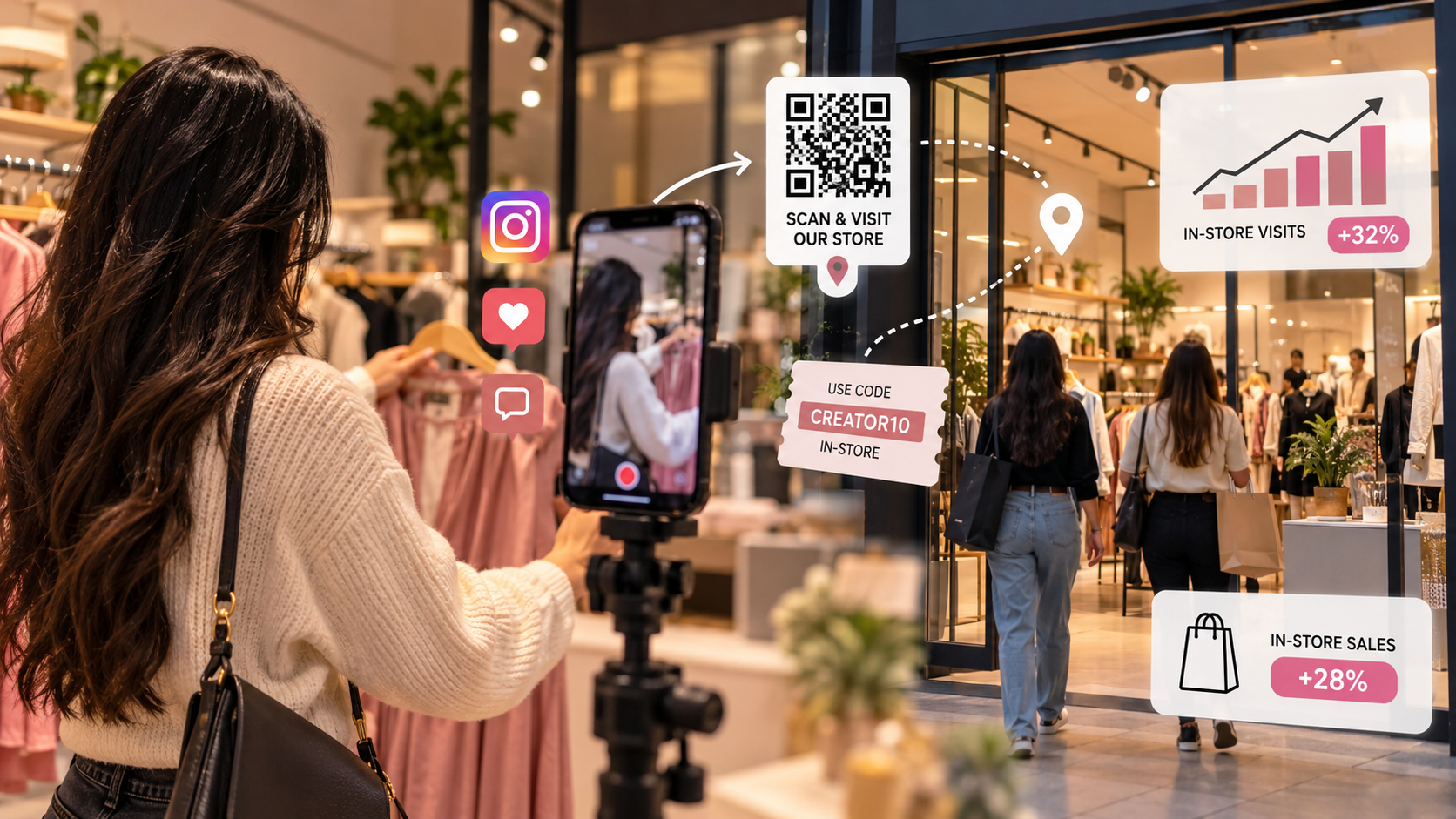
Influencer marketing attribution helps brands understand how creator campaigns influence in-store visits and actual retail sales. While views, likes and comments show online engagement, they do not always reveal how many customers purchased a product offline. By connecting creator campaigns with coupon codes, QR scans, point-of-sale data and store-level sales, brands can measure their impact more accurately.
Someone might discover a product online, compare prices later and buy it in person. Without the right tracking methods, brands can miss that journey entirely. Therefore, retailers need a measurement process that connects creator activity with store visits and sales.
In this guide, we explain practical ways to measure offline conversions. You will learn how to use coupon codes, QR codes, point-of-sale data and store comparisons. We will also explore how brands can estimate incremental sales, calculate campaign ROI and avoid overstating results.
- 1. Why Influencer Marketing Attribution Matters for Retail Brands
- 2. How Influencer Marketing Attribution Measures Offline Sales
- 3. Seven Ways to Measure In-Store Sales From Creator Campaigns
- 4. What the Numbers Say About Social Discovery and Retail
- 5. How to Calculate Influencer Campaign ROI for In-Store Sales
- 6. Build a Practical Creator Campaign Tracking Framework
- 7. Common Mistakes in Influencer Marketing Attribution
- 8. How Hobo.Video Fits Into Retail Creator Campaigns
- 9. Key Takeaways: How to Measure In-Store Sales From Creator Campaigns
- 10. Frequently Asked Questions
- Conclusion: Turn Creator Engagement Into Measurable Retail Outcomes
- About Hobo.Video
1. Why Influencer Marketing Attribution Matters for Retail Brands
Creator campaigns can influence customers long after a video appears in their feed. A shopper might discover a product on Instagram, research it online and visit a nearby store several days later. Yet the final purchase may never appear in the creator’s online analytics.
Influencer marketing attribution helps retailers connect these separate interactions. It provides a framework for understanding which campaign activities relate to store visits, redemptions and purchases.
The opportunity is relevant in India, where social media increasingly influences shopping decisions. In June 2025, Meta reported findings from a GWI study commissioned for its retail research. Almost eight in ten Indian shoppers surveyed discovered products through social media. The study also found that 96% of those social discovery experiences occurred on Meta platforms. These figures describe the study’s findings, not every Indian shopper. Read Meta’s published retail research for its context and methodology.
For retailers, the lesson is practical. Social discovery can influence offline shopping, but brands need evidence before crediting sales to creators.

Amplify Your Brand,
One Influence at a Time.
1.1 Online engagement does not prove offline sales
Views, likes, comments and shares show how audiences respond to content. However, these metrics do not establish whether people entered a store or completed a purchase.
A Reel might attract thousands of views without generating measurable retail activity. Meanwhile, a smaller local creator might influence a few shoppers who make high-value purchases.
Therefore, brands should connect engagement data with store-level evidence. Coupon redemptions, transaction records and appropriate comparison tests can provide useful signals.
1.2 Store visits and sales measure different outcomes
Retailers should separate three key measurements:
- Attributed visits: Store visits associated with a campaign under a defined measurement method.
- Attributed sales: Transactions connected to campaign identifiers, codes or other tracking signals.
- Incremental sales: Additional sales estimated to have occurred because of the campaign.
These measures answer different questions. For example, a QR code can identify interest in a campaign, while a POS redemption can identify a linked transaction. Neither automatically proves that the campaign caused an additional purchase.
Clear definitions help marketing teams report results accurately and make better spending decisions.
2. How Influencer Marketing Attribution Measures Offline Sales
Customer journeys often involve multiple touchpoints. A shopper may watch a creator’s Reel, search for the brand, visit a store and complete the purchase without clicking a tracked link.
This behaviour makes offline conversion tracking more complex than measuring a direct website purchase. Retailers need to connect available data without assuming every interaction represents a separate customer or sale.
The first step is to define what the campaign should achieve. A local launch might aim to increase visits to selected stores. A product demonstration might aim to increase sales of one category. A store event might focus on registrations and attendance.
Once the objective is clear, brands can choose tracking methods that fit their resources. Some retailers can connect promotional codes directly to POS data. Others may begin with QR scans, store traffic records and short customer surveys.
2.1 Understand the role of attribution windows
An attribution window defines the period during which a customer action can be associated with a marketing interaction. For example, a retailer might examine purchases made within seven days of a creator promotion. That period is an illustrative choice, not a universal standard.
Different products have different buying cycles. A snack purchase may happen immediately, while a furniture purchase may follow several days of research.
Brands should choose a reasonable window, document it and apply it consistently. They should also avoid treating every sale inside the window as incremental. A customer may already have intended to buy the product.
2.2 Account for multiple marketing touchpoints
A customer might see a creator Reel, receive a brand message and encounter a paid advertisement before visiting a store. Each interaction may contribute to awareness or purchase consideration.
If every channel claims full credit, the total attributed sales can exceed actual sales. Therefore, brands should establish attribution rules before campaigns begin.
For a clearer view, report tracked transactions separately from estimated incremental outcomes. This distinction helps teams compare campaigns without confusing association with causation.
3. Seven Ways to Measure In-Store Sales From Creator Campaigns
No single tracking method captures every customer journey. A practical measurement plan combines several methods according to the campaign objective, store network and available technology.
3.1 Give each creator a unique coupon code
Unique coupon codes offer a straightforward way to connect creator promotions with in-store transactions. A fashion retailer, for example, can assign a different code to each participating creator.
Customers present the code at checkout, and staff record it in the point-of-sale system. The retailer can then compare redemptions, transaction values and promoted products across creators.
Useful measurements include:
- Number of redemptions by creator.
- Sales associated with redeemed codes.
- Average transaction value.
- Discount costs and contribution margin.
- Redemption rates by store location.
However, coupon code attribution has limitations. Some customers forget to use their code, while others redeem an offer despite already planning to purchase. Therefore, code-linked sales are not a complete measure of campaign impact.
3.2 Use creator-specific QR codes
QR code tracking can connect creator content with store visits and retail offers. A creator might share a code that opens a store locator, displays a voucher or provides information about a local event.
Each code should carry a clear campaign identifier. Where appropriate, brands can also assign identifiers for individual creators, locations or product categories.
Retailers can measure scans, store-locator visits, voucher downloads and redemptions. However, a scan is not proof of a physical visit or completed purchase.
To strengthen the evidence, connect QR activity with transaction records wherever practical. Test every code before publication and ensure the landing page works well on mobile devices.
3.3 Match campaign activity with point-of-sale data
Point-of-sale data provides evidence of purchases made at physical checkout counters. When a retailer records campaign codes or identifiers against transactions, it can connect promotions with sales records.
For multi-store campaigns, consistent reporting matters. Each relevant transaction should include fields such as store location, transaction date, product category, discount and campaign identifier.
Retailers can then review:
- Number of campaign-linked transactions.
- Gross sales and net sales after discounts and returns.
- Units sold for promoted products.
- Average basket value.
- Contribution margin after relevant costs.
POS data provides stronger purchase evidence than social engagement alone. Still, purchases without campaign identifiers may have been influenced by creator content.
3.4 Compare store footfall before and after a campaign
Retail footfall analytics helps brands understand changes in physical store visits. Retailers can compare daily or weekly visitor counts before, during and after a creator activation.
The comparison should account for similar weekdays, store hours, holidays, weather and other promotions. For example, comparing Saturday traffic with Monday traffic may create a misleading result because shopping patterns differ.
Where possible, examine several weeks of historical data. Compare campaign stores with similar locations that did not receive the same campaign.
A rise in visits indicates a change in footfall, but it does not prove the campaign caused that change. A comparison group can provide stronger evidence.
3.5 Use eligible store-visit measurement tools
Some advertising platforms offer store-visit reporting for eligible advertisers. Google’s official store visit conversion guidance explains how Google Ads uses aggregated, anonymized and modelled data to estimate visits associated with eligible ad interactions.
These reports may help brands understand the offline effects of digital advertising. However, eligibility depends on the account, store locations, available data and privacy requirements.
Platform-reported visits are not verified sales from one specific influencer. Brands should review the measurement method and attribution window before using these figures in campaign reports.
They should also avoid adding estimates from different platforms together without checking for overlap.
3.6 Run a matched-store or geographic holdout test
Incrementality testing can help retailers estimate whether a campaign generated additional visits or sales. One approach involves selecting comparable stores or geographic areas.
Some locations receive the creator campaign, while others serve as a comparison group during the same period. Ideally, both groups have similar sales patterns, store sizes, customer profiles and local conditions.
The team then compares how performance changes across the two groups. If campaign stores improve more than comparable stores, the difference provides evidence that the campaign may have contributed to the result.
However, the test is not perfect. Local events, differences between stores and exposure across geographic boundaries can affect results. Careful planning and sufficient data improve the reliability of the analysis.
3.7 Ask customers how they discovered the store
Customer surveys can add context to transaction and footfall data. At checkout, a retailer might ask, “How did you hear about us?”
Possible answers include creators, paid advertising, search, friends and family, in-store promotions or other sources. Brands can also ask whether customers remember a particular creator or campaign.
Keep surveys short and easy to answer. Retailers can collect responses at checkout, through post-purchase messages or with a QR-linked form.
However, surveys rely on memory and self-reporting. Customers may forget an interaction or credit the wrong source. Use survey responses as supporting evidence rather than exact proof of incremental sales.
4. What the Numbers Say About Social Discovery and Retail
Public research provides useful context for why brands want to connect creator campaigns with offline sales. However, social discovery statistics should not be mistaken for proof that a particular creator generated a store visit.
Meta’s June 2025 retail research reported several findings from its commissioned study:
- Almost 8 in 10 surveyed Indian shoppers discovered products through social media.
- 96% of those social media discovery experiences occurred on Meta platforms.
- 3 in 10 viewers purchased products featured in brand videos, according to the study.
- 6 in 10 shoppers followed national influencers, whom the study identified as influential in product discovery and purchase decisions.
These findings suggest that social content can play a role in shopping journeys. However, they do not mean every campaign will achieve similar results. Study design, audience, product category and purchase context matter.
For additional digital context, DataReportal’s Digital 2026: India report says Meta advertising tools indicated Instagram had an advertising reach of 481 million users in India in late 2025. Advertising reach is not the same as monthly active users or unique people reached by a specific campaign.
Brands should use public data to frame the opportunity, then measure their own campaign outcomes.
5. How to Calculate Influencer Campaign ROI for In-Store Sales
Influencer campaign ROI should reflect the financial value generated by the campaign and the costs required to deliver it. Attributed revenue alone can be misleading because some purchases might have happened without the campaign.
A useful approach is to estimate incremental contribution and compare it with the full campaign cost.
Formula:
ROI = (Incremental Profit − Campaign Cost) ÷ Campaign Cost × 1005.1 A hypothetical retail example
Consider a fashion retailer that runs a creator campaign across selected stores. The following figures are illustrative, not actual campaign results.
- Campaign cost: ₹1,00,000
- Estimated incremental sales: ₹3,00,000
- Assumed contribution margin: 40%
- Incremental contribution: ₹1,20,000
The calculation is:
ROI = (₹1,20,000 − ₹1,00,000) ÷ ₹1,00,000 × 100 = 20%
This example assumes the ₹3,00,000 represents incremental sales rather than all sales linked to promotional codes. The contribution margin must reflect relevant variable costs.
If the calculation excludes production costs, discounts or other campaign expenses, it may overstate ROI. Retailers should include all relevant costs and explain how they estimated incremental sales.
5.2 Why revenue alone can mislead
A campaign might generate ₹5 lakh in tracked sales but still deliver a weak return. Creator fees, production, discounts and fulfilment costs can reduce the financial benefit.
Another campaign might generate fewer immediate sales but attract customers who return later. Brands can evaluate repeat purchases separately when reliable data and appropriate permissions are available.
Therefore, reports should show revenue, contribution, campaign costs and the measurement method. This gives marketing and finance teams a more useful picture than one headline number.
6. Build a Practical Creator Campaign Tracking Framework
A clear process helps teams connect campaign activity with retail outcomes. It also reduces confusion when marketing, sales and store teams use different reporting systems.
6.1 Before the campaign
- Define the objective: visits, sales, event attendance or product trials.
- Record baseline store traffic and sales.
- Assign creator-specific codes or QR identifiers where suitable.
- Decide the attribution window and reporting period.
- Document other promotions that may influence results.
6.2 During the campaign
- Record creator publication dates and deliverables.
- Confirm that promotional codes and QR links work.
- Ensure participating stores know how to record redemptions.
- Track store traffic and relevant sales data consistently.
- Document unusual events or changes in store operations.
6.3 After the campaign
- Match campaign identifiers with available POS records.
- Compare results with a suitable baseline or control group.
- Separate attributed transactions from estimated incremental sales.
- Calculate campaign costs and financial returns.
- Document limitations and recommendations for the next campaign.
This workflow makes creator campaign tracking more consistent. It also helps brands explain what the data supports and what remains uncertain.
7. Common Mistakes in Influencer Marketing Attribution
Even a well-planned campaign can produce misleading results if teams interpret data incorrectly. Avoid these common mistakes.
7.1 Treating every redemption as an incremental sale
A coupon identifies a linked transaction, but the customer may already have planned to buy. Use suitable comparisons to estimate whether the campaign created additional demand.
7.2 Measuring visits without measuring purchases
Higher footfall can be useful, but it does not necessarily translate into revenue. Where possible, track conversion rate, basket value, promoted product sales and contribution margin.
7.3 Comparing stores without considering local conditions
Stores differ in location, size, customer mix and seasonal demand. Use comparable locations and document differences that could affect the results.
7.4 Giving several channels full credit for the same sale
Customers may encounter creator content, paid advertising and email promotions before buying. Establish clear attribution rules and distinguish channel reporting from incrementality estimates.
7.5 Ignoring privacy and data quality
Retail measurement should use appropriate permissions and safeguards. Limit customer-level data, restrict access and prefer aggregated reporting where practical. Avoid covert tracking or linking datasets without a valid basis and appropriate safeguards.
8. How Hobo.Video Fits Into Retail Creator Campaigns
Retail brands need more than creator reach. They need relevant creators, clear campaign briefs, appropriate tracking methods and a reporting process that connects content with business outcomes.
Hobo.Video’s existing content explores hyperlocal influencer marketing, including how local creators can support store traffic. Its guide to tracking influencer campaign metrics provides broader context on campaign measurement.
Brands can also explore measuring influencer marketing ROI to understand how financial outcomes fit into performance evaluation.
These resources complement this guide’s focus on offline attribution. Before choosing a platform or agency, brands should verify current tracking, reporting and campaign management capabilities against their specific needs.
9. Key Takeaways: How to Measure In-Store Sales From Creator Campaigns
Use these practical tips when planning your next campaign:
- Set one clear objective. Decide whether you want store visits, sales, product trials or event attendance.
- Use unique tracking identifiers. Creator-specific codes and QR links can help identify campaign-related activity.
- Connect digital activity with POS data. Where possible, link redemptions to physical transactions.
- Measure footfall carefully. Compare similar periods and account for seasonal or local factors.
- Test incrementality. Use matched stores or geographic holdouts where practical.
- Calculate financial return accurately. Include relevant costs and avoid treating attributed revenue as incremental profit.
- Respect privacy. Use suitable permissions, safeguards and aggregated reporting where practical.
- Report limitations. Explain what was tracked, what was estimated and what cannot be established from the available data.
The goal is not to claim every purchase came from a creator. It is to build a fair, useful picture of how creator activity contributes to retail performance.
10. Frequently Asked Questions
1. What is influencer marketing attribution?
Influencer marketing attribution is the process of connecting creator campaign activity with customer actions, such as store visits, coupon redemptions or purchases. Brands can use unique codes, QR links, POS data and other signals to identify transactions associated with campaigns. However, attribution does not automatically prove that a campaign caused a purchase. Brands should distinguish attributed outcomes from incremental results.
2. How can brands track in-store visits from influencer campaigns?
Brands can combine store traffic data, creator-specific QR codes, promotional redemptions, customer surveys and eligible advertising platform reports. Each method provides different evidence. QR scans indicate engagement, while POS records can identify linked purchases. Where possible, brands should compare campaign stores with a suitable baseline or control group to estimate whether visits increased beyond normal patterns.
3. How do coupon codes help measure creator campaigns?
A unique coupon code links a promotion to a creator or campaign. When a customer redeems it at checkout, the retailer can record the transaction and analyse sales associated with that code. This makes coupon codes practical for smaller retailers. However, some influenced customers will not use the code, and some redemptions would have happened anyway. Therefore, code-linked sales do not represent all campaign impact.
4. What is the difference between attributed and incremental sales?
Attributed sales are transactions linked to a campaign through a defined tracking method. Incremental sales are additional sales estimated to have occurred because of the campaign. For example, a coupon may identify a purchase, but the customer might have bought the product without the offer. A suitable control group or experiment helps brands estimate the additional effect more reliably.
5. Can Google Ads measure offline store visits?
Google Ads offers store-visit conversion reporting for eligible advertisers. Google’s documentation explains that it uses aggregated, anonymised and modelled data to estimate visits associated with eligible ad interactions. Availability depends on account and campaign requirements. These estimates are not necessarily verified purchases or results attributable to one specific creator. Brands should check current eligibility and reporting details before using the data.
6. Which metrics matter most for retail creator campaigns?
Useful metrics include attributed store visits, coupon redemptions, campaign-linked transactions, promoted product sales, conversion rate, average basket value and contribution margin. Brands should also estimate incremental sales where suitable data allows it. The right metrics depend on the campaign objective. A brand seeking awareness may focus on store visits, while a sales-focused campaign needs stronger transaction and financial evidence.
7. How can small businesses measure offline conversions on a limited budget?
Small businesses can begin with creator-specific coupon codes, simple QR links and a consistent record of daily store traffic. They can compare campaign results with similar weekdays or previous periods. They should also document other promotions and seasonal changes. These methods provide useful starting evidence, although they cannot prove causation on their own. As resources grow, retailers can add POS integrations or comparison tests.
8. How should brands calculate influencer campaign ROI?
Brands should compare incremental profit with the total campaign cost. Relevant costs may include creator fees, production, discounts, event expenses and other campaign spending. Attributed revenue alone can overstate the return because some purchases might have happened without the campaign. Where incremental sales cannot be measured reliably, brands should clearly label their estimates and explain the assumptions used in the calculation.
9. How can brands avoid double-counting sales across marketing channels?
Brands should define attribution rules before a campaign starts and document which tracking signals support each result. A customer might see a creator Reel, click an advertisement and later redeem a store voucher. If each channel claims full credit, the combined figures may exceed actual sales. Use consistent reporting windows, identify overlapping touchpoints where possible and report incrementality separately from channel-level attribution.
10. Why is offline measurement important for influencer marketing in India?
Indian consumers often discover products through digital content before purchasing online or in physical stores. Meta’s 2025 retail research reported that almost eight in ten surveyed Indian shoppers discovered products through social media. That finding highlights the relevance of social discovery, but it does not prove that every campaign generates store visits. Offline measurement helps brands evaluate their own results instead of relying on general industry trends.
Conclusion: Turn Creator Engagement Into Measurable Retail Outcomes
Creator campaigns can influence shoppers well beyond their social media feeds. However, brands need reliable evidence to understand whether those interactions contribute to physical store visits and sales.
The most useful approach combines coupon codes, QR tracking, POS records, footfall comparisons and incrementality testing where practical. Together, these methods provide a clearer picture of customer behaviour and campaign performance.
Keep these lessons in mind:
- Set clear objectives before launch.
- Use tracking methods suited to your retail setup.
- Separate attributed sales from incremental sales.
- Include all relevant campaign costs when calculating ROI.
- Explain measurement limitations and respect customer privacy.
Strong influencer marketing attribution is not about claiming credit for every sale. It is about understanding what the evidence supports and using those insights to improve future campaigns.
Ready to build a creator campaign with clearer business goals? Explore Hobo.Video and connect your brand with creator-led marketing opportunities.
About Hobo.Video
Hobo.Video is India’s leading AI-powered influencer marketing and UGC company, with 2.25 million creators. Services include:
- Influencer marketing
- UGC content creation
- Celebrity endorsements
- Product testing
- Marketplace reputation management
- Regional campaigns
Trusted by brands like Himalaya, Wipro, Symphony, Baidyanath, and the Good Glamm Group.
Smart brands choose creators who break the mold. Join us and run your next campaign.
Influencer life is different when you’re backed by the right crew. Let’s grow.

 Neeti Katyal
 Anooshka Pandey