
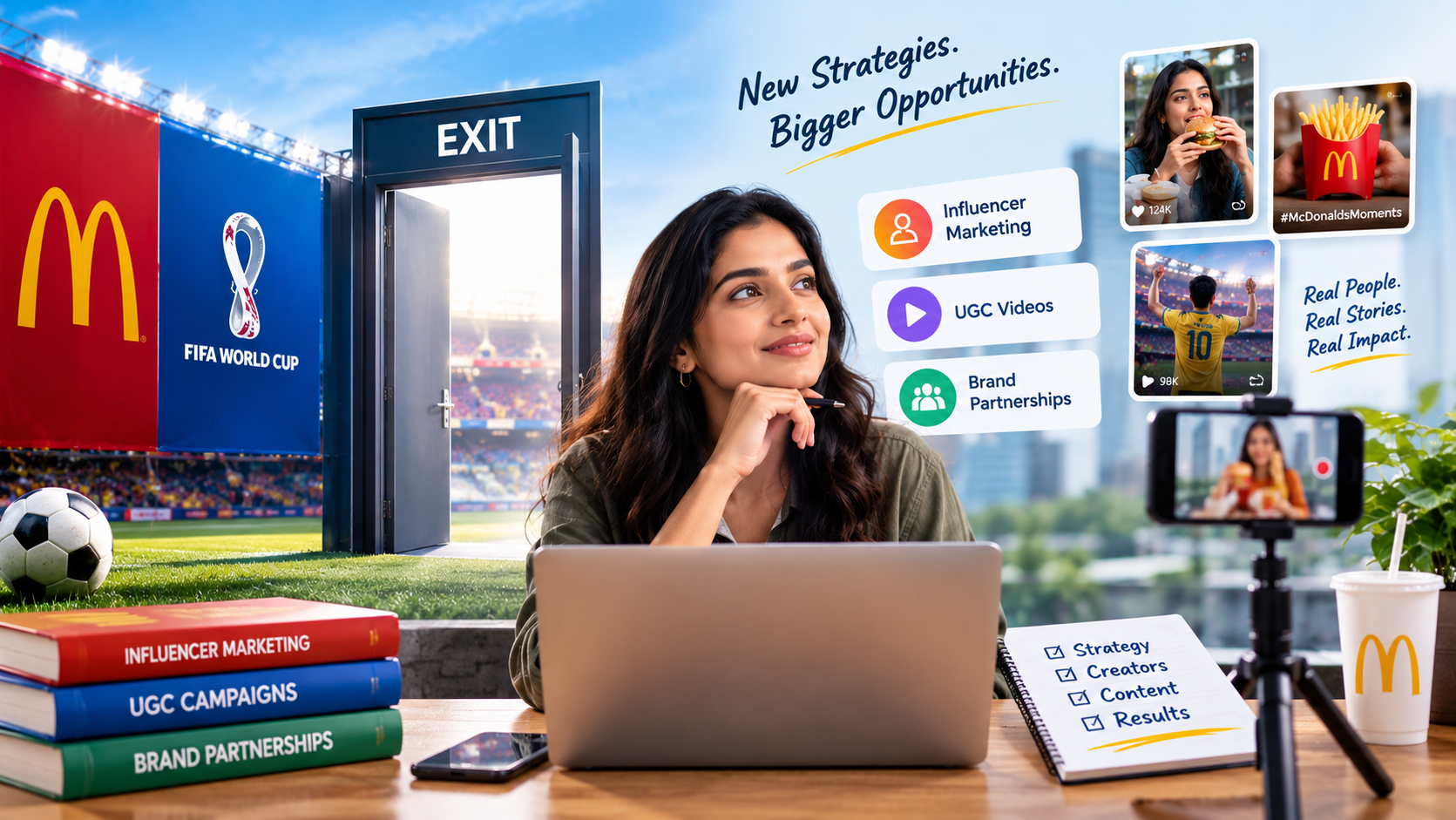
McDonald’s FIFA World Cup sponsorship exit marks an important moment for global brand marketing. After more than three decades, the fast-food giant is ending its official FIFA World Cup sponsorship following the 2026 men’s tournament. The decision raises a question that matters far beyond football: how should brands decide whether a major partnership still deserves their marketing budget? The McDonald’s FIFA World Cup sponsorship exit does not mean the company is abandoning sports or fan culture. Instead, recent reporting points towards a more selective approach, with greater emphasis on brand-owned experiences and year-round customer connections. For marketers in India, the shift offers useful lessons about influencer marketing, UGC campaigns, creator partnerships, and campaign measurement. A famous event can deliver enormous reach, but reach alone cannot prove business value. Brands must also understand what audiences remember, what customers do next, and whether the partnership strengthens their own identity.
The story is especially relevant as Indian brands invest in creators, celebrities, sports personalities, and short-form video. The central lesson is not that large sponsorships have stopped working. It is that every partnership needs a clear purpose, measurable outcomes, and a plan that lasts beyond the campaign.
- 1. What Happened? Understanding McDonald’s FIFA World Cup Sponsorship Exit
- 2. Five Marketing Lessons Brands Should Take From the Exit
- 3. What This Means for Influencer Marketing, UGC Videos, and Brand Partnerships
- 4. A Practical Framework for Indian Brands: From Sponsorship Spend to Measurable Growth
- 5. The Future of Brand Partnerships: AI, Brand-Owned Experiences, and Trust
- Conclusion: Key Lessons From McDonald’s FIFA World Cup Sponsorship Exit
- About Hobo.Video
1. What Happened? Understanding McDonald’s FIFA World Cup Sponsorship Exit
McDonald’s has confirmed the end of its long-running FIFA World Cup sponsorship after the 2026 tournament. The partnership began in 1994 and lasted more than 30 years. According to reporting by Marketing Dive, the company described the change as an evolution in how it invests in global partnerships. It also said sport and culture would remain important ways to connect with fans. Therefore, the decision should not be read as a complete withdrawal from sports marketing.
The timing matters. In June 2026, McDonald’s promoted FIFA World Cup meals, Happy Meals, collectible cups, football stars, and other fan experiences. Its official announcement described a worldwide campaign designed to bring the tournament into restaurants and everyday fan moments. The effort featured football personalities including David Beckham, Ronaldinho, Thierry Henry, Son Heung-min, and Lamine Yamal. The campaign also included tournament-themed Happy Meal collectibles. These activities connected the global event with products and experiences that customers could recognise and purchase. McDonald’s official campaign announcement provides the brand’s own description.
1.1 Why did the partnership end?
The most useful explanation comes from the company’s broader marketing direction and reporting around campaign performance. Marketing Dive reported that the 2026 campaign lifted McDonald’s Net Promoter Score and social media buzz among younger consumers, according to Kantar data shared with the publication. However, McDonald’s chief financial officer Ian Borden said the campaign underperformed against expectations, despite supporting the business and creating excitement across its system. The company also reported 0.8% same-store sales growth in the United States during the second quarter of 2026. The report said weaker traffic weighed on performance, with the company attributing one-third of the traffic loss to the World Cup campaign.
These details need careful interpretation. They do not prove that FIFA sponsorship was a failure in every market or that the partnership produced no value. Instead, they show why marketers must separate attention, customer sentiment, operational activity, and financial results. A campaign can create excitement and still fall short of its commercial target. Likewise, a sales result can reflect several factors beyond one campaign. Read the Marketing Dive report for the reported context.
1.2 What McDonald’s appears to want next
Recent reporting describes a stronger focus on brand-owned experiences, local relevance, and fan engagement throughout the year. In simple terms, the company wants to create more reasons for people to connect with McDonald’s beyond a major tournament. Its FIFA exit does not mean it will stop working with athletes, teams, or sports properties. Rather, it suggests that the brand wants to choose partnerships more selectively and make each investment work harder.

Amplify Your Brand,
One Influence at a Time.
That distinction matters for every marketer. A large partnership can provide reach, recognition, and access to a passionate community. Yet the brand still needs to turn that attention into a relevant customer experience. It must also consider how long the impact lasts after the event ends. This is where creator campaigns, UGC videos, loyalty programmes, and brand-owned content can support a wider strategy. The goal is not to replace every major sponsorship with influencers. It is to make each marketing channel serve a clear role in a connected plan.
2. Five Marketing Lessons Brands Should Take From the Exit
The McDonald’s FIFA World Cup sponsorship exit offers five useful lessons for brands of different sizes. These lessons apply to global sponsorships, Indian celebrity campaigns, regional creator partnerships, and everyday UGC programmes. They should not be treated as proof that one channel always performs better than another. Instead, use them as questions to ask before committing a budget.
2.1 Lesson 1: Reach is valuable, but it is not the final result
Major sporting events attract attention that most individual brands cannot generate alone. A global tournament can place a brand in front of fans across countries, age groups, and media channels. However, visibility is only the beginning of the customer journey. People may notice a logo without remembering the product. They may watch a celebrity advertisement without visiting a store. They may share a funny video without changing their buying behaviour.
Brands should therefore define what success means before launching a campaign. A company seeking awareness might measure qualified reach, brand recall, and search interest. A brand seeking trial might track coupon redemptions, product sampling, or first purchases. A retention campaign might focus on repeat purchase and loyalty activity. Each objective needs a suitable measurement method.
For Indian marketers, this distinction is especially useful when comparing celebrity endorsements with micro-influencer campaigns. A celebrity may create broad awareness, while a smaller creator may answer specific questions for a relevant audience. Neither option wins automatically. The right choice depends on the audience, product, creative idea, cost, and intended outcome.
2.2 Lesson 2: Borrowed fame should strengthen the brand, not replace it
A major sports property brings its own identity, history, stars, and emotional meaning. Brands borrow some of that attention when they become sponsors. This can work well, especially when the partnership feels natural. However, the audience may remember the tournament or athlete more clearly than the brand itself.
McDonald’s connected the 2026 tournament to its own products through limited-time meals, collectible cups, Happy Meals, and app experiences. These examples show how a partnership can move beyond logo placement. The event becomes a reason to interact with a product or service that the brand controls. Yet marketers still need to assess whether the resulting activity strengthens the brand’s long-term position.
Influencer campaigns face the same risk. If every post depends on a creator’s personality, a trend, or a trending audio track, the brand can disappear from the story. A stronger brief connects the creator’s style with a specific product truth or customer need. The audience should understand not only who made the content, but why the brand belongs in it.
A useful test is simple: if the logo disappeared from the content, would people still recognise what the brand offers? If the answer is no, the campaign may rely too heavily on borrowed attention.
2.3 Lesson 3: Measure business impact before, during, and after the campaign
Marketing teams often report views, impressions, likes, shares, and media value. These measures can help explain exposure, but they do not fully establish commercial impact. A campaign may receive strong engagement while generating few qualified visits or purchases. Another campaign may produce fewer interactions but attract customers who return.
Build a measurement plan before approving the creative. Record the starting point, define the target, and identify the data source for each metric. Then measure the immediate response and the longer-term result. Where possible, compare exposed audiences with a suitable comparison group. If that is not possible, use a clear before-and-after analysis and acknowledge other factors that may influence the result.
For creator campaigns, use trackable links, unique codes, campaign landing pages, and consistent UTM parameters where appropriate. However, do not rely on coupon codes alone. Customers may discover a product through a creator and purchase later through another channel. Likewise, a customer may use a code without being influenced by the content. Use several signals to build a more complete picture.
McDonald’s experience reminds marketers to ask a harder question than “Did people notice us?” Ask whether the campaign changed a relevant customer behaviour enough to justify its cost.
2.4 Lesson 4: Build relationships that continue after the campaign ends
A World Cup sponsorship creates a clear period of attention. Yet customers continue to make purchase decisions when the tournament finishes. Brands that only appear during a major event may lose contact with the audience once the excitement fades.
A better plan connects event activity to year-round communication. A sports campaign might introduce a loyalty programme, a useful content series, local community events, or recurring creator partnerships. Each activity should offer a reason for customers to return. The brand should not simply extend a hashtag for months without adding fresh value.
In influencer marketing India, brands can create ongoing creator relationships around real customer interests. A fitness brand might work with coaches across several training cycles. A food company might partner with regional creators to show different recipes and usage occasions. An electronics brand might use creators for product education, setup help, and troubleshooting content. These programmes can provide continuity without requiring every post to feel like an advertisement.
Long-term relationships also help teams learn. Creators understand the audience better over time, while brands gain a clearer view of which formats and messages help customers. However, ongoing partnerships still need regular performance reviews. Continuity is valuable when it improves relevance, not when it protects a weak campaign from scrutiny.
2.5 Lesson 5: Global reach needs local relevance
A global event creates shared excitement, but customers do not behave identically across markets. Food preferences, languages, payment habits, cultural references, and media use vary. A campaign can have a strong global idea and still need local execution.
Indian brands should consider differences between states, cities, languages, and customer groups. A Hindi-speaking creator may be suitable for one audience, while a Tamil, Bengali, Marathi, Telugu, or Malayalam creator may serve another more effectively. Even within one language, humour, references, and product needs can differ. Local relevance requires more than translating a caption.
Use local creators to explain the product in a familiar setting. Give them clear information, but allow room for natural expression. Test the message with the intended audience before expanding it. Track results by region and creator type rather than relying only on one national average. If a campaign performs well in one city but poorly elsewhere, investigate why before scaling.
This approach helps brands avoid treating India as one uniform market. It also supports more responsible spending because teams can see where the partnership creates meaningful value.
3. What This Means for Influencer Marketing, UGC Videos, and Brand Partnerships
The news does not prove that influencer marketing is replacing sports sponsorship. Instead, it highlights a need to compare channels by their purpose, costs, risks, and outcomes. A major sponsorship may provide cultural relevance and scale. Influencers may deliver trusted explanations or access to niche communities. UGC can show products in everyday use and answer practical questions. Brand-owned content can maintain a consistent relationship between campaigns.
The strongest plan combines channels when they support the same business goal. For example, a national campaign might use a major sports moment to create awareness, creators to explain the product, UGC to show real-life use, and a loyalty programme to encourage repeat visits. Each channel plays a different role. The team should still measure the contribution of each part and avoid giving every result to the most visible activity.
3.1 When should a brand choose influencer marketing?
Influencer marketing can work well when a product benefits from demonstration, explanation, community trust, or a creator’s specific expertise. A kitchen product may need a practical recipe video. A skincare product may need a clear routine demonstration and accurate product information. A regional retailer may need a local voice who understands nearby customers. These use cases differ from sponsorships designed mainly to build broad awareness.
Before choosing a creator, assess audience relevance, content quality, credibility, brand fit, usage rights, and the ability to communicate the product accurately. Follower count is only one signal. A creator with a smaller, relevant audience may deliver useful attention, but brands should verify audience quality and campaign performance rather than assume smaller creators always perform better.
Brief creators with the customer question in mind. Explain the product facts, required disclosures, prohibited claims, campaign objective, and the action viewers should take. Then allow creators to express the message naturally. A rigid script can make content feel less credible, while a vague brief can lead to confusion or unsupported claims.
3.2 Where do UGC campaigns fit?
UGC campaigns can help brands understand how people describe, use, and evaluate products. Customer reviews, permitted customer videos, creator demonstrations, and product feedback may reveal questions that conventional advertising misses. These signals can help a brand improve product pages, support articles, packaging, and future campaign briefs.
However, brands must distinguish genuine customer content from paid creator content and AI-generated assets. Do not label a paid endorsement as an independent customer review. Do not invent a testimonial or imply that a synthetic person has personally used a product. Obtain permission before using someone’s content in paid advertising, and clarify the permitted platforms, duration, edits, and usage rights.
UGC works best when it helps customers make a better-informed decision. A video that shows product size, setup, texture, fit, or a real usage situation may be more useful than a generic claim that a product is “amazing.” The brand should also examine the questions and concerns that appear in comments. Those conversations can point to product improvements, not just future content ideas.
3.3 How should brands evaluate partnerships before signing?
A partnership should start with a business problem, not a famous name. Ask what the audience needs, what the brand can offer, and why the partner is suited to the task. Then define deliverables, measurement, rights, exclusivity, disclosures, cancellation terms, and responsibilities for unexpected events.
Consider a scorecard that covers:
- Audience fit: Does the partner reach the intended customer group?
- Brand fit: Does the partnership make sense for the product and values?
- Creative potential: Can the partner tell a useful, memorable story?
- Measurement: Can the team track outcomes beyond impressions?
- Reuse rights: Can the brand repurpose content, and under what conditions?
- Risk management: Are disclosure, safety, and escalation requirements clear?
- Long-term value: Can the partnership build a relationship beyond one post or event?
A partnership with a famous athlete may be right for mass awareness. A niche creator may be better for education or conversion. A UGC programme may help produce multiple customer-focused assets. The right answer comes from the objective and evidence, not a universal rule that one format beats another.
4. A Practical Framework for Indian Brands: From Sponsorship Spend to Measurable Growth
Indian brands do not need a World Cup-sized budget to apply these lessons. They need a clear plan that connects audience insight, creative work, distribution, and measurement. The following framework can help teams assess a sponsorship, celebrity campaign, influencer programme, or UGC initiative before they commit more money.
Step 1: Write down the business objective
Choose one primary objective for the campaign. It might be awareness, product trial, qualified traffic, app usage, sales, repeat purchase, or customer education. Secondary goals are fine, but avoid giving one campaign a long list of unrelated targets. If the team cannot agree on the main goal, it will struggle to judge the result.
Next, define the audience and the behaviour you want to change. “Reach young consumers” is too broad. A clearer objective might be to help first-time buyers understand a product benefit, encourage existing customers to try a new menu item, or bring qualified visitors to a regional landing page. The more specific the goal, the easier it becomes to select the right partner and format.
Step 2: Estimate total cost, not only the headline fee
The cost of a sponsorship or creator campaign includes more than the rights fee or influencer payment. It may include creative production, agency fees, media distribution, event activation, content adaptation, staff time, product sampling, moderation, and measurement. Usage rights and exclusivity may also affect the final price.
Create a total-cost estimate before signing. Then identify the result needed to justify the investment. Do not invent a benchmark if the brand has no comparable campaign data. Instead, use historical performance, small tests, and clearly stated assumptions. A forecast is a planning tool, not a guarantee.
For smaller brands, pilot campaigns can reduce uncertainty. Test several creator formats, messages, or audiences with a limited budget. Use the results to decide what deserves more investment. However, make sure the pilot is large enough to provide useful information. A handful of views or one sale cannot establish reliable performance.
Step 3: Build a content plan that continues after launch
Do not plan only the announcement post. Map the full content journey before launch. Include awareness content, product explanations, creator demonstrations, frequently asked questions, customer stories, and post-campaign follow-up. Each asset should have a purpose and a suitable distribution channel.
For example, a regional food brand could use a sports moment to introduce a limited-time product. Creators could show how people enjoy it during match viewing. UGC could capture permitted customer experiences. The brand could then share recipes, product information, and relevant offers after the event. This is an illustrative approach, not a claim about a real campaign.
Build a content library with usage rights, dates, platforms, approved claims, and expiration details. That record helps teams avoid reusing assets after permission ends. It also makes it easier to identify which content can be adapted for paid social, product pages, or customer support.
Step 4: Measure a balanced set of results
Use a measurement framework that connects activity with outcomes.
| Objective | Possible measures | What to check |
|---|---|---|
| Awareness | Reach, frequency, brand recall, search interest | Did the intended audience notice and remember the brand? |
| Engagement | Meaningful comments, shares, saves, video completion | Did people respond to the message? |
| Consideration | Product-page visits, qualified traffic, questions | Did the content encourage further evaluation? |
| Conversion | Orders, redemptions, lead quality, acquisition cost | Did the campaign support a measurable action? |
| Retention | Repeat purchase, return visits, loyalty activity | Did the relationship continue after launch? |
| Customer insight | Feedback themes, common questions, sentiment | What did the campaign teach the business? |
These measures are examples, not universal targets. Choose metrics that match the product and buying journey. Where attribution is uncertain, explain the limits. Use a mix of quantitative data and customer feedback rather than treating one dashboard number as the full truth.
Step 5: Review the results and make a decision
After the campaign, decide whether to scale, adapt, pause, or stop the activity. Ask which audience responded, which creative helped, which costs increased, and which results lasted. Compare the campaign with a suitable baseline or earlier activity when possible.
Also record what did not work. Perhaps a creator delivered strong engagement but attracted the wrong audience. Perhaps a video generated many questions because the product explanation was unclear. Perhaps a sponsorship created broad awareness but did not connect customers with an easy next step. These findings can improve the next campaign even when the immediate result falls short.
Finally, share the learning with marketing, sales, product, customer support, and leadership. Customer questions may reveal a product issue. Conversion data may show a pricing concern. Creator feedback may expose unclear campaign instructions. The value of measurement increases when it changes the next decision.
5. The Future of Brand Partnerships: AI, Brand-Owned Experiences, and Trust
The McDonald’s FIFA World Cup sponsorship exit is a useful reminder that brands must keep reviewing the role of major partnerships. It does not establish that sponsorships are outdated or that every company should move its budget to influencers. Rather, it encourages marketers to be more precise about what they buy and what they expect to gain.
AI can help teams organise comments, identify recurring themes, draft content variations, and speed up campaign reporting. However, AI-generated summaries may miss sarcasm, local context, or important minority concerns. Human review remains essential, especially for claims about products, health, money, or safety. Likewise, AI-generated creator content should not present fictional experiences as genuine customer testimonials.
Brand-owned experiences also need more than a memorable name. They should give customers a reason to participate, return, or share something meaningful. A useful loyalty benefit, a local community activity, a product trial, or a helpful creator series can build a relationship when it meets a real need. A branded hashtag alone rarely creates lasting value without a strong experience behind it.
For Indian marketers, the opportunity lies in combining scale with relevance. National campaigns can create awareness, while regional creators and local content make the message easier to understand. UGC can reveal how people use a product, while owned channels help answer questions and maintain the relationship. Each element should reinforce the same brand promise.
Ultimately, strong partnerships create value for both the business and the audience. They should make the brand more memorable, help customers understand what it offers, and provide a clear reason to act. If a partnership delivers only temporary attention, marketers should question whether its cost and complexity remain justified.
Conclusion: Key Lessons From McDonald’s FIFA World Cup Sponsorship Exit
The McDonald’s FIFA World Cup sponsorship exit offers a timely lesson: no partnership should be protected from review simply because it is famous or long-running. Sponsorships can create cultural relevance and massive reach, but brands still need to connect those benefits with customer experience and measurable outcomes. The decision is not a verdict against sports marketing. It is a reminder to match investment with clear business goals.
Here are the practical lessons to take forward:
- Define success before launch. Decide whether the campaign should build awareness, trial, sales, retention, or customer understanding.
- Look beyond reach. Track relevant actions and longer-term outcomes, not only views and impressions.
- Make the brand part of the story. Borrowed fame should reinforce the brand’s own identity and product value.
- Choose creators for relevance. Evaluate audience fit, credibility, creative quality, and the ability to answer customer questions.
- Use UGC responsibly. Obtain permission, protect customer trust, and distinguish real experiences from paid or synthetic content.
- Build continuity. Connect event campaigns with useful content, loyalty activity, and year-round customer experiences.
- Measure honestly. Use baselines, trackable links, suitable comparisons, and clear notes about attribution limits.
- Learn before scaling. Test ideas, document results, and redirect investment when evidence supports a change.
- Adapt locally. Indian audiences differ by language, region, culture, and buying needs.
- Keep trust at the centre. A partnership should improve the customer’s understanding or experience, not simply fill a media calendar.
The McDonald’s FIFA World Cup sponsorship exit is therefore best understood as a strategic signal, not a universal rule. Brands should keep the partnerships that deliver meaningful value, improve the ones that can be fixed, and step away from those that no longer serve their goals. Influencer marketing and UGC can support that shift when teams choose the right partners, create useful content, and measure outcomes carefully.
About Hobo.Video
Hobo.Video is India’s leading AI-powered influencer marketing and UGC company. With over 2.25 million creators, it delivers end-to-end campaign management designed for brand growth. The platform blends AI intelligence with human strategy to ensure maximum ROI.
Services include:
- Influencer marketing
- UGC content creation
- Celebrity endorsements
- Product feedback and testing
- Marketplace and seller reputation management
- Regional and niche influencer campaigns
Trusted by top brands like Himalaya, Wipro, Symphony, Baidyanath, and Good Glamm Group.
Inspired by what you read? Let’s turn ideas into impact. Connect with us and unlock your brand’s next growth chapter. Start here.
If you’re an influencer looking for real brand growth, this is your moment. Join now.
Frequently Asked Questions
Why is McDonald’s ending its FIFA World Cup sponsorship?
McDonald’s is ending its official FIFA World Cup sponsorship after the 2026 men’s tournament, following a partnership that began in 1994. Recent reporting connects the decision with an evolving marketing strategy and a more selective approach to global partnerships. The company says sport and culture will remain important. The move should not be interpreted as a complete exit from sports marketing. Instead, it points towards a stronger focus on brand-owned experiences and year-round fan connections.
Does McDonald’s FIFA sponsorship exit mean sports marketing no longer works?
No. One company’s decision does not prove that sports marketing has stopped working. Sponsorship can still build awareness, create emotional connections, and bring brands into cultural moments. However, each deal must justify its cost and fit the company’s objectives. Brands should assess audience relevance, activation costs, sales impact, brand recall, and the value that remains after the event. A sponsorship may work well for one company and underperform for another.
What can Indian brands learn from the McDonald’s FIFA World Cup sponsorship exit?
Indian brands can learn to connect large campaigns with clear business goals. They should measure more than reach, choose partners for audience relevance, and build content that continues after the event. Regional creators can make campaigns more relevant to local audiences. UGC can help answer product questions and reveal customer concerns. Above all, brands should review campaign results honestly and move investment towards activities that create measurable value.
How can influencer marketing help brands after a major sponsorship campaign?
Influencer marketing can explain products, demonstrate use cases, answer common questions, and connect with niche audiences. It can also extend a campaign’s message beyond a single event. Brands should select creators based on audience fit and content quality rather than follower count alone. Clear briefs, accurate product information, appropriate disclosures, and trackable goals improve campaign management. The results should be assessed against the campaign objective, not just likes or video views.
How should brands measure influencer campaign ROI?
Start by defining the goal and recording a baseline. Track relevant measures such as qualified traffic, sales, leads, coupon redemptions, customer acquisition cost, repeat purchase, or brand recall. Use UTM parameters and unique links where suitable. Also consider that customers may see content and buy later through another channel. Therefore, avoid treating one metric as complete proof of impact. Combine campaign data with customer feedback and explain attribution limits clearly.
How can AI help brands manage influencer marketing and UGC?
AI can help organize feedback, group recurring questions, draft content variations, and summarize campaign results. It may save time when teams handle large volumes of comments and content. However, AI can misunderstand context or produce inaccurate claims. Human review remains important for brand safety, disclosures, product facts, and sensitive topics. Brands should also avoid presenting fictional AI-generated experiences as genuine customer testimonials. The goal is better decision-making, not automation without accountability.

 Neeti Katyal