
Introduction: One Celebrity Campaign Should Deliver More Than One Moment
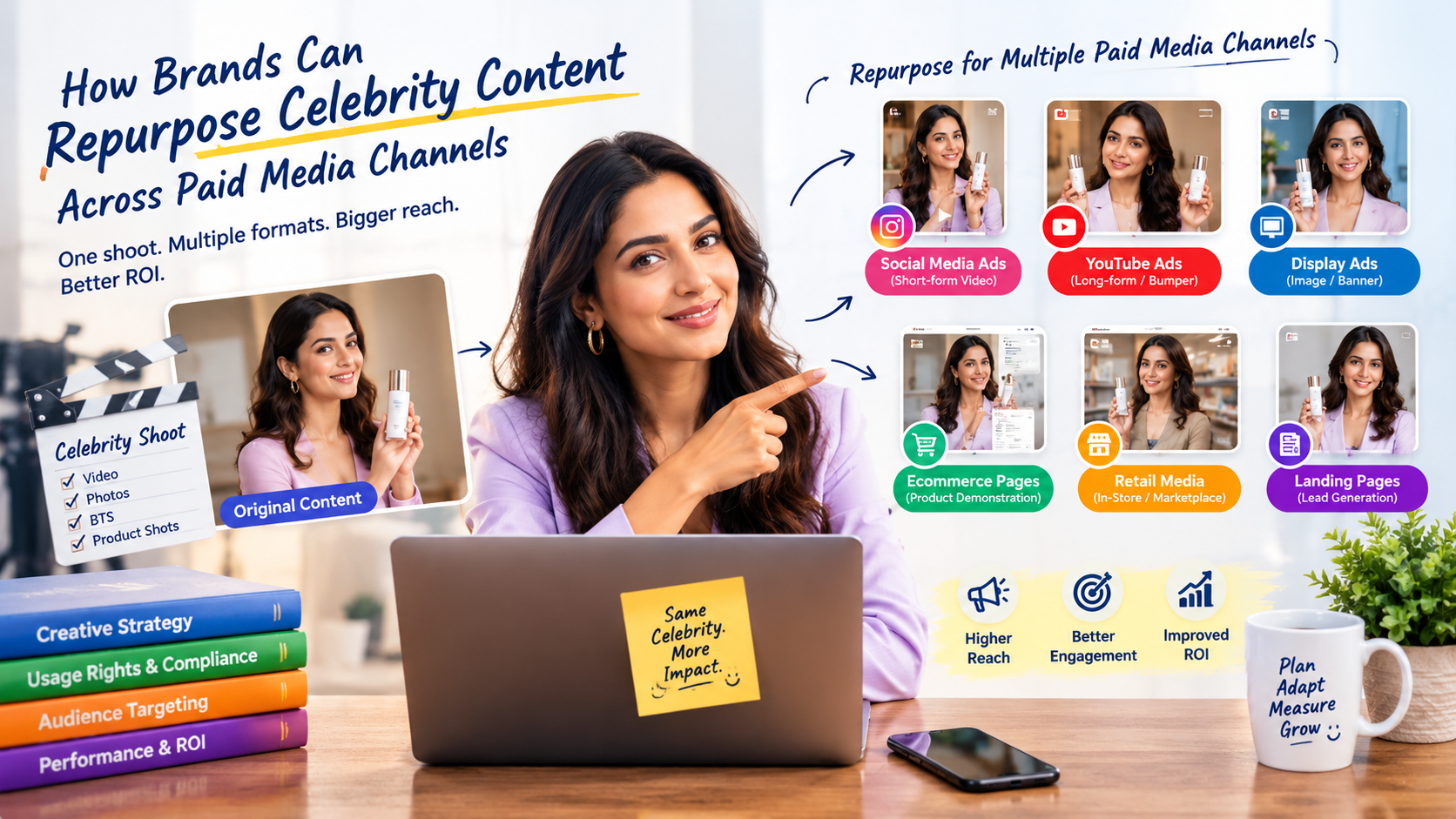
Celebrity content repurposing helps brands get more value from a single celebrity campaign. Instead of using one video only once, brands can adapt it for paid social media, YouTube ads, display campaigns, ecommerce pages, and landing pages. However, each format needs the right creative edits, usage permissions, and performance tracking.
The goal is not to publish the same advertisement everywhere. Instead, brands should adapt a celebrity’s message, story, and visual presence to fit each channel. A long-form film might become a short vertical video, a product demonstration, a paid social advertisement, or a retail media asset. Each version should preserve the campaign’s core message while serving a clear purpose. When brands repurpose celebrity content across paid media channels thoughtfully, they can build a connected campaign rather than a collection of disconnected advertisements.
- Introduction: One Celebrity Campaign Should Deliver More Than One Moment
- 1. What Does It Mean to Repurpose Celebrity Content?
- 2. Why Brands Should Repurpose Celebrity Content Across Paid Media Channels
- 3. Which Paid Media Channels Can Use Repurposed Celebrity Content?
- 4. Build a Repurposing Plan Before the Celebrity Shoot
- 5. How to Adapt Celebrity Content for Different Audiences
- 6. Usage Rights, Approvals, and Compliance
- 7. Measure the Performance of Repurposed Celebrity Content
- 8. Common Mistakes When Repurposing Celebrity Content
- 9. A Practical 30-Day Plan for Repurposing Celebrity Content
- Key Learnings: A Checklist for Repurposing Celebrity Content
- About Hobo.Video
1. What Does It Mean to Repurpose Celebrity Content?
1.1 Understand the difference between reuse and repurposing
Reusing celebrity content means publishing an existing asset again in another placement or campaign. For example, a brand might run the same approved video on two advertising platforms. Repurposing goes further. It changes the format, length, message structure, or presentation to suit a new audience or placement.
Imagine a skincare brand hires a well-known actor for a 45-second campaign film. The original video introduces a skincare concern, shows the product, and ends with a brand message. The marketing team can create several versions from that production. One version can introduce the product in six seconds. Another can focus on the product demonstration. A third can answer a common customer question. A fourth can highlight the product’s packaging and availability.
Each version should have a clear role. Otherwise, repurposing becomes simple duplication without a strategy. The team should preserve the campaign’s central promise, approved claims, and brand identity while adapting the content for the audience’s needs.
1.2 Why celebrity content deserves a longer campaign life
Celebrity campaigns often involve substantial investment in talent, production, styling, locations, direction, and approvals. If a brand uses the finished film only once, it may miss opportunities to extend that investment. A well-planned content system can turn one shoot into several useful assets.
However, more assets do not automatically mean better results. A celebrity’s presence may attract attention, but the content still needs to communicate a clear product benefit. A short clip that shows the celebrity without explaining the product may earn views without encouraging meaningful action. Likewise, a longer advertisement may tell a compelling story but fail in placements where viewers decide quickly whether to continue watching.

Amplify Your Brand,
One Influence at a Time.
Therefore, plan the content library before filming. Identify the audiences, channels, formats, messages, and calls to action the campaign needs. Then capture the material required to create those versions. This approach is usually more efficient than asking an editor to manufacture every variation from a single finished advertisement.
1.3 Celebrity content is not automatically brand-owned content
One of the most expensive mistakes happens when a brand assumes that paying a celebrity to appear in an advertisement grants unlimited reuse rights. The contract may cover a specific campaign, media type, geography, duration, or set of deliverables. It may not cover every future placement or edited version.
Before repurposing content, check the agreement. Confirm whether the brand can use the celebrity’s image, voice, name, performance, and approved statements across paid social, online video, display advertising, websites, marketplaces, and other intended placements. Review restrictions on editing, subtitles, dubbing, paid amplification, and third-party distribution.
Also check the rights attached to music, stock footage, photographers, production companies, and other people appearing in the content. A celebrity agreement cannot automatically grant rights that belong to someone else. A clear rights inventory protects the brand from avoidable disputes and helps the team plan future campaigns confidently.
2. Why Brands Should Repurpose Celebrity Content Across Paid Media Channels
2.1 Extend the value of the original production
A major campaign often creates more material than the final advertisement uses. The production may contain alternate takes, product close-ups, behind-the-scenes footage, approved sound bites, still photographs, and different introductions. With proper permissions, these assets can support additional creative versions.
For example, a home appliance brand may shoot a celebrity demonstrating a product in a modern kitchen. The main advertisement tells a brand story. Shorter edits can focus on one product feature, while still images can support product listings and display placements. A separate cut can address a frequently asked question, provided the celebrity genuinely delivered or approved the relevant statement.
The benefit comes from planning, not simply increasing output. The team should identify which parts of the production can communicate a useful message independently. It should also confirm that every edit preserves the meaning of the original statement. Removing context to make a clip shorter can accidentally change what the celebrity appears to promise.
2.2 Reach people at different stages of the buying journey
Different audiences need different information. Someone discovering a brand may respond to a short, memorable introduction. A person comparing products may want a clear demonstration. Someone ready to buy may need a relevant offer, a product link, or information about availability.
Celebrity content can support these stages when the brand builds a connected creative plan. An awareness video can introduce the campaign. A product-focused edit can explain the benefit. A retargeting advertisement can answer an objection or remind viewers about a relevant offer. A retailer placement can help shoppers identify the exact product.
However, the brand should not assume that every viewer follows the same sequence. Some people may already know the product, while others may need more education. Use audience signals and campaign data to guide the sequence. Most importantly, make sure each asset provides value rather than repeating the same message without a reason.
2.3 Keep the brand story consistent while adapting the creative
A connected campaign needs a consistent core message. Otherwise, the brand may look different across platforms, especially when several agencies or teams manage the assets. Yet consistency does not mean every advertisement should use identical wording, pacing, and visuals.
Start with the campaign’s central promise, approved product claims, tone, visual identity, and key message. Then adapt the execution to each placement. A vertical video may bring the celebrity closer to the viewer. A display advertisement may use a simple product benefit and a clear call to action. A product-page video may spend more time explaining how the item works.
This balance helps brands retain recognition without making every placement feel copied. It also gives creative teams room to test different hooks, product demonstrations, and messages. The best adaptations protect the original idea while making the content useful in its new environment.
3. Which Paid Media Channels Can Use Repurposed Celebrity Content?
3.1 Paid social advertising
Paid social is often a natural home for short celebrity edits, product demonstrations, campaign announcements, and vertical video. Different placements require different creative choices. A video designed for a wide screen may not work well when placed inside a vertical feed. Text may become too small, the product may disappear behind interface elements, or the main message may arrive too late.
Create versions for the placements you intend to use. Consider vertical, square, and landscape formats where appropriate. Keep the opening focused, show the product clearly, and make sure the call to action fits the campaign objective. Add captions when viewers may watch without sound, and check that disclosures remain visible.
Where a platform supports branded-content or partnership advertising, confirm that the necessary permissions and account settings are in place. Meta explains that brands can use eligible creator content in partnership ads when the relevant permissions are provided. This is a platform-specific process, not a universal license to reuse any celebrity post. See Meta’s creator collaboration announcement.
3.2 YouTube and online video advertising
Longer celebrity films can introduce a brand story, while shorter edits can communicate one memorable idea. A six-second bumper may reinforce recognition. A longer video may demonstrate the product or explain why it matters. Short vertical versions can also support mobile-first viewing when the campaign calls for them.
Google’s video guidance recommends matching creative choices to the campaign objective and supplying appropriate formats for different placements. Its documentation also describes tools that can help adapt existing assets into shorter or differently oriented versions. These capabilities can reduce production work, but teams still need to review the final result. Automated cropping may cut off product details, captions, or important visual context. Read Google’s video campaign best practices.
Do not assume that one edit will work equally well across every audience. Test the opening, pacing, product visibility, message, and ending. A short video needs a clear point, not merely a shorter runtime. Meanwhile, a longer version should reward viewers with useful information rather than stretching the same message.
3.3 Display advertising and digital publications
Celebrity stills and approved campaign frames can support display advertisements, publisher placements, and digital promotional units. These formats usually provide less time for explanation, so the message needs to remain clear at a glance.
Choose images that show the celebrity and product without unnecessary visual clutter. Use a concise headline, a clear brand identifier, and a relevant call to action. Make sure the product is visible at the sizes where the advertisement will appear. A beautiful image can lose its value if the packaging or key message becomes unreadable on a phone.
Display assets should also fit the context of the placement. An advertisement for a premium skincare product may need a different visual tone from one promoting a family snack. Keep the campaign recognisable, but adapt the message to the audience and page environment. Finally, review platform specifications and confirm that the image, text, and destination page comply with the placement requirements.
3.4 Retail media and ecommerce product pages
Celebrity content can help shoppers understand a product at the point of decision. A short demonstration, approved product explanation, or campaign video may support an ecommerce product page, marketplace listing, or retailer media placement. The content should answer a shopper’s question instead of relying on fame alone.
For example, a celebrity advertisement for a mixer-grinder may introduce the product’s design. A separate approved clip could show the product in use. A product-page video might focus on a feature that shoppers commonly compare. Each version should remain accurate and consistent with the product’s actual capabilities.
Retail placements also need close coordination with the sales and ecommerce teams. Check stock, pricing, product names, retailer requirements, and landing-page availability before the campaign starts. If the advertisement promotes a product that shoppers cannot buy, the brand wastes attention and media spend. Track product-page engagement and sales alongside advertising metrics, while keeping in mind that an observed sale does not by itself prove the advertisement caused it.
3.5 Landing pages and lead-generation campaigns
A celebrity advertisement may attract a visitor, but the landing page must continue the same conversation. If the advertisement promises a product demonstration, the page should make that demonstration easy to find. If the campaign invites customers to explore a service, the page should explain the next step clearly.
Repurposed celebrity footage can introduce the landing page, reinforce the main benefit, or address a common objection. However, avoid using celebrity imagery as decoration without a clear purpose. The page should help visitors understand the offer and make an informed decision.
Keep the headline, product description, and call to action consistent with the advertisement. Ensure that any celebrity statement remains accurate in the new context. If the original clip referred to a limited offer, confirm that the offer still applies. A landing page can extend the campaign’s usefulness, but only when the information remains current and the user experience supports the intended action.
4. Build a Repurposing Plan Before the Celebrity Shoot
4.1 Start with the campaign objective
Before filming, decide what the campaign should achieve. The objective may involve awareness, product education, traffic, lead generation, sales, or another measurable business outcome. That choice should influence the content plan from the start.
For awareness, the production may need a memorable opening, a clear brand cue, and a simple message. For product education, the team may need close-ups, demonstrations, and time for explanation. For sales-focused activity, the content may need to show the product clearly and connect it with a relevant next step.
Write down the objective and primary KPI. Then identify the supporting information each asset must communicate. This prevents a common problem: producing an attractive celebrity film that cannot answer the questions audiences have at different stages. The shoot should create enough approved material to support the planned channels without forcing the team to invent messages later.
4.2 Create a content matrix
A content matrix maps the original production to the assets required for each placement. It helps creative, media, legal, and account teams agree on the work before filming begins.
| Asset | Main purpose | Possible placement | Key requirement |
|---|---|---|---|
| Hero film | Introduce the campaign story | Online video, campaign landing page | Complete approved narrative |
| Short cut | Communicate one central idea | Paid social, short video placements | Strong opening and clear message |
| Product demonstration | Explain a product feature | Social ads, ecommerce pages | Accurate product use |
| Celebrity stills | Build recognition | Display, retailer placements | Approved image and visible branding |
| FAQ clip | Address a customer concern | Retargeting, landing page | Accurate, approved response |
| Regional-language edit | Reach a language audience | Regional paid media | Approved translation or dubbing |
| Call-to-action version | Encourage a next step | Conversion-focused placements | Correct offer and destination |
Use this table as a planning template, not a fixed number of deliverables. The right mix depends on the budget, celebrity agreement, production plan, audience, and media strategy. Record which assets are approved, which require additional approval, and which rights apply to each version.
4.3 Capture extra footage with clear permissions
The shoot can produce more than the hero film, but every additional asset should have a defined purpose. Capture approved product close-ups, alternate openings, clean background shots, still photographs, and demonstrations where appropriate. If the celebrity answers questions, agree on the questions and intended uses before recording.
Do not assume every off-camera conversation or unused take can become advertising material. Confirm what the celebrity has agreed to record and how the brand may use it. If the team wants to create a new testimonial, claim, or endorsement from an unrelated statement, seek fresh approval and verify the statement’s meaning.
Also capture product-only footage where useful. This gives the media team options when a placement needs to focus on product details rather than the celebrity. A good production plan makes the celebrity an important part of the story without making every asset dependent on the same shot.
4.4 Plan edits around a clear creative brief
Each version needs a short brief explaining the audience, objective, message, placement, length, and call to action. The brief should also list required disclosures, approved claims, brand elements, and any legal restrictions.
For example, a retargeting edit may need to answer a product question. An awareness edit may focus on a distinctive brand idea. A marketplace video may need to show how the product works. These versions can share footage, but they should not all use the same script by default.
Give editors clear rules about what they can change. Trimming pauses may be acceptable, while altering a celebrity’s statement could change its meaning. Subtitles and dubbing must preserve the intended message. Any edit that changes a claim, implies a new endorsement, or introduces a new offer should go through the required review process before publication.
5. How to Adapt Celebrity Content for Different Audiences
5.1 Match the format to the placement
A successful edit respects the way people encounter the advertisement. A vertical feed often requires a different composition from a widescreen video. A display unit needs a simple visual hierarchy. A product page may allow a longer demonstration. The format should support the message, not dictate it.
When adapting the original footage, keep the celebrity’s face, the product, and the essential text within the safe area. Review subtitles on smaller screens. Check that the opening frame makes sense without sound where necessary. Confirm that the brand name appears clearly and that the final call to action remains readable.
Google’s advertising asset specifications explain that formats and requirements vary by campaign type. Use the current specifications for the actual placement rather than relying on a general design template. After exporting, preview the creative in its intended environment. A file that looks good on an editor’s monitor may not work well inside a mobile feed.
5.2 Adapt the message without changing the endorsement
The message can change in emphasis without changing the celebrity’s actual position. A long advertisement may include several approved points, while a short edit highlights one. However, the edit must not create a misleading impression.
Suppose a celebrity says a product is convenient for daily use. The brand should not edit the clip to suggest that the celebrity guarantees a medical result or a financial return. Similarly, an approved statement about one product should not be used to imply an endorsement of a different product line without permission.
Keep the original recording, approved transcript, final edit, and approval record together. This helps reviewers check whether the edited version preserves the statement’s meaning. It also makes future campaign updates easier because the team can identify which lines and visuals are cleared for use.
5.3 Localize for regional audiences
India’s language and cultural diversity creates opportunities for regional campaign versions. A celebrity campaign may reach a wider audience when the brand adapts captions, voice-over, on-screen text, and supporting messages for a particular language group. However, localisation should improve understanding rather than simply translate words.
Use a qualified language reviewer to check the meaning, tone, product terminology, and cultural context. Confirm that the celebrity’s original statement supports the translated message. If the brand uses dubbing, subtitles, or a voice-over, check the contract and approvals for that form of adaptation.
Do not assume that a celebrity’s national popularity guarantees equal relevance in every region. Audience research should guide language, media choice, and creative emphasis. Regional adaptations should also reflect actual product availability and local offers. A campaign feels more relevant when it speaks clearly to the audience and provides information they can act on.
5.4 Keep AI-assisted edits under human review
AI tools can help resize footage, generate captions, organise assets, or create draft versions. They can reduce repetitive production work, but they should not replace human review. Automated cropping may remove important context, while generated subtitles may misrepresent a product statement.
Using AI to create a synthetic celebrity voice, face, or endorsement raises additional consent, disclosure, and legal concerns. A brand should never create the impression that a celebrity personally said or endorsed something they did not approve. Obtain specific permission for any permitted synthetic use, and follow applicable rules for disclosure and consumer protection.
In India, ASCI’s guidance addresses synthetic content and unauthorised use of a person’s likeness or voice. Review the ASCI Code and guidelines before using digitally altered celebrity material. AI can assist the production process, but it cannot make an unauthorised endorsement acceptable.
6. Usage Rights, Approvals, and Compliance
6.1 Build a clear rights checklist
Before a campaign launches, confirm the rights that apply to each asset and placement. The agreement should define the content, media, duration, geography, edit permissions, and any restrictions. It should also address whether the brand can run paid advertising from its own account or through a celebrity’s or creator’s account.
Check the rights to the celebrity’s image, voice, name, performance, and recorded statements. Review the music licence, footage rights, photography rights, and permissions for other identifiable people. If the brand intends to use the content on retailer websites or through an agency, confirm those uses are covered too.
Keep a central rights register. Record the asset filename, approval date, licence start and end dates, permitted channels, markets, and responsible contact. Set reminders before rights expire. This makes it easier to pause or replace assets before the licence ends and helps prevent an old advertisement from remaining live without approval.
6.2 Check paid amplification and account permissions
A brand may have permission to publish a celebrity advertisement on its own channels without having permission to run it through another account. Paid amplification, partnership ads, whitelisting, and access to a public figure’s account can involve separate platform permissions and contract terms.
Meta’s branded-content tools and partnership ads have their own eligibility and permission processes. The platform’s documentation explains how creators and brands can work together on eligible content. Review the current Meta guidance before planning a campaign around those features.
Do not share passwords or use informal access arrangements as a substitute for authorised permissions. Document who can approve, publish, edit, and pause the advertising. If an agency manages the campaign, confirm that its access and use are covered by the relevant agreement. Good access management protects the celebrity, the brand, and the campaign team.
6.3 Follow advertising disclosure and claim rules
Celebrity advertisements must not mislead consumers. Product claims should be supportable, and testimonials should reflect the person’s genuine, reasonably current opinion and adequate information or experience. ASCI’s guidance explains responsibilities around celebrity endorsements and advertising claims. Read the ASCI Code guidelines before approving the creative.
For social media endorsements, use clear and prominent disclosures where required. The Department of Consumer Affairs published endorsement guidance for celebrities and social media influencers in January 2023. The guidance stresses that disclosures should be clearly displayed. See the official Press Information Bureau release.
The exact requirements depend on the content, placement, and applicable rules. Have the legal or compliance team review claims, disclosures, and platform-specific requirements before launch. Do not assume that an original advertisement’s disclosure remains adequate after the content is cropped, subtitled, or placed in a new format.
6.4 Avoid outdated claims and expired offers
Repurposed content can remain useful long after the original campaign. Yet prices, product features, offers, availability, and claims may change. A clip that was accurate last year may create confusion today.
Before reusing an asset, verify every statement and visual that could affect a purchase decision. Check product packaging, price references, offer dates, retailer links, and the availability of the promoted item. If the celebrity mentions a limited-time offer, do not reuse the clip after the offer ends without appropriate changes and approval.
Create a review date for evergreen assets. Some content may remain valid for longer, while promotional assets need closer monitoring. If a claim changes, update or pause every version that includes it. A content library becomes more valuable when the team knows which assets are current, approved, and safe to reuse.
7. Measure the Performance of Repurposed Celebrity Content
7.1 Choose metrics that match the objective
A campaign designed for awareness should not be judged only by immediate sales. A campaign designed to drive purchases should not rely on reach alone. Select metrics that match the purpose of each asset, then compare the results with the campaign’s original goal.
| Objective | Useful metrics | What to investigate |
|---|---|---|
| Awareness | Reach, frequency, completed views, brand lift where measured | Did the intended audience notice the message? |
| Consideration | Qualified visits, product-page engagement, search activity | Did people explore the product? |
| Conversion | Purchases, qualified leads, conversion rate, CPA | Did the asset support the desired action? |
| Ecommerce | Product-page engagement, add-to-cart rate, orders | Did the content help shoppers evaluate the item? |
| Retention | Repeat purchase, renewal, or return visits where measurable | Did the campaign contribute to continued engagement? |
Use consistent definitions across versions. If one campaign reports video views at a different threshold from another, the numbers may not be comparable. Record the placement, audience, budget, duration, and measurement method alongside each result. This gives the team context before it decides which creative to scale.
7.2 Compare creative versions fairly
When testing two edits, change one meaningful variable at a time where practical. For example, compare two openings while keeping the audience, offer, placement, and landing page consistent. If several factors change simultaneously, the team may struggle to explain why performance differed.
Define the test before launch. Choose the primary metric, test duration, audience conditions, and minimum evidence needed for a decision. Avoid stopping a test simply because one version looks better after a few early conversions. Small samples can fluctuate, especially for products with long purchase cycles or low conversion volumes.
Review performance alongside creative quality and customer feedback. A version may generate more clicks but attract less qualified traffic. Another may produce fewer visits but better conversion rates. The winning creative depends on the campaign objective and the value of the resulting outcomes, not one isolated metric.
7.3 Measure the total cost of each version
Repurposing can reduce the need for entirely new production, but it still involves costs. Editing, resizing, translation, voice-over, legal review, media buying, and usage rights can add to the campaign budget. Track these expenses so the team can compare versions fairly.
For example, calculate the cost of preparing each asset and the media spend used to distribute it. Then compare that cost with the relevant outcome, such as qualified visits, completed purchases, or cost per acquisition. Include only the costs appropriate to the metric, and document the method.
Do not assume a reused asset is free. Equally, do not assume a new asset is always better. A clear cost record helps the team understand where repurposing creates efficiency and where a fresh shoot or new creative concept may be necessary.
7.4 Understand attribution limits
An advertisement may appear before a purchase without being the sole reason for it. A customer might already intend to buy, see several other advertisements, or receive a recommendation from a friend. Platform reporting can assign credit according to its own attribution rules, and different platforms may report overlapping conversions.
Therefore, separate reported conversions from incremental impact. Attribution helps the team understand which interactions receive credit under a chosen model. Incrementality testing can help estimate whether the campaign created additional outcomes compared with a suitable control. The two methods answer different questions.
Use a consistent reporting window and reconcile purchases with business records where possible. For larger campaigns, consider holdout tests or other suitable experimental designs. Document limitations such as cross-device behaviour, consent choices, offline sales, and overlapping exposure. This makes the results more useful for budget decisions and prevents the team from overstating what the data proves.
8. Common Mistakes When Repurposing Celebrity Content
8.1 Publishing the same edit everywhere
A single video cannot automatically meet the needs of every placement. Different screen shapes, audience behaviours, and objectives call for different creative decisions. A widescreen film may crop poorly on mobile. A product demonstration may need more time than a short awareness placement allows.
Build a placement plan and produce the appropriate versions. Check the message, product visibility, captions, and call to action in each format. Repurposing should make the content more relevant, not simply increase the number of places where it appears.
8.2 Cutting a clip until its meaning changes
Shorter advertisements can be effective, but aggressive editing can remove context. A celebrity’s statement may sound more absolute when the surrounding explanation disappears. A demonstration may appear to promise a result that the original video did not claim.
Review each edit against the original recording and approved transcript. If the new version changes the meaning, seek approval or choose another clip. Keep an audit trail so the team can confirm what was approved and when.
8.3 Assuming fame will fix weak creative
A recognisable face can attract attention, but it cannot automatically explain a product or answer a customer’s concern. If the content lacks a clear benefit, the audience may remember the celebrity and forget the brand.
Make the product and message easy to understand. Show how the product fits the customer’s needs, use claims that can be supported, and provide a clear next step. Test whether people remember the brand as well as the celebrity. Recognition is useful only when it supports the campaign’s purpose.
8.4 Ignoring rights expiry dates
A campaign asset may continue running after the agreed licence ends if nobody tracks the deadline. This can create contractual and reputational problems, especially when several agencies or platforms manage the content.
Store the licence dates beside the asset, set reminders, and assign an owner responsible for pausing or replacing expired versions. Check paid media accounts, retailer placements, landing pages, and scheduled posts. A central register reduces the chance that an old file remains live unnoticed.
8.5 Reusing a claim after the product changes
Product ingredients, packaging, pricing, availability, and promotional conditions can change. An old celebrity video may then become inaccurate, even if the original advertisement was approved.
Review the factual claims and offer details before every new use. If the content no longer reflects the product, do not reuse it unchanged. Create an updated version and obtain the required approvals. Keeping the content library current protects both customer trust and campaign effectiveness.
9. A Practical 30-Day Plan for Repurposing Celebrity Content
Week 1: Audit assets and rights
- List existing celebrity videos, photographs, alternate takes, and approved product demonstrations.
- Record the rights, permitted channels, markets, and expiry dates for each asset.
- Identify content that needs new approval or cannot be used in paid media.
- Check whether product claims, offers, and links remain current.
- Select a small number of assets with clear repurposing potential.
At the end of the week, create a clean asset library. Label each file with its campaign, version, approval status, and permitted use. This prevents the team from wasting time editing content that cannot legally or practically run.
Week 2: Create the channel and creative plan
Choose the campaign objective and the placements that can support it. Map each asset to a specific role, such as awareness, product education, retargeting, or ecommerce support. Then write a brief for every version.
Include the required format, length, message, call to action, disclosures, and approval process. Confirm whether the campaign needs subtitles, regional-language adaptations, product-only footage, or alternate openings. Agree on the media budget and measurement plan before production begins.
Week 3: Produce, review, and test
Prepare the selected versions and preview them in their intended placements. Check mobile readability, product visibility, caption accuracy, and the meaning of each celebrity statement. Confirm that disclosures remain clear and that every destination link works.
Where practical, test alternative openings, product demonstrations, or calls to action. Keep the comparison fair by controlling other major variables. Record the final approved versions and their rights information in the central library. Do not publish drafts simply to meet a deadline.
Week 4: Measure and improve
Review delivery, engagement, qualified traffic, conversions, cost, and customer feedback according to the campaign objective. Compare versions using consistent definitions. Investigate unexpected results before changing the budget.
Document what worked, what did not, and what the team learned about the audience. Decide which assets deserve more distribution, which need editing, and which should be retired. Then use those findings to improve the next production brief. Over time, the brand can build a more organised content library and reduce avoidable repetition.
Key Learnings: A Checklist for Repurposing Celebrity Content
Before you repurpose celebrity content across paid media channels, confirm the following:
- Set a clear objective. Decide whether the asset supports awareness, consideration, sales, or another business goal.
- Audit the rights. Confirm the celebrity, image, voice, music, footage, and editing permissions.
- Plan the placements. Choose channels and formats based on audience behaviour and campaign needs.
- Create a content matrix. Map the original production to each required asset and its purpose.
- Adapt the creative. Keep the core message consistent while adjusting format, pacing, captions, and calls to action.
- Review claims. Confirm that every statement remains accurate and supported.
- Localise carefully. Check translations, voice-overs, subtitles, and regional context.
- Use AI responsibly. Review generated edits and never fabricate an endorsement or unauthorised likeness.
- Track performance. Use metrics that match the objective and compare creative versions fairly.
- Monitor rights expiry. Keep a central register and pause assets when permission ends.
- Learn from the results. Use performance and customer feedback to improve the next campaign.
The real value of repurposing comes from giving each asset a useful job. A celebrity’s presence may draw attention, but the content must still answer customer questions and support the brand’s promise. When the rights, creative strategy, and measurement work together, brands can extend campaign value without turning every placement into a copy of the original advertisement.
About Hobo.Video
Hobo.Video is India’s leading AI-powered influencer marketing and UGC company. With over 2.25 million creators, it offers complete campaign management for brand growth. Combining AI and human strategy ensures maximum ROI.
Services include:
- Influencer marketing
- UGC content creation
- Celebrity endorsements
- Product feedback and testing
- Marketplace and seller reputation management
- Regional and niche influencer campaigns
Trusted by top brands such as Himalaya, Wipro, Symphony, Baidyanath, and the Good Glamm Group.
The right creators can unlock new levels of brand growth. Register now and start your campaign.
Ready to grow your influence and earn doing what you love? Join the fam.
Frequently Asked Questions
What does it mean to repurpose celebrity content?
Repurposing celebrity content means adapting approved celebrity videos, images, or statements for different advertising placements and campaign objectives. A long campaign film might become a short vertical video, product demonstration, display advertisement, or ecommerce asset. Each version should suit its placement while preserving the meaning of the original endorsement. Brands must also confirm that their agreements cover the new formats, channels, edits, and intended period of use.
Can brands use celebrity advertisements on every social media platform?
Not automatically. The celebrity agreement, music and footage licences, platform policies, and account permissions may restrict how the content can be used. A brand should check the permitted channels and obtain any additional approvals before publishing or boosting the content. It should also adapt the creative to each placement and confirm that required disclosures remain visible. Permission to publish one advertisement does not necessarily grant unlimited paid media rights.
How can brands turn one celebrity video into multiple ads?
Start by identifying the main messages and product demonstrations in the original production. Then create a content matrix that maps each message to a specific audience, placement, and campaign objective. The team may produce short cuts, vertical edits, still frames, FAQ clips, and product-focused versions. Every version needs a clear purpose and a review against the original approved content. Avoid edits that change the celebrity’s meaning or imply an unapproved claim.
What rights should a brand secure before repurposing celebrity content?
The agreement should clearly cover the celebrity’s image, name, voice, performance, and statements, alongside the intended media, geography, duration, and editing rights. Brands should also review music, photography, footage, and third-party permissions. If the campaign involves paid amplification through another account, confirm the relevant permissions separately. Keep a rights register with approval records and expiry dates. When a proposed use falls outside the contract, seek written approval before publishing it.
How should brands measure repurposed celebrity ads?
Start with the campaign objective. Awareness campaigns may focus on reach, frequency, completed views, and brand-lift research where available. Conversion campaigns may track qualified visits, purchases, conversion rate, and acquisition cost. Compare versions using consistent definitions and record their media spend. Also remember that platform-attributed conversions do not automatically prove incremental impact. For larger campaigns, a suitable experiment can help estimate whether the advertising generated additional results.
Can AI tools help repurpose celebrity content?
AI tools can assist with resizing, captioning, asset organization, and creating draft versions. However, every output needs human review for accuracy, context, visual quality, and compliance. Synthetic celebrity faces or voices raise additional consent and disclosure concerns. Brands should never create a false endorsement or imply that a celebrity said something they did not approve. Check current platform rules, contractual terms, and applicable advertising guidance before using digitally altered celebrity content.
