
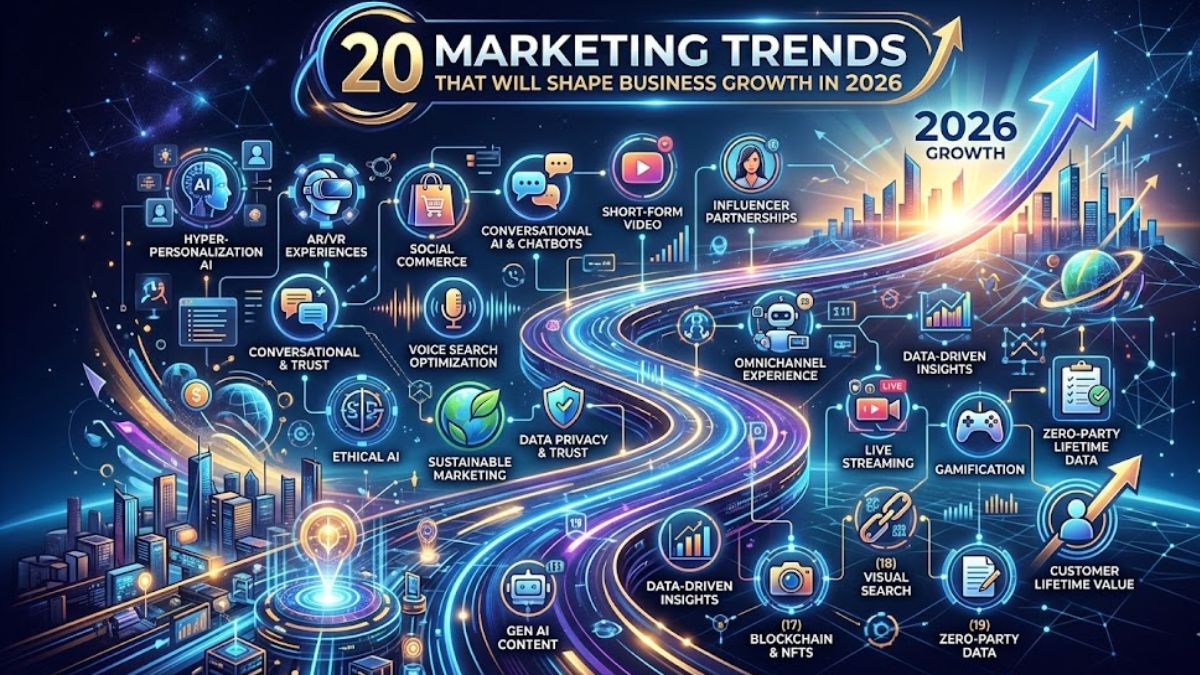
Marketing is changing faster than ever. Consumer behavior continues to evolve, technology keeps advancing, and competition grows across every industry. Businesses that adapt early often gain a significant advantage. That is why understanding the 20 Marketing Trends shaping 2026 is essential for startups, growing brands, and established companies alike. The 20 Marketing Trends discussed in this article reflect shifts in customer expectations, content consumption, ecommerce behavior, and digital engagement. While some trends are extensions of existing practices, others are creating entirely new opportunities. Together, these 20 Marketing Trends reveal where businesses should invest attention, resources, and creativity in the coming year.
Why Marketing Trends Matter in 2026
The numbers behind India’s digital market are genuinely hard to wrap your head around. Over 900 million internet users according to IAMAI data, with smartphone adoption still climbing in Tier 2 and Tier 3 cities where the next wave of consumer growth is actually happening.
What that scale means practically is that consumer behavior is shifting faster than most marketing teams can track. The channels that worked reliably three years ago are delivering different results today. New ones are emerging before the old ones have been fully figured out. Brands that stay close to what’s actually changing in consumer behavior tend to find the opportunities before their competitors do. Brands that don’t tend to discover the shift in their performance numbers, which is a more expensive way to learn.
- 1. AI-Powered Personalization
- 2. Short-Form Video Dominance
- 3. Influencer Marketing Becomes More Specialized
- 4. User-Generated Content Takes Center Stage
- 5. AI UGC Content Expansion
- 6. Voice Search Optimization
- 7. Community-Led Brand Building
- 8. Creator Economy Growth
- 9. First-Party Data Strategies
- 10. Hyperlocal Marketing
- 11. AI Influencer Marketing
- 12. Interactive Content Experiences
- 13. Social Commerce Expansion
- 14. B2B Marketing Humanization
- 15. Email Marketing Evolution
- 16. Sustainability Messaging
- 17. Creator-Led Product Launches
- 18. Omnichannel Customer Journeys
- 19. Authentic Storytelling
- 20. AI-Powered Analytics
- About Hobo.Video
1. AI-Powered Personalization
Generic experiences have a trust problem. Consumers have been trained by years of actually good personalization from a handful of platforms to expect that the brands they interact with understand something about them. AI makes that personalization possible at scale. Relevant product recommendations, content that reflects actual behavior, messaging that responds to where a customer is in their journey rather than broadcasting the same thing to everyone. The brands delivering this consistently are seeing better engagement and better retention. The ones still sending the same email to their entire list are measuring the gap in unsubscribe rates.
2. Short-Form Video Dominance
Instagram Reels and YouTube Shorts aren’t a trend to monitor anymore. They’re the primary content format for a significant portion of the consumer population.
The reason they work is behavioral. People consume content faster than they used to, make attention decisions in seconds, and favor formats that deliver value or entertainment without demanding patience. Short-form video fits that behavior perfectly. Brands that have figured out how to make genuine content in this format, not repurposed ads, are getting visibility that other formats can’t match right now.
3. Influencer Marketing Becomes More Specialized
The era of the celebrity endorsement as a default influencer strategy is winding down, and the data is what killed it. A niche creator with 80,000 highly engaged followers in exactly the right category routinely outperforms a celebrity with ten million loosely connected ones. Audiences built around specific interests and genuine trust convert better than mass reach. Brands that have made this adjustment are seeing it in their campaign performance. The ones still chasing follower counts are paying more for less. Working with a top influencer marketing company to find creators with authentic engagement rather than impressive numbers is increasingly how serious brands approach this.

Amplify Your Brand,
One Influence at a Time.
4. User-Generated Content Takes Center Stage
The trust gap between brand-created content and customer-created content has become one of the most consistently documented findings in marketing research. People trust people. A customer showing how a product actually works in their real life, with genuine opinions about what they liked and what they didn’t, converts better than a polished commercial making the same case. UGC videos have moved from a nice supplementary channel to a primary creative asset for brands that are serious about performance marketing.
5. AI UGC Content Expansion
Scaling authentic content has historically been the constraint that kept UGC programs smaller than they should be. Good creator content takes time and relationship-building to generate consistently. AI UGC tools are changing that constraint. Brands can now produce varied, authentic-feeling creative at a volume that wasn’t practical before, test multiple formats simultaneously, and identify what’s working fast enough to act on it within a campaign rather than after it ends. The combination of creator authenticity and AI-assisted production efficiency is producing results that neither approach achieves alone.
6. Voice Search Optimization
The way people search when they use their voice is meaningfully different from how they type a query. Voice queries are conversational, phrased as complete questions, and often more locally oriented. Content that isn’t built around how people actually speak is increasingly invisible to a segment of search behavior that keeps growing. Brands optimizing for natural language queries rather than just keyword strings are positioning themselves better for where search is heading.
7. Community-Led Brand Building
Products get copied. Communities don’t. The brands building genuine communities around shared interest, identity, or purpose are creating customer relationships that are considerably more durable than anything a campaign can generate. People who feel a sense of belonging to something don’t just stay longer. They recruit others, advocate publicly, and forgive mistakes more readily. Building community through social platforms, private groups, and creator networks is slower than running ads. The retention and lifetime value numbers it produces are substantially better.
8. Creator Economy Growth
The career path question has shifted for a generation of young professionals. How to become an influencer is a genuine search query from people treating it as a serious option, not a long shot. For brands, the practical implication is an expanding supply of creators who are building audiences with genuine care, which means more partnership options and more niche coverage than was available even two years ago. The creator economy growing benefits brands as much as it benefits creators.
9. First-Party Data Strategies
Third-party tracking has been eroding for years through privacy regulation, browser changes, and platform policy shifts. Brands that built their customer intelligence entirely on third-party data are finding the foundation increasingly unstable. First-party data collected through owned channels, email lists, loyalty programs, direct customer relationships, is more valuable and more durable. Building those owned channels is the work that protects future marketing capability, and the brands that started early have a meaningful structural advantage over the ones still figuring it out.
10. Hyperlocal Marketing
National campaigns that ignore regional nuance are leaving performance on the table in India. A consumer in Chennai and a consumer in Lucknow are not the same audience, and content that treats them as interchangeable tends to resonate with neither.
Regional creators who communicate in local languages and understand cultural context drive engagement that national campaigns can’t replicate. Brands building regional creator networks rather than just national ones are finding audiences that respond with the kind of genuine interest that broad targeting rarely produces.
11. AI Influencer Marketing
The manual approach to influencer selection was always imprecise. At the scale and complexity of the current creator landscape, it’s become genuinely untenable for brands running serious programs. AI influencer marketing replaces guesswork with data across the most consequential decisions: which creators have genuine audience quality, which have audience overlap with your actual customer, which have content patterns that suggest your product would land well. The campaigns that come out of data-driven selection consistently outperform the ones assembled on instinct. This gap will only widen as the tools improve through 2026.
12. Interactive Content Experiences
Passive consumption has a ceiling. Participation doesn’t.
Polls, quizzes, interactive videos, and content that invites a response rather than just a view generate significantly higher engagement and time-on-content than static formats. More importantly, they create a different relationship between the audience and the brand. People remember experiences they participated in differently than content they watched.
The brands investing in interactive formats are building engagement habits that standard content can’t match.
13. Social Commerce Expansion
The friction between product discovery and purchase has been collapsing steadily as social platforms build commerce infrastructure directly into their products.
Consumers discover something through a creator, and the path to buying it has never been shorter. The purchase happens in the same environment where the recommendation was made, sometimes without leaving the app. For brands built around creator partnerships, this is a compounding advantage. The distribution and the transaction are increasingly the same channel.
14. B2B Marketing Humanization
Corporate messaging that sounds like it was written by a committee for a company website isn’t landing with business buyers the way it used to. The people making B2B purchasing decisions are the same people who spend their evenings watching creator content and buying from brands they feel a connection to. They bring those expectations to their professional purchasing behavior. B2B brands that communicate like humans, with genuine storytelling, honest tradeoffs, and real perspective rather than feature lists and case study templates, are building the kind of preference that influences decisions when the time comes.
15. Email Marketing Evolution
Email that ignores what a subscriber has done since they signed up is an increasingly poor use of a direct channel. Behavioral triggers, AI-driven segmentation, and personalization that reflects actual customer journey stages are turning email back into a high-performance channel for brands doing it properly. The brands treating email as a broadcast medium are seeing the engagement numbers that deserve. The ones treating it as a personalized conversation are seeing something considerably better.
16. Sustainability Messaging
Environmental commitment has moved from a differentiator to a baseline expectation for a meaningful and growing segment of consumers, particularly younger ones. The important nuance is that vague sustainability claims are increasingly counterproductive. Consumers have become sophisticated enough to distinguish between genuine commitment and messaging designed to occupy the space without the substance behind it. Brands with real environmental practices that communicate them honestly are building the trust that pays off in purchase preference. Brands that use sustainability language as a marketing tactic are being identified and called out faster than they used to be.
17. Creator-Led Product Launches
The traditional product launch sequence, press release, paid media, retailer placement, has been supplemented and in some categories replaced by creator-led launch strategy. Brands collaborating with famous Instagram influencers and niche creators before a launch build awareness and credibility simultaneously. The creator’s audience arrives at the product with social proof already attached. The launch moment is amplified by people who are trusted rather than just visible. For brands with the right creator relationships, this approach generates a quality of attention that paid advertising alone cannot buy.
18. Omnichannel Customer Journeys
Customers don’t think in channels. They think in experiences with a brand. Someone who discovers a product through a creator, researches it on a website, asks a question through a chatbot, and buys it in a store is having one experience across four touchpoints. Brands that deliver consistency across all of them build the kind of trust that drives both conversion and return. Brands that treat each channel as a separate silo deliver the kind of friction that loses customers at the moment they were ready to buy.
19. Authentic Storytelling
The appetite for transparency about how products are made, what companies actually stand for, and what the genuine customer experience looks like has grown significantly. Polished messaging that papers over rough edges is less effective than it used to be because consumers have access to the unfiltered version through reviews, creator content, and social conversation. Brands that lead with honesty, acknowledging real tradeoffs and genuine limitations alongside the strengths, build the kind of credibility that holds up when the unfiltered version circulates anyway.
20. AI-Powered Analytics
The gap between brands making decisions based on real data and brands still working from intuition and lagging indicators is widening fast. AI analytics tools are making sophisticated customer behavior analysis available to marketing teams that couldn’t previously justify the infrastructure or the headcount. Identifying opportunities before they peak, optimizing campaigns while they’re still running, forecasting customer behavior with enough lead time to act on it. These capabilities are becoming table stakes for serious marketing operations, not advanced features for large enterprises.
FAQs
Why are marketing trends important?
Marketing trends help businesses understand changing customer behavior and market dynamics, allowing them to remain competitive.
Which marketing trend will have the biggest impact in 2026?
AI-powered personalization and creator-driven marketing are expected to influence most industries significantly.
What role does influencer marketing play?
Influencer marketing helps brands build trust, reach targeted audiences, and increase conversions through authentic recommendations.
Why are UGC Videos effective?
UGC Videos feel genuine and relatable, making them more persuasive than traditional advertisements.
What is AI influencer marketing?
AI influencer marketing uses artificial intelligence to identify creators, predict outcomes, and optimize campaign performance.
About Hobo.Video
Hobo.Video is India’s leading AI-powered influencer marketing and UGC company. With over 2.25 million creators, it offers end-to-end campaign management designed for brand growth. The platform combines AI and human strategy for maximum ROI.
Services include:
- Influencer marketing
- UGC content creation
- Celebrity endorsements
- Product feedback and testing
- Marketplace and seller reputation management
- Regional and niche influencer campaigns
Trusted by top brands like Himalaya, Wipro, Symphony, Baidyanath and the Good Glamm Group.
Stop wondering what’s next. Let’s unlock your true brand growth potential. We’re just a click away.
If you’re an influencer creating awesome content, brands should see it. Let’s make that happen.

 Anooshka Pandey
 Vishnumaya
 Aqsa Pathan