
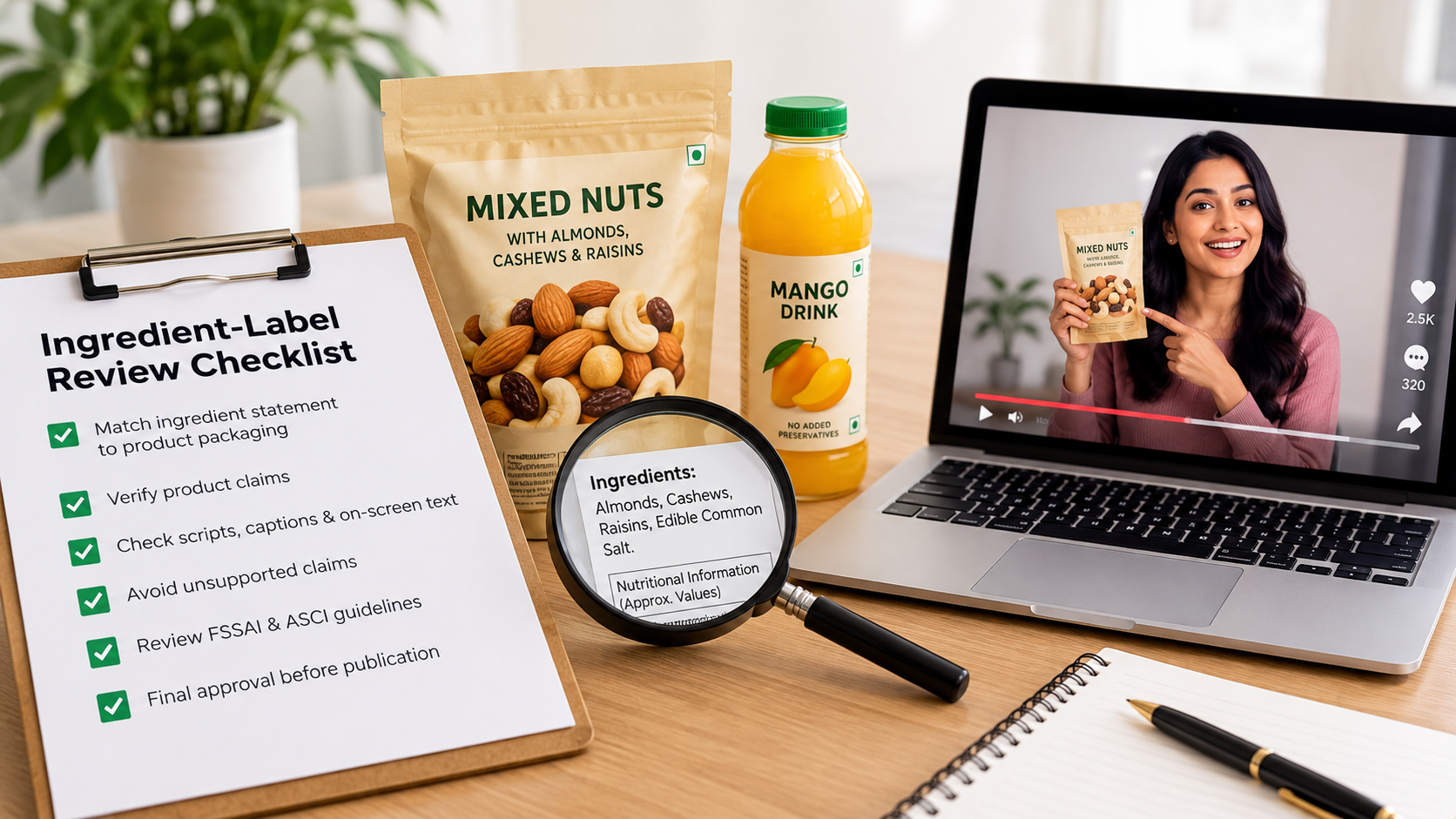
A creator can make an everyday product feel exciting in a 30-second video. However, one inaccurate ingredient statement can damage a brand’s credibility. That is why every FMCG team needs an ingredient-label review checklist before approving creator content.
Today, consumers discover food, beverages, personal care products and household essentials through short videos, social media posts and creator recommendations. They may hear claims about ingredients, nutritional benefits, product quality or product performance. However, not every statement in a creator video automatically matches the product’s approved information.
- 1. Why FMCG Creator Campaigns Need an Ingredient-Label Review Checklist
- 2. What Is an Ingredient-Label Review Checklist?
- 3. Match Every Ingredient Statement to the Actual Product Packaging
- 4. Separate Label Facts From the Creator’s Personal Opinion
- 5. Flag Unsupported Claims Before Publication
- 6. Review Scripts, On-Screen Text and Captions Together
- 7. Build a Clear Creator Approval Workflow
- 8. Create a Correction Process for Inaccurate Creator Statements
- 9. The Complete Ingredient-Label Review Checklist
- 10. Common Mistakes Brands Should Avoid
- 11. How Hobo.Video Can Support Better Creator Campaign Workflows
- Key Takeaways: Building a Reliable Review Process
- Frequently Asked Questions
- Conclusion
- About Hobo.Video
For brands, this creates a practical challenge. Marketing teams want engaging content, while regulatory teams need accurate product information and appropriate claims. Creators also need clear guidance before filming, editing and publishing sponsored content.
A structured review process can help all three groups work together. It allows brands to verify product statements, identify unsupported claims and correct errors before publication. More importantly, it protects consumer trust without making every creator video sound like a traditional advertisement.
This guide explains how to build an ingredient-label review checklist, apply it across FMCG creator campaigns and establish a repeatable content approval workflow. It also includes practical examples, a reusable checklist and a correction process for inaccurate statements.
For Indian food and beverage products, brands should consult the applicable Food Safety and Standards Authority of India (FSSAI) requirements. They should also consider the Advertising Standards Council of India (ASCI) advertising code and relevant influencer guidance. Other FMCG categories may require different regulatory checks.
1. Why FMCG Creator Campaigns Need an Ingredient-Label Review Checklist
Influencer marketing allows brands to communicate product information through familiar faces and relatable experiences. A creator might demonstrate a snack, prepare a beverage or show how a personal care product fits into a daily routine. This format can make product discovery feel more natural.

Amplify Your Brand,
One Influence at a Time.
However, a product demonstration can also introduce inaccurate information. A creator might misread an ingredient list, repeat an outdated claim or use wording from an unverified campaign brief. Even a small mistake can change how viewers understand the product.
An ingredient-label review checklist gives marketing teams a consistent way to identify these problems. It also helps brands coordinate creator briefs, internal approvals and final content reviews.
1.1. Why Product Accuracy Matters in Creator Marketing
Consumers often use creator content to learn about products before purchasing them. They may pay attention to ingredients, nutritional values, product features and advertised benefits. Therefore, inaccurate information can influence their expectations and purchasing decisions.
Consider a packaged beverage promoted through a creator reel. The creator might correctly mention a listed vitamin but then claim that the drink prevents illness. The second statement goes beyond simply identifying an ingredient. It introduces a benefit claim that requires separate assessment.
Brands should therefore check the complete message rather than verify individual words in isolation. The narration, visuals, caption and product packaging can combine to create an overall impression.
A clear verification process helps marketing teams distinguish confirmed product facts from assumptions. It also makes it easier to explain corrections to creators without disrupting the campaign unnecessarily.
1.2. How a Review Checklist Protects Brand Credibility
A documented review process supports consistency across products, creators and agencies. Instead of relying on memory, teams can use the same verification fields for every campaign.
For example, a brand launching three snack flavours can maintain separate product records. Each record can identify the correct packaging, approved ingredient information and relevant claims. The reviewer can then compare each creator asset against the appropriate product.
This approach offers several practical advantages:
- It reduces avoidable corrections after filming.
- It helps prevent outdated product information from entering new campaigns.
- It gives creators clearer instructions before production.
- It creates a record of the evidence used during approval.
- It helps teams identify repeated content review problems.
The objective is not to eliminate creativity. Instead, brands can establish clear factual boundaries while allowing creators to communicate naturally.
1.3. Why Marketing Teams Should Review Content Before Publication
Fixing an inaccurate claim before publication is generally easier than correcting a widely shared video. Once an asset goes live, the team may need to contact the creator, update the caption, edit the video or assess whether removal is appropriate.
A pre-publication review also helps teams identify missing information early. For example, the product specification might not support a statement included in the original brief. A reviewer can flag this issue before the creator records the voice-over.
Marketing teams should therefore treat claim verification as part of campaign planning. It should not become a last-minute task after the creative work is complete.
2. What Is an Ingredient-Label Review Checklist?
An ingredient-label review checklist is a structured document that helps brands verify product-related statements in creator content. It compares proposed scripts, visuals, captions and claims against approved packaging information and supporting evidence.
The checklist should identify the exact statement under review, its verification source and the person responsible for approval. It should also record any requested correction and the final decision.
For food and beverage products, the process should consider applicable FSSAI requirements. ASCI’s advertising code and influencer guidance can also inform the review of advertising claims and disclosures. Brands should confirm the relevant requirements for their specific products and campaigns.
2.1. The Essential Fields Every Checklist Should Include
A useful ingredient-label review checklist does not need to be complicated. However, it should capture enough information to make decisions traceable.
Include these fields:
| Field | Information required |
|---|---|
| Product name | Exact product and variant |
| SKU | Product identifier used by the brand |
| Creator or campaign | Relevant creator and campaign name |
| Proposed statement | Exact spoken or written claim |
| Verification source | Approved label, specification or supporting evidence |
| Review status | Approved, revise or escalate |
| Required correction | Specific wording or visual change |
| Reviewer | Person responsible for the decision |
| Final approval | Confirmation of the approved version |
These fields help teams avoid vague feedback. For example, “please correct the benefit claim” is less useful than identifying the exact sentence and the evidence that fails to support it.
2.2. Which Documents Should Brands Use for Verification?
The review process should begin with current, approved product information. Different documents serve different purposes, so teams should not treat them as interchangeable.
Useful sources may include:
- Current approved packaging artwork.
- Product specifications and formulation records.
- Approved nutritional information.
- Relevant allergen information.
- Substantiation documents for specific claims.
- Internal product fact sheets approved by the responsible team.
- Applicable regulatory guidance.
A marketplace listing or old social media post may help identify a potential inconsistency. However, neither should automatically replace the current approved product documentation.
If the available documents conflict, pause approval and ask the appropriate product or regulatory contact to resolve the discrepancy.
2.3. How to Organise Checklist Records
Brands running multiple creator campaigns should maintain a separate record for each product variant and asset. This makes it easier to identify the exact content that received approval.
A simple spreadsheet can include the product name, creator, asset link, claim under review, source document, review status and correction notes. Teams can also add a version number and approval date.
For larger campaigns, this record becomes particularly useful when several people review the same content. It provides a common reference and reduces the risk of someone approving an outdated edit.
3. Match Every Ingredient Statement to the Actual Product Packaging
The first step in an ingredient-label review checklist is verifying the product itself. Before reviewing the creator’s script, collect the latest approved packaging artwork and product specification for the exact stock-keeping unit (SKU) being promoted.
Never assume that two variants share the same ingredients. Different flavours, pack sizes or formulations may have different declarations. Product information may also change between production runs or packaging updates.
3.1. Confirm the Exact Product Variant and SKU
Start by identifying the product shown in the creator’s video. Compare its name, flavour, size and SKU with the campaign brief.
This step is important when a campaign features several products. For example, a creator might receive a multipack containing three flavours. If the brief refers to one variant but the video shows another, the team must verify the relevant statements again.
The reviewer should also confirm that the product packaging shown in the final video matches the product being discussed. A correct script cannot compensate for incorrect packaging visuals.
Product identity checks:
- Confirm the full product name.
- Verify the correct flavour or variant.
- Match the product to its SKU.
- Check the pack size where relevant.
- Confirm that the packaging shown matches the approved product.
3.2. Verify Ingredients and Nutritional Information
Next, compare every ingredient mentioned in the content with the appropriate approved product documentation.
Check ingredient names, nutritional figures and relevant label statements. Also review allergen information where applicable. Do not rely on a creator’s memory or an unverified description copied from another website.
For example, a creator might say that a snack contains almonds. The reviewer should confirm that this statement is accurate for the specific product variant. If the content includes a nutritional figure, the team should verify it against the correct source and ensure the context is appropriate.
The reviewer should also identify claims that go beyond the ingredient list. The presence of an ingredient does not automatically substantiate a health or performance benefit.
3.3. Create a Product Verification Record
A verification record should link each ingredient statement to its source. This makes approval easier to explain and repeat.
For instance, the record might show that a creator’s statement about an ingredient matches the current approved packaging. A separate statement about a health benefit may require additional evidence and specialist review.
Do not mark a claim as approved simply because one part of the sentence is correct. Assess the complete statement and the impression it creates.
Product verification checklist:
- Correct product name, variant and SKU confirmed.
- Latest approved packaging artwork available.
- Ingredient statements checked against the correct source.
- Nutritional information verified where used.
- Relevant allergen information reviewed.
- Product visuals match the promoted variant.
- Conflicting information has been escalated.
4. Separate Label Facts From the Creator’s Personal Opinion
Creators should be able to express genuine preferences. However, brands must distinguish personal opinions from statements that communicate verifiable product facts or benefits.
This distinction helps marketing teams preserve the creator’s voice while maintaining control over factual claims.
4.1. Identify Personal Opinions
Personal opinions describe an individual’s preferences or subjective experiences. Examples include enjoying a flavour, liking a texture or preferring a particular packaging format.
For example:
“I enjoy the crunchy texture of this snack.”
This statement expresses a personal preference. The brand should still ensure that the creator genuinely holds the opinion and that the surrounding content does not create a misleading impression.
However, personal wording is not automatically free from review. A statement framed as an experience may still imply a product-related outcome.
4.2. Identify Factual Product Claims
Factual claims communicate information that can be checked against evidence. These may include ingredients, nutritional values, product features or manufacturing-related statements.
For example:
“This snack contains almonds.”
The reviewer should verify this statement against the correct product information. If the product does not contain the stated ingredient, the creator must not use the claim.
Some factual claims may also involve additional regulatory requirements. Therefore, matching a statement to the label may be necessary but not sufficient for approval.
4.3. Review Claims That Imply Product Benefits
Some statements imply that a product produces a particular outcome. Examples may involve energy, immunity, digestion, skin appearance or other health-related benefits.
Consider this statement:
“I felt more energetic after drinking this beverage.”
In an advertising context, viewers may interpret the sentence as a product-performance claim. The reviewer should assess the wording, surrounding visuals and campaign message before approving it.
Creators should not use personal experience to present an unsupported product benefit as established fact. If the team cannot substantiate the claim or confirm that it is permitted, the statement should be revised or escalated.
4.4. Use a Claim Classification System
A simple classification system makes reviews more consistent.
| Claim category | Example | Review approach |
|---|---|---|
| Personal opinion | “I like the flavour.” | Confirm it is genuine and not misleading |
| Ingredient fact | “Contains almonds.” | Verify against approved product information |
| Nutritional statement | A specific nutritional value | Check the source, wording and applicable requirements |
| Performance claim | “Improves digestion.” | Require appropriate substantiation and regulatory review |
| Comparative claim | “The best snack available.” | Check the comparison, evidence and applicable requirements |
This classification helps reviewers identify the level of scrutiny a statement needs. It does not replace product-specific or legal review.
5. Flag Unsupported Claims Before Publication
Certain phrases should trigger additional scrutiny because they may communicate broad, absolute or health-related benefits. Examples include “healthiest,” “chemical-free,” “cures,” “boosts immunity” and “detoxifies.”
These phrases should never receive automatic approval. Their meaning depends on the product, the context and the impression a reasonable viewer may take away.
5.1. Identify High-Risk or Absolute Wording
Words such as “always,” “never,” “best,” “safest” and “guaranteed” can create strong expectations. They may also imply a comparison or promise that the brand cannot support.
The reviewer should ask what the viewer is likely to understand. Does the statement describe a verified product feature, or does it promise an outcome? Does the wording suggest superiority over competing products? Is there sufficient evidence for the complete claim?
If the team cannot answer these questions, it should not approve the statement without further review.
5.2. Review Health and Nutrition Claims Carefully
Health and nutrition claims require particular attention in food and beverage advertising. An ingredient’s presence does not automatically prove that the finished product delivers a specific benefit.
For example, a beverage may list a particular vitamin. However, a claim that the beverage prevents illness communicates something different from simply identifying that vitamin.
The reviewer should verify the exact claim, supporting evidence and applicable requirements. If the claim cannot be substantiated or appears impermissible, the team should remove or revise it after appropriate review.
5.3. Use a Claim Review Table
| Proposed claim | Why it needs attention | Suggested action |
|---|---|---|
| “Chemical-free” | May create a misleading or scientifically inaccurate impression | Flag and assess the exact context |
| “The healthiest snack” | Makes a broad superiority claim | Require appropriate evidence and review |
| “Boosts immunity” | Communicates a health-related benefit | Verify substantiation and applicable requirements |
| “Made with almonds” | Makes an ingredient statement | Check the correct formulation and label |
| “I love the flavour” | Expresses personal preference | Confirm that it reflects the creator’s genuine opinion |
These examples are review prompts, not final legal determinations. A statement should be assessed in its complete advertising context.
5.4. Consult the Relevant Regulatory Guidance
For food and beverage products, consult the FSSAI Advertising and Claims Regulations. Review the applicable regulations and amendments relevant to the product and claim.
Also consult ASCI’s advertising code and influencer resources for relevant advertising and disclosure guidance.
These resources serve different purposes. The review should consider the applicable legal requirements, advertising standards and substantiation needed for the specific campaign.
Other FMCG categories, including cosmetics and personal care products, may require different regulatory references. Brands should not assume that food-related rules apply to every product category.
6. Review Scripts, On-Screen Text and Captions Together
A creator’s script may be accurate while the final video communicates something misleading. A short text overlay may exaggerate a benefit, a caption may introduce a new claim or a visual may imply an outcome that the narration never mentions.
Therefore, the ingredient-label review checklist must cover the complete published asset.
6.1. Review the Script and Voice-Over
Start by comparing the creator’s spoken words with the approved product information and campaign brief.
Check every ingredient statement, nutritional reference, benefit claim and product comparison. Review the full sentence rather than approving isolated words.
For example, a creator may correctly identify an ingredient but then claim that it produces a particular health outcome. The ingredient statement and the benefit claim need separate verification.
Mark unclear statements for revision. Give the creator the exact wording that requires attention and explain the reason for the change.
6.2. Check On-Screen Text and Subtitles
Text overlays can change how viewers interpret a video. A short headline may make a broader claim than the creator’s narration.
For example, a creator might accurately state that a beverage contains a vitamin. However, an overlay reading “Prevents illness” introduces a separate health-related message.
Review subtitles as well as designed text. Automated captions may contain errors, especially when the creator speaks quickly or uses product-specific terminology.
Check that the final text matches the approved wording and remains readable. If the content requires qualifying information, review its placement and presentation.
6.3. Review Captions, Hashtags and Thumbnails
The caption may contain additional product claims that do not appear in the video. Hashtags can also contribute to the overall message, while thumbnails may exaggerate a product’s effects.
Review these elements separately:
- Caption and promotional copy.
- Hashtags that communicate product benefits.
- Thumbnail text and opening hooks.
- Product packaging and close-up visuals.
- Pinned comments supplied as part of the campaign.
- Disclosures and qualifying information, where required.
Do not assume that an accurate video makes every accompanying element accurate. Each published component should follow the same review process.
6.4. Approve the Final Edited Asset
The last step is to review the actual version scheduled for publication. A previously approved script does not guarantee that the final video remains accurate.
Creators may add text, change the voice-over or use a different product shot during editing. These changes can introduce new claims or alter the meaning of existing statements.
Final asset checklist:
- Script and voice-over reviewed.
- Subtitles and on-screen text checked.
- Captions and hashtags reviewed.
- Thumbnail and opening hook checked.
- Product packaging matches the promoted variant.
- Required disclosures and qualifying information reviewed.
- Final edited asset matches the approved version.
7. Build a Clear Creator Approval Workflow
A checklist works best when everyone knows who owns each decision. Without a defined workflow, creators may receive conflicting feedback from marketing, agencies and regulatory reviewers.
The brand should establish the process before creator production begins.
7.1. Prepare a Product Fact Sheet
Create a product fact sheet for each product or variant included in the campaign. It should contain approved product information and the sources reviewers should use.
Include:
- Product name, variant and SKU.
- Current approved ingredient information.
- Relevant nutritional details.
- Claims that have been reviewed and approved for the campaign.
- Claims or wording that require additional review.
- Links to the relevant source documents.
- Contact details for product or regulatory questions.
A fact sheet helps creators understand the product before filming. It also reduces the risk of creators relying on outdated information or making assumptions.
7.2. Assign Clear Review Responsibilities
Each review stage should have a responsible person or team.
Marketing team: Reviews the campaign brief, creative direction and brand tone.
Product team: Confirms product information and relevant specifications.
Regulatory or legal reviewer: Assesses claims that require specialist review.
Creator or agency: Implements feedback and supplies the revised asset.
Final approver: Confirms that the required checks have been completed.
The exact responsibilities will vary by organisation. Smaller teams may assign several roles to one person, but the approval process should remain clear.
7.3. Use Approved, Revise and Escalate Statuses
A simple status system can make campaign tracking easier.
- Approved: The statement or asset has passed the required checks.
- Revise: The content needs a specific correction before approval.
- Escalate: The claim needs additional evidence or specialist assessment.
Record the reason for every revision or escalation. This prevents repeated questions and helps teams understand what remains unresolved.
7.4. Set Deadlines and Version-Control Rules
Set review deadlines before production begins. Give creators enough time to make corrections without rushing the final approval.
The team should also define what happens when a material change occurs after sign-off. For example, a revised caption, new product shot or altered benefit claim may require another review.
Use clear filenames or version numbers to distinguish approved assets from drafts. Keep the final approval record linked to the exact published version.
This approach reduces confusion when multiple creators, products and reviewers are involved.
8. Create a Correction Process for Inaccurate Creator Statements
Even a strong approval process cannot guarantee that mistakes will never occur. A creator may accidentally use outdated product information, misread a label or publish an unapproved version.
Brands should prepare a correction process before launching the campaign. The team should know whom to contact, who can approve the correction and how the issue will be documented.
8.1. Record and Verify the Issue
Start by saving the exact statement that appears inaccurate. Record the video timestamp, caption, text overlay or relevant screenshot.
Next, compare the statement with the current approved product information. Determine whether the issue involves an incorrect ingredient, unsupported benefit, misleading comparison or another problem.
Do not assume that every mistake has the same level of risk. The appropriate response depends on the content, product and potential impact. Escalate concerns that require specialist assessment.
8.2. Give the Creator Precise Correction Instructions
Contact the creator or agency with clear instructions. Identify the incorrect statement, provide the verified information and explain what needs to change.
For example, instead of saying “please make the video compliant,” identify the exact sentence and request a specific revision.
Where necessary, specify whether the team needs a corrected voice-over, revised text overlay, updated caption or replacement visual. Clear instructions reduce confusion and unnecessary back-and-forth.
8.3. Review the Corrected Version
The creator should submit the revised asset for review. Check the correction and the surrounding content to ensure the edit has not introduced another issue.
If the correction changes the overall message, review the full asset again. Confirm that the final version matches the approved product information and the relevant campaign requirements.
Do not treat a correction request as complete until the responsible reviewer confirms the updated version.
8.4. Document the Resolution and Prevent Recurrence
Maintain a record of the original asset, issue, correction request, revised version and final decision.
The team should also investigate why the error occurred. Perhaps the product fact sheet was outdated, the brief contained ambiguous wording or a final edit bypassed approval.
Use that information to improve the next campaign. For example, recurring ingredient errors may indicate that the team needs clearer product documentation or an additional review step.
If an inaccurate claim has already been published and may have regulatory or consumer implications, involve the appropriate legal or regulatory team promptly.
9. The Complete Ingredient-Label Review Checklist
Use this checklist as a practical starting point for FMCG creator campaigns. Adapt it to the product category, campaign format and applicable requirements.
9.1. Product Information
- Correct product name, variant and SKU confirmed.
- Latest approved packaging artwork available.
- Ingredient statements checked against the correct source.
- Nutritional information verified where used.
- Relevant allergen information reviewed.
- Product visuals match the promoted variant.
- Conflicting product information escalated.
9.2. Claims and Creator Wording
- Every factual statement has a verification source.
- Personal opinions are distinguished from factual claims.
- Health, nutrition and performance claims have received appropriate review.
- Comparative and absolute claims have been checked.
- Unsupported or potentially misleading wording has been flagged.
- No unapproved claim has been added during editing.
9.3. Creative Assets and Publication
- Script and voice-over reviewed.
- On-screen text and subtitles checked.
- Captions and hashtags reviewed.
- Thumbnail and product visuals checked.
- Required disclosures and qualifying information reviewed.
- Final edited asset matches the approved version.
- Approval owner and final decision documented.
9.4. Post-Publication Readiness
- Creator and brand contact details available.
- Correction and escalation process defined.
- Approved product information can be located quickly.
- Responsibility for implementing corrections is clear.
- Final asset and approval record are stored.
- Team knows how to escalate a potentially serious issue.
9.5. How to Use the Checklist in a Real Campaign
Imagine a brand promoting a packaged snack through five creators. Each creator receives the same product fact sheet, approved claims and campaign instructions.
The first creator submits a script that correctly identifies an ingredient. The reviewer verifies it against the current packaging and marks the statement approved.
The second creator claims that the snack improves digestion. The reviewer flags the statement because the ingredient list alone does not substantiate that benefit. The claim is escalated for appropriate review before publication.
The third creator uses the wrong flavour pack in the video. The team requests the correct product shot and checks the revised edit.
The remaining creators follow the same review process. Each asset receives its own record, so the team can identify what was checked and which version received approval.
This example demonstrates how a consistent workflow can support several creators without treating every asset as identical.
10. Common Mistakes Brands Should Avoid
Even experienced marketing teams can overlook issues when campaigns move quickly. The following mistakes are worth checking during every review.
10.1. Reusing Claims From Older Campaigns
A statement that appeared in an earlier campaign is not automatically suitable for a new one. Product formulations, packaging and supporting evidence may have changed.
Always verify claims against current product information. Review the complete wording and confirm that the claim remains appropriate for the new campaign.
10.2. Reviewing Only the Script
The final video may include new text, captions or visuals. These elements can change the overall message even when the original script was accurate.
Review the complete published asset, including its supporting promotional copy.
10.3. Treating Ingredient Presence as Proof of a Benefit
The presence of an ingredient does not automatically prove that the finished product delivers every benefit associated with that ingredient.
Check the exact claim and the evidence needed to support it. If the evidence does not support the statement, revise or escalate it.
10.4. Assuming Disclaimers Fix Misleading Claims
Qualifying information should clarify a claim. It should not contradict a misleading headline or conceal the actual meaning of the advertisement.
Review the main statement and any disclaimer together. Ensure that the complete message remains accurate and appropriate.
10.5. Failing to Keep Approval Records
Verbal approval and scattered chat messages can make it difficult to identify the final approved version.
Maintain a central record that links the product information, claim review, correction history and final asset. This creates a more reliable process across campaigns.
11. How Hobo.Video Can Support Better Creator Campaign Workflows
FMCG campaigns often involve multiple creators, products, scripts and publication dates. A consistent briefing and review approach helps marketing teams keep product information and feedback organised.
Hobo.Video supports brands with influencer marketing and user-generated content campaigns. Brands can establish clear product briefs, define claim-review responsibilities and organise creator feedback around their campaign objectives.
For ingredient-sensitive campaigns, teams should prepare verified product fact sheets before creator outreach begins. They should also identify who will review product claims and approve the final assets.
A standardized workflow can help teams manage creative revisions while maintaining clear boundaries around factual product information. However, brands remain responsible for verifying claims and meeting the applicable requirements for their products.
Explore Hobo.Video to learn more about influencer marketing and UGC campaign support.
11.1. Prepare Better Creator Briefs
A clear creator brief should explain the product, target audience, campaign objective and approved product information. It should also identify statements that require additional review.
Creators should know where to find verified ingredient details and whom to contact when a claim is unclear. This reduces guesswork before filming begins.
11.2. Keep Content Review Consistent
Use the same review fields across scripts, videos and captions. Record revisions and confirm which version received approval.
This process helps marketing teams coordinate feedback and makes the final publication decision easier to track.
11.3. Make Accuracy Part of the Campaign Workflow
Product accuracy should not be a last-minute compliance check. Build verification into campaign planning, creator briefing, production and final approval.
Planning an FMCG creator campaign? Start with a verified product fact sheet, assign clear review owners and share the approval checklist with every creator. A little preparation can prevent avoidable revisions and help protect consumer trust.
Key Takeaways: Building a Reliable Review Process
An ingredient-label review checklist gives FMCG marketing teams a repeatable way to verify creator content before publication.
Keep these principles in mind:
- Verify the product: Match ingredient statements to the correct product variant and current approved packaging.
- Classify the claim: Separate personal opinions from factual, comparative and health-related statements.
- Check the evidence: Do not treat an ingredient list as automatic proof of a product benefit.
- Review every asset: Check scripts, voice-overs, overlays, captions, thumbnails and the final edit.
- Assign responsibilities: Make it clear who verifies product information and who approves claims.
- Record decisions: Maintain a traceable approval history for every creator asset.
- Prepare for corrections: Define how the team will handle inaccurate content before and after publication.
The goal is not to make creator content sound scripted. Instead, brands should give creators the verified information they need to communicate accurately and naturally.
Frequently Asked Questions
1. What Is an Ingredient-Label Review Checklist?
An ingredient-label review checklist is a document used to verify ingredient statements and product claims in marketing content. It helps brands compare creator scripts, captions and visuals with approved packaging information and supporting evidence. The checklist can also record review status, required edits and final approval. This makes the process more consistent and helps teams trace the decisions behind published content.
2. Why Do FMCG Brands Need to Review Creator Content?
Creator content can influence how consumers understand a product. If a video misstates an ingredient or implies an unsupported benefit, viewers may receive inaccurate information. A structured review helps brands catch these issues before publication. It also gives creators clearer guidance, reduces repeated edits and helps marketing teams document how product claims were checked.
3. Does FSSAI Apply to Every FMCG Product?
No. FSSAI’s food-related rules apply to relevant food and beverage products, not every FMCG category. Cosmetics, personal care products and other categories may be subject to different legal and regulatory requirements. Brands should identify the product category first, then confirm which rules apply to the proposed claims and advertising. Specialist review may be necessary for products with specific regulatory obligations.
4. Can a Creator Share a Personal Opinion About a Product?
Yes, provided the opinion is genuine and does not create a misleading impression. A statement about enjoying a flavour differs from a factual claim about a product’s health benefits. Brands should review the full context because personal wording can still imply a performance or health claim. Creators should not use personal experiences to disguise unsupported product claims.
5. Is an Ingredient List Enough to Substantiate a Health Claim?
Not necessarily. An ingredient list can help verify whether a particular ingredient is declared in the product. It does not automatically establish that the finished product delivers a specific health benefit. Brands should check the precise claim, relevant evidence and applicable regulatory requirements before approving it. Claims that go beyond the label may require additional substantiation and specialist review.
6. Which Claims Should Trigger Additional Review?
Claims involving health benefits, nutrition, disease prevention, immunity, detoxification, superiority or absolute promises should trigger closer review. Terms such as “healthiest” and “chemical-free” can create broad or unsupported impressions. Reviewers should consider the wording, product category, available evidence and complete creative context before deciding whether a statement can be approved.
7. Should Captions and On-Screen Text Be Reviewed Separately?
Yes. Captions and on-screen text can introduce claims that are absent from the spoken script. A thumbnail may also exaggerate a product benefit or create an inaccurate impression. Review the voice-over, subtitles, captions, hashtags, visuals and final edit together. Material changes should trigger another review before the updated asset is published.
8. What Should a Brand Do if a Creator Publishes an Inaccurate Claim?
The brand should document the statement, verify the correct information and assess the appropriate correction. Depending on the issue, this may involve editing the content, correcting a caption, removing an asset or escalating the matter to a specialist. Give the creator precise instructions and record the resolution. If the issue may have regulatory implications, involve the relevant legal or regulatory team promptly.
9. How Can Brands Manage Reviews Across Many Creators?
Use a standard product fact sheet, a shared checklist and clearly assigned approval owners. Maintain separate records for each product variant and creator asset. A simple approved, revise or escalate status helps teams track progress. Brands should also establish deadlines and require reapproval when a material change occurs after sign-off.
10. Does an Approved Creator Script Guarantee Compliance?
No. A script approval is only one part of the review process. The final video, captions, overlays, thumbnail and publication context can introduce additional claims or change the meaning of a statement. Brands should check the complete final asset and confirm that the published version matches the approved content. Regulatory requirements and supporting evidence should also be reviewed as appropriate.
Conclusion
An ingredient-label review checklist helps FMCG brands balance creator authenticity with accurate product communication. By verifying ingredient statements, distinguishing opinions from claims and reviewing every part of the final asset, teams can catch avoidable problems before publication.
The strongest process also defines who approves claims, where supporting evidence is stored and how corrections are handled. These steps make reviews more consistent across products, agencies and creators.
Before launching the next campaign, prepare the product fact sheet, share approved wording and assign clear review responsibilities. Use the checklist for every creator asset, document the approval and recheck any material changes.
Clear briefs, verified claims and documented approvals help brands build creator campaigns that earn consumer trust.
About Hobo.Video
Hobo.Video is India’s leading AI-powered influencer marketing and UGC company, with 2.25 million creators. Services include:
- Influencer marketing
- UGC content creation
- Celebrity endorsements
- Product testing
- Marketplace reputation management
- Regional campaigns
Trusted by brands like Himalaya, Wipro, Symphony, Baidyanath, and the Good Glamm Group.
Smart brands choose creators who break the mold. Join us and run your next campaign.
Influencer life is different when you’re backed by the right crew. Let’s grow.

 Neeti Katyal
 Sahil Singh