
Running Google Ads without understanding Google Ads keyword types is like opening a shop without knowing who will walk in. Many Indian advertisers waste money not because Google Ads does not work, but because their keywords attract the wrong intent. Keywords decide visibility, relevance, and cost. That is why this topic matters so much.
Google Ads keyword types help you control when your ads appear, who sees them, and how closely the search intent matches your offer. From startups to large brands, every successful campaign starts with keyword clarity. This guide explains everything in plain language. No heavy jargon. No theory overload.
If you want predictable results, lower CPCs, and better conversions, understanding types of keywords in Google Ads is non-negotiable. Let’s break it down step by step.
- 1. What Are Google Ads Keywords and Why They Matter
- 2. Understanding Keyword Match Types Google Ads Offers
- 3. Broad Match Keywords Explained for Beginners
- 4. Phrase Match Keywords and Intent Control
- 5. Exact Match Keywords for High-Intent Searches
- 6. Negative Keywords and Cost Control
- 7. Google Ads Keyword Structure for Scalable Campaigns
- 8. Google Ads Keyword Basics Every Advertiser Should Know
- 9. How Keyword Match Types Impact Quality Score
- 10. Common Keyword Mistakes Indian Advertisers Make
- 11. Connecting Google Ads with Influencer Marketing
- 12. Why UGC and Creators Improve Search Performance
- Conclusion: Key Learnings and Takeaways
- About Hobo.Video
1. What Are Google Ads Keywords and Why They Matter
Google Ads keywordsare signals you give to Google about when your ad should appear. When a user searches on Google, the system checks advertisers whose keywords match that query. If your keyword matches, your ad enters the auction. That auction decides visibility, cost, and placement.
Many beginners think keywords only control traffic volume. In reality, they control traffic quality. Strong Google Ads keyword basics ensure that your ad reaches users with the right intent. Weak keyword choices attract irrelevant clicks and inflate costs.
Google reports that higher keyword relevance can significantly improve Quality Score. A better Quality Score reduces cost per click and improves ad rank. For Indian advertisers facing rising competition, this directly impacts profitability.
Keywords are not just words. They represent user intent.

Amplify Your Brand,
One Influence at a Time.
2. Understanding Keyword Match Types Google Ads Offers
Keyword match types Google Ads provides decide how closely a user’s search must match your keyword. This is where most confusion begins. However, once understood, everything becomes logical and manageable.
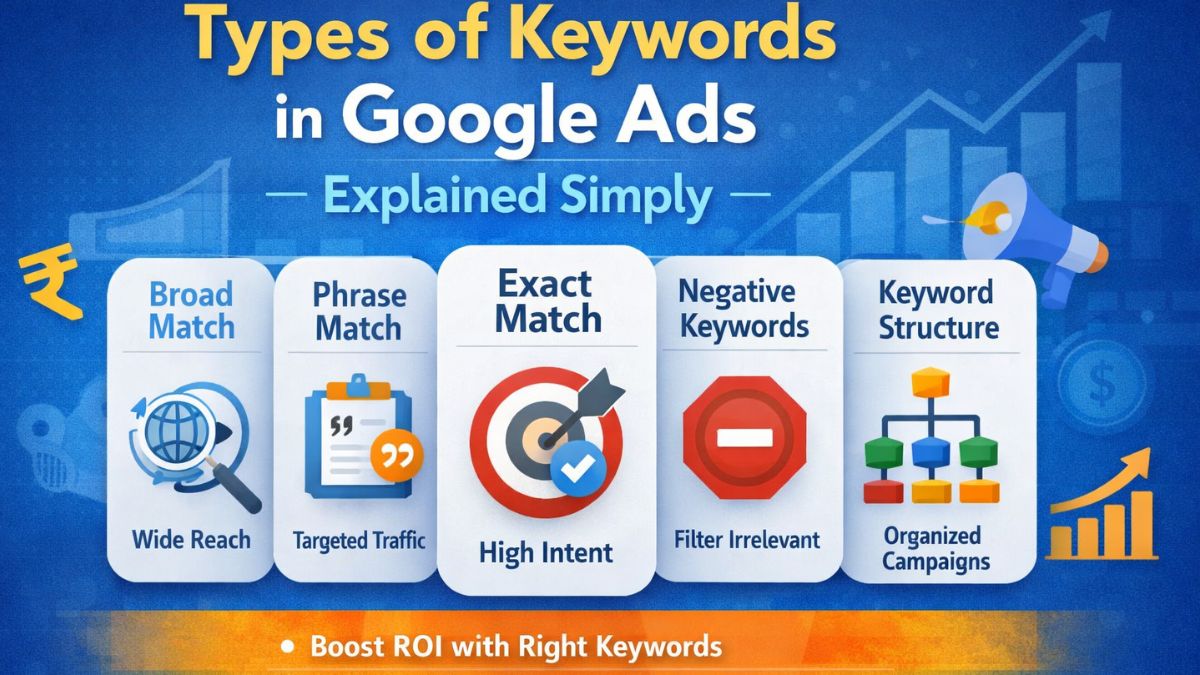
Google currently offers three main match types. Each serves a specific role in campaign strategy. Broad match offers reach. Phrase match balances control and flexibility. Exact match offers precision and high intent.
When people search for Google Ads match types explained, they usually want clarity on control versus scale. There is no single best option. The right match type depends on campaign goals, budget, and funnel stage.
Successful advertisers combine multiple match types within a strong Google Ads keyword structure. This approach captures demand while maintaining efficiency.
3. Broad Match Keywords Explained for Beginners
Broad match is the most flexible option among Google Ads keyword types. Your ad can appear for searches related to your keyword, even if the exact phrase is not used. Google uses user intent, past behaviour, and context to decide relevance.
For example, a keyword like “online fitness coaching” may trigger ads for “personal trainer apps” or “home workout guidance.” This flexibility helps discover new search patterns. However, it also increases the risk of irrelevant clicks.
Broad match works best with smart bidding and strong negative keywords. Without negatives, costs rise quickly. With proper controls, broad match becomes a growth tool.
In India, brands running discovery or awareness campaigns often rely on broad match. Beginners should start cautiously and monitor search terms closely.
4. Phrase Match Keywords and Intent Control
Phrase match sits between broad and exact match. It allows your ad to show when the search includes the meaning of your keyword. The words may change, but intent stays aligned.
For instance, a phrase match keyword like “digital marketing course” can trigger ads for “best digital marketing course in Delhi.” However, it will avoid unrelated searches like “marketing jobs.”
Phrase match is ideal for mid-funnel users. These users know what they want but are still comparing options. Many Indian service brands depend on phrase match for consistent leads.
When advertisers test keyword match types Google Ads, phrase match often becomes the most reliable performer. It offers balance without sacrificing too much reach or relevance.
5. Exact Match Keywords for High-Intent Searches
Exact match provides the highest level of control among all Google Ads keyword types. Your ad appears only when the search closely matches your keyword’s meaning. While Google allows close variants, intent remains tight.
Exact match keywordsattract users ready to take action. These users convert faster and usually at a lower cost. For example, searches like “buy ayurvedic supplements online” show strong purchase intent.
Industry data shows exact match keywords often deliver significantly higher conversion rates compared to broad match. In competitive Indian markets, this difference directly affects ROI.
Exact match is best used for transactional keywords, brand searches, and high-value products. It protects budgets while delivering predictable results.
6. Negative Keywords and Cost Control
Negative keywords tell Google when your ads should not appear. They are one of the most powerful yet underused tools in Google Ads. Without them, even the best campaigns bleed money.
For example, if you sell paid tools, adding “free” as a negative keyword filters low-intent users. This improves click quality and conversion rates.
Negative keywords work across all PPC keyword types. They refine traffic and increase relevance. Google confirms that higher relevance improves Quality Score, which lowers CPC.
Studies show advertisers who actively manage negative keywords can reduce wasted spend by nearly 20 percent. For Indian advertisers working with limited budgets, this saving is critical.
7. Google Ads Keyword Structure for Scalable Campaigns
A strong Google Ads keyword structure organizes keywords by intent rather than by product alone. This makes campaigns easier to manage, optimize, and scale.
Instead of mixing informational and transactional keywords in one ad group, separate them based on user intent. This improves ad relevance and landing page alignment.
Well-structured accounts also make performance analysis easier. You can quickly identify which intent stage underperforms and optimize accordingly.
Modern advertisers avoid rigid SKAGs and use intent-based grouping instead. This structure works better with automation and smart bidding.
A clean structure is not optional. It is the foundation of long-term performance.
8. Google Ads Keyword Basics Every Advertiser Should Know
Before scaling campaigns, you must understand Google Ads keyword basics clearly. Keywords are not about volume alone. They are about matching intent at the right moment.
High-volume keywords often look attractive but bring low-quality traffic. Low-volume keywords often deliver higher ROI. This pattern is common in Indian niche markets.
Search terms reports are goldmines. They reveal how users actually search. Many profitable keywords come from real data, not keyword planners.
Also, keyword types in Google Ads behave differently with automation. Clear intent signals help smart bidding work better. Confusion increases costs.
Mastering basics makes advanced strategies easier.
9. How Keyword Match Types Impact Quality Score
Quality Score depends on expected click-through rate, ad relevance, and landing page experience. Google Ads keyword match types influence all three factors.
Broad match can hurt relevance if unmanaged. Exact match improves relevance but limits reach. Phrase match balances both effectively.
Google confirms that higher relevance leads to lower cost per click. Even a small Quality Score improvement can significantly reduce spend over time.
In India’s competitive ad environment, this advantage compounds quickly. Better match type usage improves economics, not just performance.
Keyword strategy is not about traffic alone. It is about efficiency and sustainability.
10. Common Keyword Mistakes Indian Advertisers Make
One common mistake is copying competitor keywords blindly. Without understanding intent, this leads to wasted spend. Another issue is overusing broad match without negatives.
Many advertisers ignore regional search behaviour. Indian users search differently across cities and languages. Ignoring this loses intent.
Some advertisers avoid exact match, fearing limited scale. In reality, exact match protects profits and stabilizes campaigns.
Ignoring search terms reports is another costly mistake. These reports reveal real user behaviour.
Avoiding these errors improves results immediately. Smart keyword choices outperform bigger budgets.
11. Connecting Google Ads with Influencer Marketing
Modern growth strategiesconnect paid search with influencer marketing. Search captures demand. Influencer marketing creates demand.
When creators talk about a brand, users later search for it. These branded searches convert cheaply and efficiently. This is where paid search shines.
Platforms offering AI influencer marketing help brands scale trust. Trust improves click-through rates and landing page performance.
Brands that combine Google Ads keyword types with creator-led awareness see stronger long-term ROI. Search works best when trust already exists.
This connection is often overlooked but extremely powerful.
12. Why UGC and Creators Improve Search Performance
UGC Videos improve credibility. Influencers humanize brands. Together, they strengthen paid search outcomes.
Indian consumers trust people more than ads. When users see creators share real experiences, they search with confidence.
Hobo.Video works with top influencers in India to create authentic narratives. These narratives fuel high-intent searches.
UGC-driven landing pages also improve conversion rates. Google rewards better engagement with lower CPCs.
When paid search meets community-driven trust, performance multiplies. This is the future of sustainable digital growth.
Conclusion: Key Learnings and Takeaways
Summary of What You Should Remember
- Google Ads keyword types control reach and relevance
- Broad match helps discover demand
- Phrase match balances intent and scale
- Exact match protects ROI
- Negative keywords reduce waste
- Strong Google Ads keyword structure enables growth
- Influencer marketing and UGC strengthen paid search
Mastering Google Ads keyword types is essential for profitable advertising. It is not optional anymore.
About Hobo.Video
Hobo.Videois India’s leading AI-powered influencer marketing and UGC company. With a network of over 2.25 million creators, it helps brands drive trust, engagement, and conversions at scale. The platform blends AI UGC, creator insights, and human strategy to deliver measurable ROI.
Services include:
- Influencer marketing
- UGC content creation
- Celebrity endorsements
- Product feedback and testing
- Marketplace and seller reputation management
- Regional and niche influencer campaigns
Trusted by brands like Himalaya, Wipro, Symphony, Baidyanath, and the Good Glamm Group.
You’ve built something awesome. Let’s grow your brand the smart way.Start here.
We’re a growing community of creators doing big things — you in?Join now.
FAQs
1. What are Google Ads keyword types?
They define how closely a search query must match your keyword before your ad appears.
2. Which keyword match type is best for beginners?
Phrase match is usually safest because it balances control and reach.
3. Are broad match keywords risky?
Yes, without negatives. With proper controls, they are powerful.
4. How often should search terms be reviewed?
Weekly reviews are ideal for most campaigns.
5. Do keyword types affect Quality Score?
Yes. Better relevance improves Quality Score and lowers CPC.
6. Should I use all keyword match types?
Yes, but strategically based on intent stages.
7. What is Google Ads keyword structure?
It is how keywords are organized by intent in campaigns.
8. Can influencer marketing help Google Ads?
Yes. It increases branded searches and trust.
9. How many keywords per ad group are ideal?
Focus on intent alignment, usually 5 to 15 keywords.
10. How do I reduce wasted ad spend?
Use negatives, refine match types, and improve relevance.

 Vishnumaya