
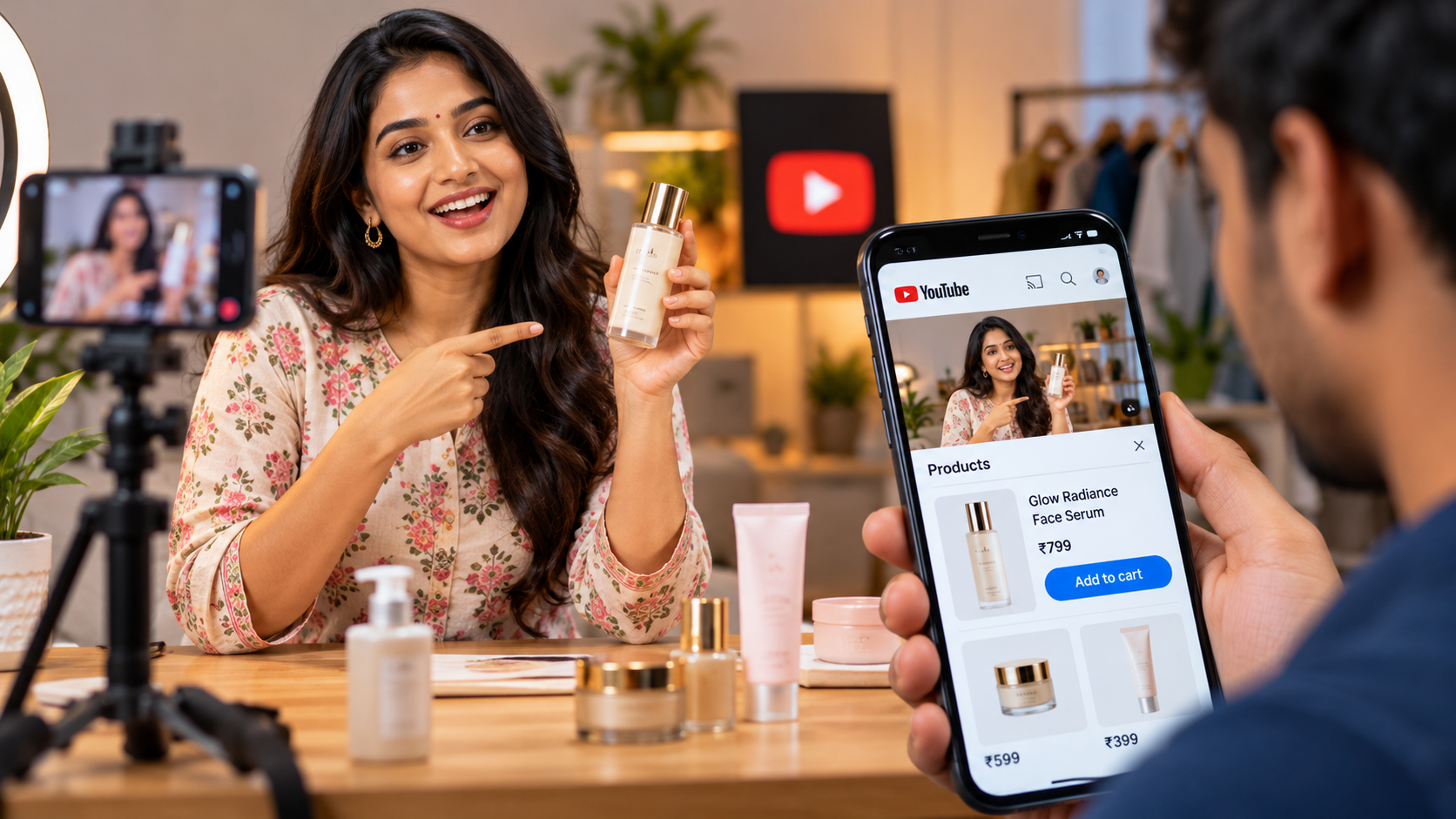
- Introduction: When Watching a Video Becomes the Start of a Shopping Journey
- 1. What Is YouTube Shopping in India?
- 2. Why YouTube Shopping Matters to Indian Brands in 2026
- 3. How Creator-Led Commerce Changes Product Discovery
- 4. Choosing the Right YouTube Content Format for Shopping
- 5. How Brands Can Plan a YouTube Shopping Campaign
- 6. YouTube Shopping and Traditional Influencer Marketing: What Is the Difference?
- 7. How to Measure YouTube Shopping Campaign Performance
- 8. Challenges Brands Should Consider Before Launching
- 9. What Indian Brands Should Prepare for Next
- 10. A Practical Checklist for Your First YouTube Shopping Campaign
- 11. How Hobo.Video Can Support Creator-Led Campaigns
- Key Takeaways: What Brands Should Remember
- Frequently Asked Questions About YouTube Shopping in India
- Conclusion: Building Better Shopping Experiences Through Creator Content
- About Hobo.Video
Introduction: When Watching a Video Becomes the Start of a Shopping Journey
Think about the last time you purchased something after watching a YouTube video. Perhaps a creator explained a skincare product, compared two smartphones, or demonstrated a kitchen appliance. You watched because you wanted useful information. Then, somewhere between the demonstration and the review, you started considering the product yourself.
This behaviour helps explain the growing interest in YouTube Shopping in India. People increasingly use video content to understand products before making purchasing decisions. Instead of relying entirely on advertisements or product descriptions, viewers can learn from demonstrations, comparisons, and creator recommendations.
For Indian brands, this creates an opportunity to connect product discovery with content audiences already enjoy. However, success requires more than adding a product tag to a popular video. Brands must understand their customers, choose suitable creators, and measure the results carefully.
YouTube’s latest India-specific announcements also point towards a changing shopping ecosystem. In October 2026, Google reported that more than 450 million logged-in users in India searched for shopping-related content on YouTube in June 2026. The company also reported that shopping-related watch time in India grew by more than 55% year over year in April 2026.
These figures suggest that video is becoming an important part of product research. Yet the real opportunity lies in understanding how people use that content, what questions they need answered, and how brands can help them make informed choices. This guide explores the latest developments, practical campaign planning, commercial models, measurement methods, and challenges brands should consider.
1. What Is YouTube Shopping in India?
YouTube Shopping connects product discovery with video content. Eligible creators can tag supported products in their content, allowing viewers to explore products featured in reviews, demonstrations, tutorials, and other videos. The affiliate programme gives eligible creators another way to earn from their content. When viewers purchase qualifying products under the programme’s terms, creators may receive commissions through participating retailers.
YouTube introduced its Shopping affiliate programme in India in October 2024, initially partnering with Flipkart and Myntra. The programme built on existing shopping features that allowed eligible creators to promote their own merchandise.

Amplify Your Brand,
One Influence at a Time.
The model connects three groups:
- Viewers: People who want to research products and understand their features.
- Creators: People who produce content and recommend relevant products.
- Retailers and brands: Businesses that want to help customers discover products and potentially generate sales.
However, YouTube Shopping is not a guarantee of sales. A product tag can make a product easier to find, but customers still consider price, quality, availability, reviews, and their personal needs. The strongest campaigns therefore combine relevant products, helpful content, suitable creators, and a smooth purchasing experience.
1.1 How Does the YouTube Shopping Affiliate Programme Work?
The process begins with creator eligibility. A channel must meet YouTube’s current requirements before its owner can access the relevant affiliate features. Once eligible, the creator can select supported products and tag them in available content formats. Viewers can then explore those products through the shopping features presented on YouTube. If a viewer completes an eligible purchase, the creator may earn a commission under the applicable programme terms.
For example, imagine a creator publishing a video about affordable skincare products. The creator explains each product’s intended use, discusses the packaging, and demonstrates how to incorporate it into a routine. Where supported, product tags allow viewers to explore eligible items without relying solely on a description link. The creator may earn a commission from qualifying purchases. Meanwhile, the brand gains another opportunity to reach people researching its product.
Brands should remember that product tagging, sponsorship fees, and affiliate commissions represent different arrangements. A creator may receive a fixed payment, commission, or a combination, depending on the agreement and applicable rules. For current eligibility requirements and programme details, consult the official YouTube Shopping affiliate programme guide.
1.2 How Is YouTube Shopping Different From Regular Online Shopping?
Traditional online shopping often begins with a search, marketplace listing, or advertisement. Customers compare product specifications, examine images, and read available reviews.
Creator-led shopping can begin earlier in that journey.
A person might watch a cooking tutorial without intending to shop. During the video, they notice an appliance that solves a problem they experience at home. The creator explains its function, demonstrates how it works, and discusses its practical use.
That moment can create product interest before the viewer begins a formal shopping search.
This difference matters because video can provide context that a product listing may not communicate as effectively. A demonstration can show the size of an item, how someone uses it, or how two products differ.
However, video does not replace every part of the buying journey. Customers may still visit marketplaces, compare prices, check specifications, or seek additional reviews.
The opportunity is to connect discovery with research, not to assume that discovery automatically leads to purchase.
2. Why YouTube Shopping Matters to Indian Brands in 2026
Indian shoppers have many ways to discover products. They may encounter brands through search engines, marketplaces, social platforms, recommendations from friends, or creator videos.
YouTube Shopping adds another way to connect product interest with supported shopping features.
Its relevance becomes clearer when we examine recent platform figures and developments.
2.1 Shopping-Related Search Behaviour Is Expanding
Google reported that more than 450 million logged-in users in India conducted shopping-related searches on YouTube during June 2026. The company also reported that shopping-related watch time grew by more than 55% year over year in April 2026.
These are platform-reported figures, not independent estimates of Indian e-commerce sales. They also do not mean that every shopping-related search leads to a purchase.
Nevertheless, they show that product-related content attracts substantial attention on YouTube.
For brands, this creates a practical question: what information do potential customers need before buying?
A smartphone buyer may want camera demonstrations and battery comparisons. Someone researching skincare may look for ingredient explanations and usage guidance. A family considering a kitchen appliance may want to understand its size, cleaning requirements, and everyday performance.
Brands can use these questions to guide creator selection and content planning.
Rather than producing another general promotional video, they can create content that answers a specific customer concern.
2.2 Creator Participation in Affiliate Shopping Is Growing
Google’s October 2026 announcement reported several developments in India’s YouTube Shopping affiliate ecosystem:
- Average affiliate payouts to Indian creators increased by more than 160% year over year, comparing Q1 2025 with Q1 2026.
- More than 50% of eligible Indian creators had enrolled in the affiliate programme as of May 2026.
- Enrolled creators increased by more than 200% between June 2025 and June 2026.
- More than 19 million videos had been tagged with affiliate products since the programme launched in India.
These numbers suggest growing creator participation. However, they do not establish that every creator earns substantial commissions or that every brand campaign performs well.
The figures also represent different measures and time periods. Brands should avoid combining them into a single growth claim.
The more useful takeaway concerns creator selection. As participation grows, brands should evaluate creators on their ability to explain products, serve a relevant audience, and communicate clearly.
Subscriber count alone cannot establish commercial suitability.
A specialist creator with a focused audience may be a stronger fit for a technical product than a larger channel whose content covers unrelated subjects.
2.3 Retail Partnerships Influence Product Availability
Product availability is central to any shopping programme.
Google announced an expansion of YouTube Shopping’s retail partnerships in India in October 2026. The announcement included Amazon, AJIO, Meesho, Snapdeal, and Tata CLiQ among the new partners, joining existing partners such as Flipkart, Myntra, Nykaa, Purplle, Shopsy, and Tira. The announcement described the new partnerships as rolling out soon.
That timing matters. An announced partnership should not automatically be treated as fully operational.
Before building a campaign around a particular retailer, brands should verify the current programme status, product eligibility, and tagging availability.
They should also confirm that the products they want to promote have sufficient stock and suitable product information.
A campaign may attract interest but struggle to generate sales if the featured item is unavailable, its price changes unexpectedly, or the product page provides an unclear purchasing experience.
Therefore, retailer verification belongs in campaign planning, not just the final publishing checklist.
3. How Creator-Led Commerce Changes Product Discovery
Creator-led commerce changes the way brands can introduce products to potential customers. Instead of relying only on a product listing or a short advertisement, brands can use content to demonstrate how an item fits into a real situation.
However, the format must serve a genuine customer need.
3.1 From Product Claims to Product Demonstrations
A brand can describe a blender as powerful, compact, and easy to clean. Yet those words may not answer every customer’s question.
A creator can show the blender in use, explain the controls, demonstrate its capacity, and discuss the cleaning process.
The demonstration provides context that helps viewers judge the product for themselves.
This approach can also reveal practical limitations. A creator might explain that an appliance suits small households but has limited capacity for large batches. Such details may help customers choose more confidently.
For brands, this creates a shift in content planning. Instead of asking only, “What message should the video communicate?”, they should also ask, “What does the customer need to see?”
That question can produce more useful briefs and more relevant creator collaborations.
3.2 From Broad Reach to Relevant Reach
A large audience can create awareness, but reach alone does not establish purchase intent.
Consider a premium skincare brand. A creator whose audience regularly discusses skincare routines may be a better fit than a general entertainment creator with a much larger following.
The specialist creator may already produce content about ingredients, routines, and product comparisons. Their audience may therefore be more interested in the category.
However, brands should still examine the creator’s actual content and audience data. A category label alone does not prove relevance.
A useful evaluation considers:
- Audience interests and geographic relevance.
- Language and communication style.
- Content quality and consistency.
- The creator’s ability to demonstrate the product.
- Previous brand collaborations and disclosures.
- Commercial terms and campaign objectives.
This approach helps brands select creators for their ability to serve the intended audience rather than relying on popularity alone.
3.3 From a Single Video to an Ongoing Customer Journey
A viewer may discover a product in a Short, watch a detailed review later, and compare prices before purchasing.
These interactions may happen across different sessions. Therefore, brands should not assume that one video will always create an immediate conversion.
A well-planned content strategy can address different stages of product research.
For example:
- A short demonstration introduces the product’s main use.
- A longer review explains its features and limitations.
- A comparison video answers questions about competing options.
- A follow-up video addresses common customer concerns.
Not every campaign needs all four formats. The choice depends on the product, available budget, creator capabilities, and audience behaviour.
The important point is to build content around the questions customers ask throughout their decision-making process.
4. Choosing the Right YouTube Content Format for Shopping
Different video formats serve different purposes. A short demonstration may introduce a product quickly, while a detailed review may help viewers compare alternatives.
Brands should choose formats according to the complexity of the product and the information customers need.
4.1 YouTube Shorts for Quick Product Discovery
Shorts can introduce a product through a brief demonstration, visual comparison, or practical tip.
For example, a home organisation creator could show how a storage product solves a common problem in a small apartment. A beauty creator could demonstrate the texture of a product and explain its intended use. The video should communicate one clear idea. If the creator tries to explain too many features, viewers may struggle to understand the product’s main benefit.
Brands should also avoid treating short content as a substitute for every detailed explanation. A product with complex technical requirements may need additional content to answer customer questions. Where shopping functionality is available to the creator, eligible products can be tagged according to YouTube’s current rules. The campaign brief should confirm the available features before production begins.
4.2 Long-Form Videos for Detailed Research
Long-form videos allow creators to explore a product in greater depth.
They can explain setup, demonstrate features, compare alternatives, and discuss practical limitations. This makes them useful for products that require more consideration before purchase. For example, a creator reviewing a laptop might cover its display, keyboard, ports, battery performance, and intended use. The creator could also explain who might benefit from a different model.
That information helps viewers evaluate the product against their needs. Brands should give creators accurate product information and clear disclosure requirements. However, they should avoid scripts that prevent honest discussion of relevant limitations.
Long-form content works best when the creator has enough time to answer real questions without turning the video into a repetitive sales pitch.
4.3 Live Content for Questions and Demonstrations
Live content can support demonstrations and real-time audience questions.
A creator might show how a kitchen appliance works, respond to questions about its features, and explain where viewers can find more information.
However, brands should distinguish live shopping from general livestream promotion. The shopping tools and purchase pathways available depend on the platform’s current features and the creator’s eligibility.
A livestream should also have a clear structure.
The creator can introduce the product, demonstrate its main use, answer common questions, and summarise the key details. This gives the session direction without removing the conversational quality that makes live content useful.
Brands should prepare accurate answers to likely questions and establish a process for handling queries the creator cannot answer confidently.
5. How Brands Can Plan a YouTube Shopping Campaign
A campaign needs a clear objective, suitable creators, an appropriate commercial model, and a measurement plan.
The following five-step framework provides a practical way to organise those decisions.
5.1 Step One: Define the Primary Business Objective
Begin by deciding what the campaign should achieve.
A brand launching a new product may want to increase awareness and introduce its features. An established brand may want to generate attributable sales or improve product discovery.
These goals require different approaches.
For an awareness campaign, the brand might prioritise relevant reach, video views, and audience response. For a sales-focused campaign, it may prioritise product clicks, attributable purchases, conversion rate, and campaign cost.
Avoid selecting every possible metric as a primary KPI. A long list can make it difficult to judge success.
Instead, choose one main objective and a small number of supporting measures.
The objective should also define the campaign’s audience, duration, product selection, and budget.
This gives creators and internal teams a shared understanding of what the campaign needs to accomplish.
5.2 Step Two: Select Products That Suit Creator Content
Not every product benefits equally from the same format.
Products with visible features or practical uses may work well in demonstrations. Complex products may need detailed explanations. Products with frequent availability issues may require extra planning.
Before selecting products, consider:
- Whether the product solves a clear customer problem.
- Whether a creator can demonstrate its benefits accurately.
- Whether the product is available through the intended retailer.
- Whether the price and offer suit the target audience.
- Whether sufficient stock is available.
- Whether the product page answers common questions.
The last point is particularly important. A helpful video can generate interest, but an unclear product page may make it harder for customers to complete their purchase.
Brands should therefore review the entire journey, from video discovery to checkout.
5.3 Step Three: Shortlist Creators Using Evidence
The right creator should have an audience and content style suited to the product.
Start by reviewing relevant channels and identifying creators who already discuss the category. Examine their recent videos, presentation style, and audience interactions.
Then assess their ability to communicate the product’s value.
Creator who explains complex information clearly may be suitable for electronics. One who demonstrates styling ideas may suit fashion. A creator who produces practical tutorials may suit home products.
Brands should also check for content quality, consistency, disclosure practices, and previous collaborations.
Where available, review audience demographics and performance data. Do not rely on screenshots or unsupported claims without considering their context.
A structured shortlist makes creator selection more consistent and easier to explain internally.
5.4 Step Four: Build a Clear Creative and Commercial Brief
A campaign brief should give creators the information they need without making every sentence sound scripted.
Include the campaign objective, target audience, product details, required deliverables, publication dates, disclosure requirements, and reporting expectations.
Also clarify the commercial arrangement.
A paid sponsorship generally involves an agreed fee for defined work. An affiliate arrangement may provide a commission on qualifying purchases. Some campaigns may combine a fixed fee and performance-based compensation.
The agreement should explain the payment structure and responsibilities clearly.
Brands should also specify content usage rights, approval requirements, and any restrictions that apply.
Before production, confirm the creator’s access to relevant shopping features and the product’s eligibility.
Finally, allow room for the creator’s own voice. The content should communicate accurate information while remaining natural for the creator’s audience.
5.5 Step Five: Measure Results and Improve the Next Campaign
Once the campaign is live, compare results with the original objective.
For awareness, examine relevant reach, views, and audience response. Product discovery, review available product clicks and traffic measures. For sales-focused activity, assess attributable purchases, conversion rates, and campaign costs.
Do not interpret every metric in isolation.
A video may generate many views but few product clicks. Another may attract fewer viewers but stronger product interest. These outcomes can point towards different optimisation opportunities.
If viewers click but do not purchase, investigate pricing, stock, delivery details, the product page, and the checkout process.
If viewers watch but rarely interact, review the content’s opening, relevance, and clarity.
Document these findings so the next campaign builds on actual results rather than assumptions.
6. YouTube Shopping and Traditional Influencer Marketing: What Is the Difference?
YouTube Shopping and traditional influencer marketing can work together. The distinction lies in the role shopping features and commercial arrangements play within the campaign.
| Factor | YouTube Shopping and Affiliate Content | Traditional Sponsored Content |
|---|---|---|
| Main purpose | Product discovery and potentially attributable sales | Awareness, consideration, engagement, or sales |
| Product access | Eligible products may be tagged in supported content | May use verbal mentions, descriptions, or other links |
| Payment | May include commission on qualifying purchases | Usually includes an agreed sponsorship fee |
| Measurement | Available product clicks, attributable purchases, and other metrics | Views, reach, engagement, traffic, conversions, and agreed KPIs |
| Creative control | Depends on the agreement and programme rules | Depends on the sponsorship agreement |
| Best suited to | Campaigns that benefit from product discovery and measurable shopping activity | Campaigns requiring specific creative deliverables or broader brand messaging |
These distinctions are general rather than absolute. A sponsored video can also include shopping features or affiliate arrangements where permitted.
Similarly, affiliate content can support awareness and product education, not just immediate sales.
The right approach depends on the brand’s objective, product category, budget, creator agreement, and available tracking.
Brands should avoid choosing an affiliate model simply because it appears performance-based. They still need to assess the product, audience, content, and customer journey.
7. How to Measure YouTube Shopping Campaign Performance
Measurement helps brands understand whether creator content contributes to their objectives.
Before launch, define the metrics, reporting sources, and time period that will be used to evaluate the campaign.
7.1 Views and Audience Engagement
Views indicate video exposure, but they do not automatically establish purchase interest.
Engagement measures, such as comments and likes, can provide additional context. However, the meaning of these signals depends on the campaign and the content.
A video may attract many comments because viewers enjoy the creator, even if they show little interest in the featured product.
Therefore, brands should review engagement alongside product-related signals.
For example, comments asking about size, compatibility, ingredients, or availability may reveal questions that the next video should address.
Brands should also use consistent definitions when comparing creators. Different content formats and reporting windows may affect how metrics should be interpreted.
The goal is not to find one perfect metric. It is to understand what the available evidence says about the campaign’s performance.
7.2 Product Clicks and Click-Through Rate
Product clicks can indicate whether viewers explored a featured item.
Click-through rate compares clicks with an agreed exposure measure, such as views or impressions. Brands should state which denominator they use because these calculations are not interchangeable.
For example, imagine a video receives 10,000 views and generates 300 product clicks.
If the brand calculates clicks divided by views, the result is 3%.
This does not mean that 3% of all unique viewers clicked. View counts and unique-viewer counts represent different measures.
The calculation simply shows the relationship between recorded views and product clicks under the selected method.
Use these metrics to compare similar content where possible. Avoid comparing different campaigns without considering audience, format, duration, product category, and tracking differences.
7.3 Attributable Purchases and Conversion Rate
Attributable purchases help brands understand how many purchases the available tracking system credits to a campaign.
Conversion rate measures purchases relative to a defined traffic measure.
Suppose a campaign records 2,000 product clicks and 80 attributable purchases.
The calculation is:
Conversion rate = Attributable purchases ÷ Product clicks × 100
In this example:
80 ÷ 2,000 × 100 = 4%
The conversion rate based on product clicks is 4%.
However, attribution does not capture every possible influence on a purchase. A customer might watch a creator video, search for the product later, and buy through another route.
Therefore, brands should interpret attributed sales alongside other evidence. They should also avoid claiming that every recorded purchase resulted solely from one creator video.
7.4 Campaign Cost and Return
Brands should evaluate performance against the full cost of the campaign.
Depending on the arrangement, costs may include creator fees, content production, product samples, agency fees, and paid promotion.
A simple cost-per-acquisition calculation is:
Cost per acquisition = Campaign cost ÷ Attributable acquisitions
Suppose a campaign costs ₹60,000 and produces 120 attributable acquisitions.
The cost per acquisition is ₹500.
This calculation helps the brand understand the cost of each attributed acquisition. It does not establish profitability by itself.
To assess profitability, the brand must consider margins, returns, discounts, fulfilment costs, and other relevant expenses.
For a profit-based calculation, use:
Campaign ROI = (Incremental profit − Campaign cost) ÷ Campaign cost × 100
Brands should define incremental profit and campaign cost consistently. They should also distinguish profit-based ROI from revenue-based return.
8. Challenges Brands Should Consider Before Launching
Creator-led commerce can support product discovery, but several practical issues can affect results.
8.1 Creator Eligibility and Programme Rules
Not every creator can access every shopping feature.
Eligibility depends on YouTube’s current requirements, programme access, and channel status. Brands should confirm these details before finalising a campaign.
This is particularly important when the campaign depends on product tagging.
A creator may be suitable from a content perspective but unable to access the specific feature the brand intends to use.
Review the official YouTube Shopping affiliate programme requirements before planning around the programme.
8.2 Retailer and Product Availability
A product tag cannot compensate for an unavailable item.
Before publishing, confirm product eligibility, stock, pricing, and the intended retailer’s current programme status.
This matters when platforms announce new retail partnerships. An announcement may describe a future rollout rather than immediate availability.
Brands should also check product-page quality. Missing specifications, unclear images, or confusing delivery information can make the purchasing journey harder.
The campaign team should coordinate with the retailer or relevant internal team to resolve these issues before the content goes live.
8.3 Attribution and Reporting Limitations
Attribution systems help brands connect activity with outcomes, but they do not reveal every influence on customer behaviour.
Some customers may purchase later or through a different channel. Others may see several creator videos before making a decision.
Brands should therefore avoid treating one attribution report as a complete account of the customer journey.
Instead, combine available sales data with relevant engagement and traffic measures. Where possible, compare performance against a baseline or suitable control.
Clear reporting definitions also matter. Teams should agree on the measurement period, attribution method, and meaning of each KPI before the campaign begins.
8.4 Trust and Commercial Disclosure
Creator recommendations work best when viewers understand the nature of a commercial relationship.
Brands and creators should follow applicable advertising disclosure requirements and YouTube’s relevant policies.
They should also communicate product claims accurately. A creator should not promise guaranteed results or make unsupported claims simply to make the content more persuasive.
For example, a skincare video should describe the product’s intended use without promising that every viewer will achieve the same outcome.
A trustworthy campaign gives audiences enough information to evaluate the product. It does not hide limitations or create unrealistic expectations.
8.5 Product-Market Fit
Even excellent content cannot make every product relevant to every audience.
A creator may produce a well-made video, yet viewers may not need the product or may consider it too expensive.
Before launch, brands should evaluate customer demand, product positioning, pricing, and audience fit.
They should also consider whether the product is easy to explain through video. Some products benefit from visual demonstrations, while others require more detailed research.
These factors should influence the campaign brief and creator shortlist.
9. What Indian Brands Should Prepare for Next
YouTube’s shopping ecosystem continues to develop. Brands should monitor official announcements and distinguish available features from planned updates.
In September 2026, YouTube announced that additional affiliate campaigns would be introduced in India in 2027. These are intended to let retailers and brands offer incentives, such as special commission rates or bonuses, for creator content featuring selected products.
Brands should treat these campaigns as an upcoming opportunity rather than a feature that is already universally available.
In the meantime, they can prepare by identifying suitable products, building creator relationships, documenting campaign objectives, and improving their reporting processes.
They should also review how their product pages support the customer journey.
When a campaign attracts interest, shoppers need accurate product information, transparent pricing, and a reliable way to complete their purchase.
Preparation does not require a large campaign immediately. Brands can start by testing a focused product category, working with suitable creators, and documenting what they learn.
The aim is to build a repeatable process that can adapt as platform features and retailer partnerships change.
10. A Practical Checklist for Your First YouTube Shopping Campaign
Before launch, use this checklist to confirm that the campaign is ready.
10.1 Product Readiness
- Confirm the product’s eligibility and availability.
- Check stock, pricing, and product-page information.
- Identify the customer questions the content should answer.
- Ensure product claims are accurate and supported.
- Confirm the retailer’s current programme status.
10.2 Creator Readiness
- Review the creator’s content and audience relevance.
- Confirm programme eligibility and available features.
- Agree on deliverables, deadlines, and commercial terms.
- Share accurate product information.
- Explain disclosure and reporting requirements.
10.3 Campaign Readiness
- Define one primary objective.
- Select a small set of supporting KPIs.
- Establish a realistic budget.
- Confirm content usage rights and approval requirements.
- Set the campaign duration and reporting period.
10.4 Measurement Readiness
- Define each metric before launch.
- Confirm the available reporting sources.
- Document the attribution method.
- Track campaign costs consistently.
- Schedule a review after publication.
- Record lessons for future campaigns.
This checklist helps teams catch operational problems before they affect performance.
11. How Hobo.Video Can Support Creator-Led Campaigns
Planning a creator campaign requires more than identifying popular channels. Brands must connect their objectives with suitable creators, clear briefs, relevant content, and consistent measurement.
Hobo.Video works across influencer marketing and user-generated content, helping brands organise creator-led campaigns around their marketing needs.
For example, a brand exploring YouTube Shopping may first need to identify creators whose audiences match its products. It may then need to develop product demonstrations, coordinate deliverables, and measure the resulting activity.
The appropriate approach depends on the campaign’s objective and the features available to participating creators.
A brand should also distinguish YouTube Shopping affiliate activity from other creator services. Access to Hobo.Video’s campaign services does not automatically provide access to YouTube Shopping features. Creators must meet YouTube’s relevant eligibility requirements.
Businesses interested in a broader creator strategy can explore Hobo.Video’s influencer marketing services and review the campaign requirements with the team.
For additional context, readers can explore Hobo.Video’s existing articles on Indian Gen Z shopping behaviour on Instagram and YouTube and live commerce influencer strategy for Indian e-commerce.
These articles cover related areas, while this guide focuses specifically on YouTube Shopping developments and campaign planning.
Key Takeaways: What Brands Should Remember
Before launching a campaign, keep these practical lessons in mind.
- Start with customer needs. Identify the questions people ask before purchasing the product.
- Choose creators for relevance. Audience fit and communication skills matter more than subscriber count alone.
- Verify programme access. Confirm creator eligibility, product tagging, and retailer availability.
- Match content to the product. Use short demonstrations for quick discovery and detailed reviews for complex products.
- Clarify commercial terms. Distinguish fixed fees, affiliate commissions, and combined arrangements.
- Measure the right outcomes. Select KPIs that match the campaign objective.
- Review the complete buying journey. Product availability and page quality can affect results after a click.
- Be transparent. Follow applicable disclosure requirements and communicate product claims accurately.
- Learn from the data. Compare results carefully and document what worked.
- Monitor platform changes. Verify new features and retail partnerships before including them in campaign plans.
The central lesson is simple: creator-led commerce works best when helpful content meets a real customer need. Shopping features can support that process, but they cannot replace sound strategy, relevant products, and reliable execution.
Frequently Asked Questions About YouTube Shopping in India
1. What Is YouTube Shopping in India?
YouTube Shopping allows eligible creators to tag supported products in their content, helping viewers discover items featured in videos. Through the affiliate programme, eligible creators may earn commissions on qualifying purchases made through participating retailers. Brands can explore creator partnerships to support product discovery, but availability depends on the programme’s current rules, retailer participation, and product eligibility.
2. How Does the YouTube Shopping Affiliate Programme Work?
Eligible creators can tag supported products in their videos and other available formats. Viewers can explore these products and make qualifying purchases through participating retailers. The creator may earn a commission under the programme’s terms. Commission rates, product availability, eligibility, and reporting depend on current programme arrangements. Creators and brands should check the official YouTube documentation before planning a campaign.
3. Can Indian Brands Use YouTube Shopping to Promote Their Products?
Brands can explore eligible creator partnerships and product discovery opportunities through YouTube Shopping. However, the available options depend on participating retailers, supported products, creator eligibility, and the commercial arrangement. Brands should verify whether their products can be tagged before finalising campaign deliverables. They should also ensure that product pages provide accurate information and a reliable purchasing experience.
4. Is YouTube Shopping Available to Every Creator?
No. Creators must meet YouTube’s current eligibility requirements to access the relevant affiliate features. Eligibility may depend on programme participation, channel status, location, and other requirements. Brands should confirm a creator’s access before building a campaign around product tagging. Creators should also review the latest official guidance because programme requirements and available features may change over time.
5. What Is the Difference Between YouTube Shopping and Influencer Marketing?
Influencer marketing is a broad approach in which brands collaborate with creators to support awareness, consideration, or sales. YouTube Shopping adds product discovery and, where available, affiliate functionality to supported content. The approaches can complement each other. A sponsored creator video may also include eligible shopping features, provided the arrangement follows applicable programme rules and clearly documents commercial terms.
6. Which Products Work Best With YouTube Shopping?
Products that benefit from demonstrations, comparisons, or practical explanations may be suitable for creator-led shopping content. Examples include beauty products, fashion items, electronics, kitchen appliances, and home products. However, no category guarantees strong results. Brands should consider customer demand, product availability, pricing, creator expertise, and the information shoppers need before making a decision.
7. How Can Brands Measure YouTube Shopping Performance?
Brands can review available measures such as product clicks, attributable purchases, conversion rates, sales value, and campaign costs. They may also examine views and engagement when those metrics support the campaign objective. Before launch, teams should define each KPI and confirm which reporting sources are available. Attribution should be interpreted carefully because customers may interact with several channels before purchasing.
8. Can Small Businesses Benefit From YouTube Shopping?
Small businesses may benefit when they identify a suitable product, understand their audience, and work with relevant creators. A large campaign is not always necessary to learn what customers respond to. A focused test can help a business assess content quality, product interest, and the purchasing journey. However, results depend on the product, creator, pricing, audience fit, and available shopping features.
9. Are YouTube Shopping and Affiliate Marketing the Same Thing?
No. Affiliate marketing is a commercial model in which a creator or publisher may earn a commission for qualifying actions, such as purchases. YouTube Shopping provides shopping-related features that can support eligible affiliate activity. Affiliate marketing also operates through other platforms and channels. Brands should distinguish the general commercial model from YouTube’s specific eligibility rules, product-tagging features, and participating retailer arrangements.
10. How Can Brands Start Planning a YouTube Shopping Campaign?
Start by defining the campaign objective and selecting products that suit creator demonstrations. Next, shortlist relevant creators, confirm their eligibility, and verify retailer and product availability. Prepare a clear brief covering content, disclosures, commercial terms, and reporting. Finally, define the KPIs and review the results after publication. This process helps brands learn from each campaign and improve future decisions.
Conclusion: Building Better Shopping Experiences Through Creator Content
YouTube Shopping in India is creating new opportunities for brands and creators to connect product discovery with video content. Recent platform developments point towards growing participation, expanded retail partnerships, and additional commercial opportunities.
However, brands should not treat shopping features as a shortcut to sales. They need suitable products, relevant creators, accurate information, and a clear measurement plan.
The strongest starting point is a focused campaign. Choose a product that customers want to understand, find creators who can explain it clearly, and decide how you will measure the outcome.
Then use the results to improve the next campaign.
As the ecosystem develops, YouTube Shopping in India may become a more useful part of the wider creator-marketing mix for businesses that prepare carefully and focus on customer needs.
If your brand wants to build a creator-led campaign, Hobo.Video can help you explore influencer marketing and UGC solutions suited to your objectives.
Start building meaningful creator partnerships with Hobo.Video and turn useful content into stronger brand connections.
About Hobo.Video
Hobo.Video is India’s leading AI-powered influencer marketing and UGC company. Backed by more than 2.25 million creators, it delivers end-to-end campaign management designed for brand growth. The platform blends AI with human strategy to help brands reach maximum ROI.
Services include:
- Influencer marketing
- UGC content creation
- Celebrity endorsements
- Product feedback and testing
- Marketplace and seller reputation management
- Regional and niche influencer campaigns
Top brands such as Himalaya, Wipro, Symphony, Baidyanath, and the Good Glamm Group trust Hobo.Video.
Need a Strategy plan that actually works for your brand? Let’s build it together.
Influencer life is different when you’re backed by the right crew. Let’s grow.

 Anooshka Pandey
 Neeti Katyal