
The marketing world has changed. Traditional advertising didn’t disappear, but it lost its grip on how people actually make buying decisions. Consumers now follow creators real people they’ve chosen to let into their feeds and they watch reviews, tutorials, unboxings, and lifestyle content before spending money. Brands can’t ignore this. And a whole category of Growth Agencies has built itself around exactly that reality. These agencies aren’t just running influencer posts. They’re wiring creator relationships into how a business actually grows visibility, engagement, leads, revenue. As creator-led commerce keeps expanding, picking the right agency matters more than most brands realize.
- 1. What Are Creator-Led Growth Agencies?
- 2. Why Creator-Led Marketing Is Growing Rapidly
- 3. How Growth Agencies Differ from Traditional Marketing Firms
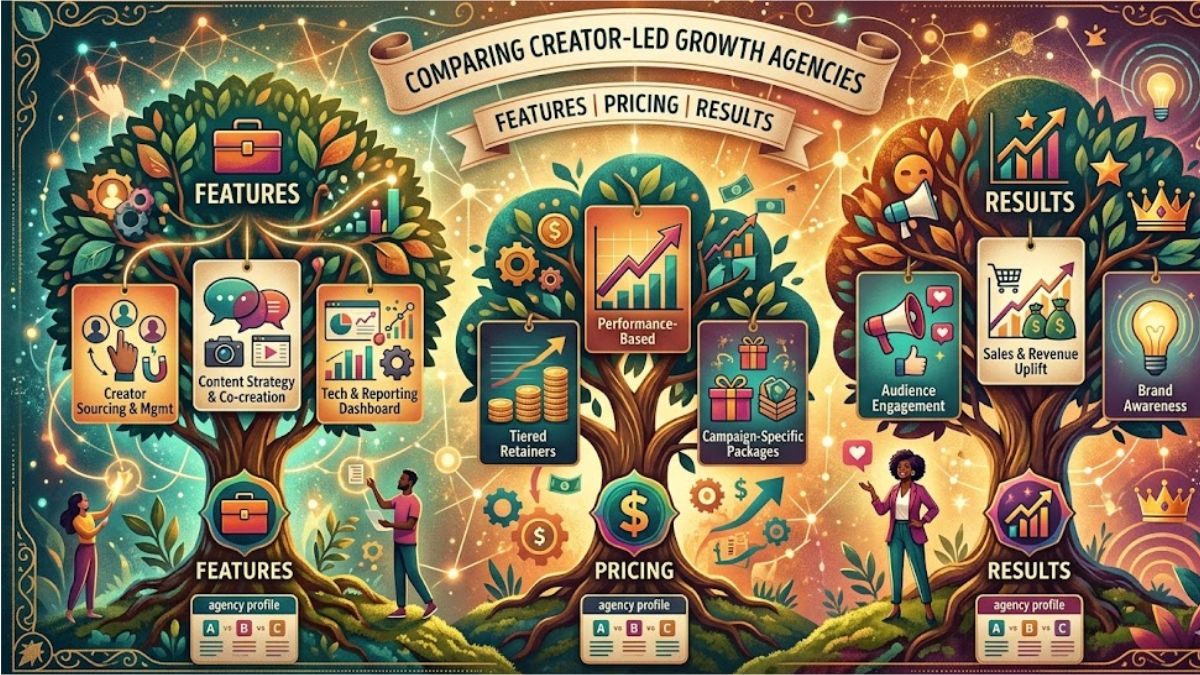
- 4. Core Features Offered by Modern Growth Agencies
- 5. Growth Marketing Agency: The Most Popular Model
- 6. Ecommerce Growth Agency Comparison
- 7. YouTube Growth Agency Services Explained
- 8. YouTube Channel Growth Agency vs Traditional Video Marketing
- 9. Growth Hacking Agency Approach
- 10. Growth Marketing Agency for Startups
- 11. Digital Growth Agency Capabilities
- 12. Amazon Growth Agency Services
- 13. Best Growth Marketing Agencies: What Makes Them Different?
- 14. Pricing Models Used by Growth Agencies
- 15. Measuring Results and ROI
- 16. The Role of Influencer Marketing in Agency Growth
- 17. UGC Videos and the Future of Creator Marketing
- 18. How to Choose the Right Growth Agency
- About Hobo.Video
1. What Are Creator-Led Growth Agencies?
They help brands grow through creators, influencers, user-generated content, and community. Not through ads alone. The core logic is simple: people tune out ads, but they pay attention to creators they’ve chosen to follow. Brands that figured this out early started shifting budgets accordingly. Creator-led agencies combine influencer campaigns, UGC production, community building, social commerce, content distribution, and performance tracking into one operating system. The goal isn’t just reach. It’s a repeatable growth engine built on real human connections.
2. Why Creator-Led Marketing Is Growing Rapidly
Goldman Sachs projects the creator economy will hit around $480 billion by 2027. That’s not an accident it reflects something real about how consumer trust has shifted. People believe creators more than they believe brands. Influencer-driven campaigns consistently outperform conventional digital ads on engagement. Businesses have noticed, and they’re moving budgets to match. Brands today want to know exactly what their spend is producing. Impressions aren’t enough. Creator-led marketing delivers something closer to accountability.
3. How Growth Agencies Differ from Traditional Marketing Firms
Traditional agencies run awareness campaigns. They get eyeballs. That’s not nothing, but it’s also hard to connect to a revenue line. Creator-focused Growth Agencies are built around performance. Creator partnerships, community engagement, content that scales, conversion work, revenue attribution these aren’t extras. They’re the whole job. The best ones can tell a story and show you the numbers. That combination is rarer than it sounds.
4. Core Features Offered by Modern Growth Agencies
Before signing with anyone, it’s worth knowing what you’re actually buying. Influencer Campaign Management covers everything from finding the right creators to negotiating contracts, monitoring campaigns in real time, and producing reports that mean something. Content Production means creators make content you can use across channels reviews, tutorials, testimonials, product demos. Authentic material that doesn’t look like it came from a production house. Community Building is slower work, but it pays off. Agencies that invest in long-term audience development tend to produce customers who stick around.
5. Growth Marketing Agency: The Most Popular Model
A growth marketing agency runs strategy, analytics, and execution under one roof. The focus is customer acquisition and retention, not just top-of-funnel noise. What separates them from traditional firms is the testing culture. They run experiments constantly, kill what doesn’t work, and scale what does. Brands come to them because they want real growth not engagement metrics that look good in a slide deck. Most work across multiple channels at once. That integrated approach compounds over time.
6. Ecommerce Growth Agency Comparison
Online retail is harder than it used to be. Acquisition costs are up. Competition is everywhere. An ecommerce growth agency focuses on the parts that actually move revenue: conversion optimization, product page performance, email automation, customer retention. Not just traffic. The strongest partners improve the entire customer journey from first click to repeat purchase. That’s what creates durable growth, not one-off sales spikes.

Amplify Your Brand,
One Influence at a Time.
7. YouTube Growth Agency Services Explained
YouTube isn’t just a video platform. It’s the second-largest search engine on the internet, and most brands still treat it like a place to dump content. A YouTube growth agency fixes that. They help businesses get found on the platform, grow subscribers, improve how viewers actually engage with content, and build a content strategy that has logic behind it. More brands now treat a YouTube agency as a core marketing partner rather than a nice-to-have. The channel can serve awareness and lead generation at the same time which is harder to pull off than it sounds.
8. YouTube Channel Growth Agency vs Traditional Video Marketing
These are not the same thing, and confusing them is expensive. A video production company makes videos. A YouTube channel growth agency grows your channel. The work looks different. Growth agencies focus on keyword research, viewer retention curves, thumbnail testing, and content planning that builds on itself over time. Production companies focus on shooting and editing. You can have beautiful videos that nobody watches. The agencies in this category are specifically trying to prevent that. They care about long-term audience growth, not whether one video went viral and then the channel went quiet.
9. Growth Hacking Agency Approach
Growth hacking has a slightly gimmicky reputation, but the underlying idea is solid: run structured experiments, find what works, scale it fast. A growth hacking agency tests landing pages, ad creatives, email sequences, user flows anything in the funnel that might be losing people. The goal isn’t to be clever. It’s to find a winning variation before burning through budget on a guess. Startups gravitate toward these agencies for an obvious reason they need to grow quickly with limited money. An experienced growth hacking team often finds opportunities that in-house teams are too close to see.
10. Growth Marketing Agency for Startups
Startups don’t have the runway to figure things out slowly. Budgets are tight, investor expectations aren’t, and every month without traction costs something. A growth marketing agency that works specifically with startups understands this. They’re not optimizing for brand prestige they’re optimizing for traction. The best ones build acquisition systems that can actually scale rather than tactics that work once and then plateau. That distinction matters especially in the early stages, where a wrong bet on a channel can set a company back months.
11. Digital Growth Agency Capabilities
Running a digital business today means juggling paid ads, SEO, content, creator campaigns, and conversion work often simultaneously. A digital growth agency brings all of that under one roof. The appeal is coordination. When paid, organic, and creator channels are run separately, they pull in different directions. A single agency with visibility across all of them can align the strategy. For a lot of companies, that alone justifies the engagement. Some also find that it improves alignment between marketing, sales, and customer success teams, though that depends heavily on the agency.
12. Amazon Growth Agency Services
Amazon is enormous and increasingly difficult to compete on without help. Organic discovery has gotten harder, ad costs have gone up, and the algorithm is opaque. An Amazon growth agency handles listing optimization, advertising campaigns, review strategy, and conversion rate work. The ones worth hiring understand how the marketplace algorithm actually works and how shoppers behave on the platform. That context is genuinely hard to build in-house without years of direct experience.
13. Best Growth Marketing Agencies: What Makes Them Different?
The gap between a good agency and an average one usually comes down to a few things. Data discipline is one. The best agencies make decisions based on evidence, not instinct or trend-chasing. Creator networks matter too an agency with real relationships across categories moves faster than one that’s pitching cold. Multi-channel understanding is underrated. Customer journeys don’t follow a single path, and agencies that only see one channel miss what’s happening elsewhere. Transparent reporting sounds obvious, but plenty of agencies still bury performance data in vanity metrics. The best ones show you what’s working and what isn’t, even when the answer is uncomfortable.
14. Pricing Models Used by Growth Agencies
Pricing varies significantly depending on scope, agency size, and how results are measured. Monthly retainers are the most common structure. For smaller businesses in India, that typically runs between ₹50,000 and ₹2 lakh per month. Larger brands often pay between ₹2 lakh and ₹10 lakh. Performance-based models exist too where the agency’s compensation is tied to results. It aligns incentives well, but agencies that are confident in their work tend to push for it more than those that aren’t. Project-based pricing works for brands that want to test a partnership before committing to a longer engagement.
15. Measuring Results and ROI
Every metric matters less than revenue. That sounds obvious until you’re three months into a campaign evaluating it on reach. Successful creator campaigns improve engagement, build customer trust, lift brand awareness, improve conversion rates, and eventually move revenue. Nielsen research has consistently found that influencer campaigns generate strong returns because consumers actually trust creator recommendations in a way they don’t trust ads. Evaluate agencies on outcomes, not outputs. The number of posts published is not a KPI.
16. The Role of Influencer Marketing in Agency Growth
Agencies rely on influencer marketing because it delivers something ads can’t: credibility. Creators have audiences that chose to follow them. That relationship changes how recommendations land. Brands running campaigns in India are increasingly working with regional creators alongside national ones the audience fit is often tighter, and the cost per engagement is lower. The influencer marketing space in India is evolving fast. Agencies that aren’t tracking those shifts in real time tend to fall behind.
17. UGC Videos and the Future of Creator Marketing
uPeople trust other people more than they trust brands. UGC video is the format that capitalizes on that most directly. Brands are using user-generated content across ads, product pages, and social not just as supplementary material but as primary creative. AI UGC tools have accelerated production volume significantly, and AI influencer marketing platforms are making creator discovery more efficient. How much of that actually replaces human judgment is still an open question, but the direction is clear. Authentic content at scale is the goal, and technology is getting better at enabling it.
18. How to Choose the Right Growth Agency
Start with an honest answer to one question: what does success actually look like for you? Not “more growth” something specific. Subscriber count, cost per acquisition, revenue from a particular channel. Once that’s defined, establish KPIs before any campaign launches. Agencies are much easier to evaluate when there’s a clear baseline and a clear target. Figure out where your growth is most likely to come from. Not every channel works for every business, and a good agency should help you figure that out rather than defaulting to whatever they’re best at. For brands that want creator relationships at the center of their strategy, the work is partly operational and partly cultural building content systems that creators actually want to be part of takes time. The brands that do it well tend to think long-term about it from the start.
Frequently Asked Questions
What are Growth Agencies?
Growth Agencies help businesses increase revenue, customer acquisition, and engagement through strategic marketing initiatives.
Why are creator-led agencies becoming popular?
Consumers trust creators more than traditional advertisements, making creator-led campaigns highly effective.
What does a growth marketing agency do?
A growth marketing agency focuses on measurable business outcomes using data, experimentation, and optimization.
Are growth agencies suitable for startups?
Yes. Many startups use specialized agencies to access expertise without building large internal teams.
What is a growth hacking agency?
A growth hacking agency uses rapid testing and experimentation to identify scalable growth opportunities.
About Hobo.Video
Hobo.Video is India’s leading AI-powered influencer marketing and UGC company. With over 2.25 million creators, it offers end-to-end campaign management designed for brand growth. The platform combines AI and human strategy for maximum ROI.
Services include:
- Influencer marketing
- UGC content creation
- Celebrity endorsements
- Product feedback and testing
- Marketplace and seller reputation management
- Regional and niche influencer campaigns
Trusted by top brands like Himalaya, Wipro, Symphony, Baidyanath and the Good Glamm Group.
Together, we’ll make your brand growth feel natural and doable. Let’s begin.
Your reach deserves rewards. Let’s make that happen. Tap to sign up.

 Vishnumaya